Government asks censor board to review Pakistani movie Joyland’s suitability for screening

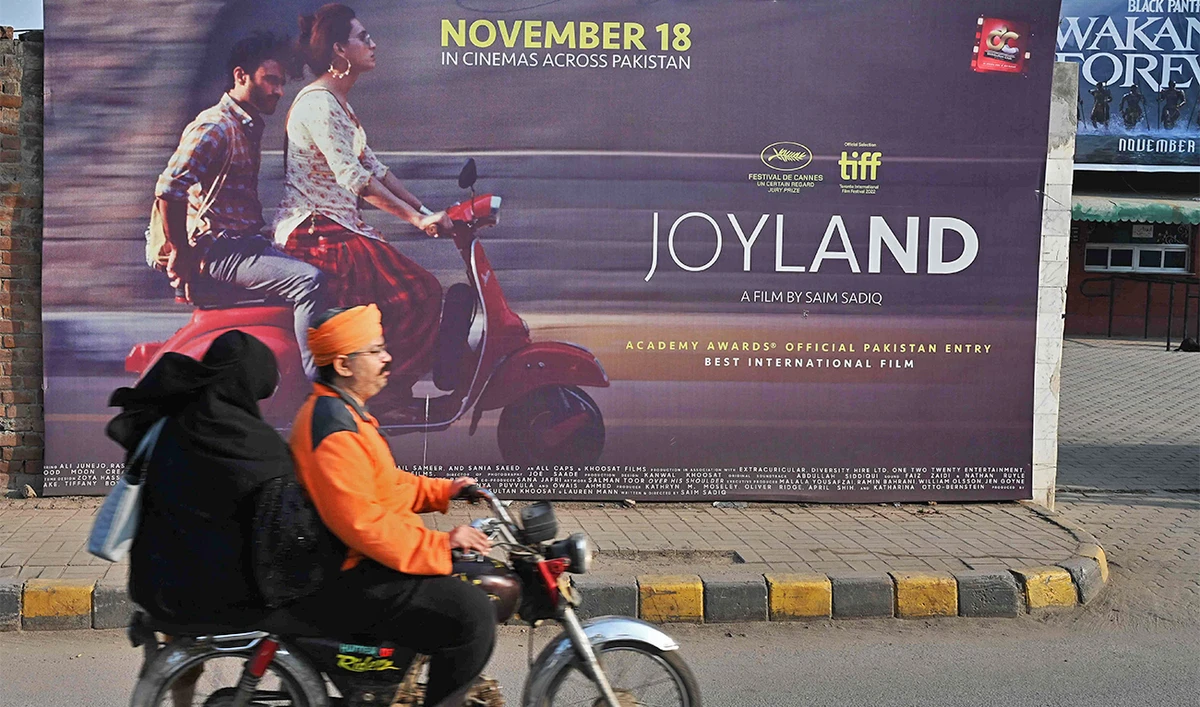
A couple rides past a promotional hoarding banner of Pakistan-produced movie "Joyland" displaying outside a cinema in Lahore on November 16, 2022. (AFP)
Short Url
Updated 16 November 2022
Follow

Government asks censor board to review Pakistani movie Joyland’s suitability for screening

  • Information minister says complaints received from parents, middle-class people
  • Special committee formed by PM suggests ‘full board review’ of Joyland

KARACHI: A government committee formed by Prime Minister Shehbaz Sharif to consider complaints against the Pakistani film Joyland on Tuesday tasked the country’s censor board to review whether the movie is suitable for screening or not.

Last week, the information ministry declared Joyland “repugnant to the norms of decency and morality” and ruled that it was an “uncertified film” for release in cinemas. Joyland celebrates “transgender culture” in Pakistan, with the film’s plot revolving around a family torn between modernity and tradition in contemporary Lahore.

Transgender people are considered outcasts by many in Pakistan, despite some progress with a law that protects their rights and a landmark Supreme Court ruling designating them as a third gender.

It has won the Cannes “Queer Palm” prize for the best feminist-themed movie as well as the Jury Prize in the “Un Certain Regard” competition, a segment focusing on young, innovative cinema talent. Joyland is Pakistan’s entry for next year’s Academy Awards.

The committee, headed by federal minister Sardar Ayaz Sadiq, held a meeting to review complaints against the film on Tuesday.

“The committee was directed to consider the complaints against the said film being contrary to social norms,” the information ministry’s press release said.

“After thorough deliberations, it [the committee] concluded that the Central Board of Film Censors (CBFC) should conduct a FULL BOARD REVIEW immediately to take final decision of its suitability for screening.”

Speaking on a private news channel, Information Minister Marriyum Aurangzeb said the film had been “intensely censored” at first before it was certified by the censor board. She said once the movie was released at international festivals, the censor board received a flurry of complaints against it by people who had watched it abroad. 

“A surge of applications and petitions were received [against Joyland],” Aurangzeb said. “When petitions are received, it is binding to review them,” she added. 

“To my surprise, I was told by the censor board that they were [applications] received from middle-class people and parents,” the minister said. 

She said the censor board is an autonomous body as per Pakistani law, adding that the government had not interfered with the process. Aurangzeb said the decision by the censor board will be taken by Wednesday evening. 

Joyland writer and director, Saim Sadiq, also spoke on the channel, lamenting that Pakistan “is being made fun of” around the world. He said people were unable to comprehend why a movie that received critical acclaim was not being approved by the country’s own government. 

“If they [people who watched the film abroad] had an issue with the film that it shouldn’t be released in Pakistan, why did they watch it abroad,” Sadiq asked.

The information ministry’s decision to rule that the film was “uncertified” triggered outrage on social media, with many questioning the decision by the government.

“It is a story of our people told by our people for our people. Hoping for it to be made accessible to these very people #ReleaseJoyland,” Pakistani actor Humayun Saeed wrote on Twitter earlier this week.

“I personally do not believe in banning films that highlight issues faced by marginalized segments of our society,” Salman Sufi, the head of the prime minister’s strategic reforms unit, wrote on Twitter.

“People should be trusted to watch & make their own mind.”

Prominent Pakistani journalist, Aamna Isani, shared the definition of a transgender according to the constitution. “If you have a problem with that, appeal for an amendment to the constitution. Until then, #ReleaseJoyland,” she wrote on Twitter.


Cairo book fair breaks visitor records

Updated 03 February 2026
Follow

Cairo book fair breaks visitor records

  • Strong Saudi participation underscores KSA’s prominent role in Arab cultural landscape
  • Egyptian writer Naguib Mahfouz, who was awarded the Nobel Prize in Literature in 1988, was selected as the fair’s featured personality

CAIRO: The 57th edition of the Cairo International Book Fair has attracted record public attendance, with the number of visits reaching nearly 6 million, up from a reported 5.5 million previously.

Egypt’s Minister of Culture Ahmed Fouad Hanou said: “This strong turnout reflects the public’s eagerness across all age groups to engage with the exhibition’s diverse cultural and intellectual offerings.”

Hanou said the event included “literary and intellectual activities, meetings with thinkers and creative figures, and thousands of titles spanning various fields of knowledge.”

The Egyptian writer Naguib Mahfouz, who was awarded the Nobel Prize in Literature in 1988, was selected as the fair’s featured personality, coinciding with the 20th anniversary of his death.

The exhibition’s official poster features a famous quote by Mahfouz: “Who stops reading for an hour falls centuries behind.”

A total of 1,457 publishing houses from 83 countries participated in the fair. Mahfouz’s novels occupied a special place, as Egypt’s Diwan Library showcased the author’s complete works, about 54 books.

“The pavilion of the Egyptian National Library and Archives witnessed exceptionally high attendance throughout the fair, showcasing a collection of rare and significant books.

Among the highlights was the book “Mosques of Egypt” in Arabic and English, Dr. Sherif Saleh, head of financial and administrative affairs at the Egyptian National Library and Archives, told Arab News.

The fair ended on Tuesday with a closing ceremony that featured a cultural performance titled “Here is Cairo.”

The event included the announcement of the winners of the fair’s awards, as well as the recipient of the Naguib Mahfouz Award for Arabic Fiction.

Organizers described this year’s edition as having a celebratory and cultural character, bringing together literature, art, and cinema.

Romania was the guest of honor this year, coinciding with the 120th anniversary of Egyptian-Romanian relations.

At the Saudi pavilion, visitors were welcomed with traditional coffee. It showcased diverse aspects of Saudi culture, offering a rich experience of the Kingdom’s heritage and creativity.

There was significant participation from Saudi Arabia at the event, highlighting the Kingdom’s prominent role in the Arab cultural arena.

Saudi Arabia’s participation aimed to showcase its literary and intellectual output, in alignment with the objectives of Vision 2030.

The Kingdom’s delegation was led by Saudi Arabia’s Ambassador to Egypt Saleh bin Eid Al-Hussaini. Also in attendance were Dr. Abdul Latif Abdulaziz Al-Wasel, CEO of the Literature, Publishing and Translation Commission, and Dr. Hilah Al-Khalaf, the commission’s director-general.

The King Abdulaziz Public Library placed the Encyclopedia of Saudi Arabia in a prominent position at the pavilion. The encyclopedia, consisting of 20 volumes, is organized according to the Kingdom’s culturally diverse regions.

Founded in 1980 by King Abdullah, the library was established to facilitate access to knowledge and preserve heritage collections. Over the years, it has grown into one of the Kingdom’s most important cultural institutions.

Internationally, the library has strengthened ties between Saudi Arabia and China, including the opening of a branch at Peking University and receiving the Crown Prince Mohammed bin Salman Award for Cultural Cooperation between the two nations.

Regionally, the library has played a pivotal role in the Arab world through the creation of the Unified Arabic Cataloging Project, one of the most important initiatives contributing to knowledge accessibility and alignment with global standards.