

NASA’s moon rocket on track for Wednesday launch attempt

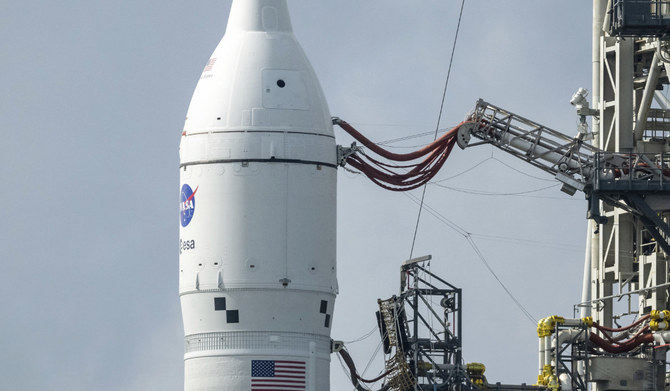
A close-up view of NASA’s moon rocket at Kennedy Space Center, Monday, Nov. 14, 2022, in Cape Canaveral, Fla. (AFP)
Short Url
Updated 15 November 2022
Follow

NASA’s moon rocket on track for Wednesday launch attempt

  • The space agency plans to send astronauts around the moon in 2024 and land a crew on the lunar surface in 2025

CAPE CANAVERAL, Florida: NASA remained on track for Wednesday’s planned liftoff of its new moon rocket, after determining that hurricane damage provided little extra risk to the test flight.
Hurricane Nicole’s high winds caused a 10-foot (3-meter) section of caulking to peel away near the crew capsule at the top of the rocket last Thursday. The material tore away in small pieces, rather than one big strip, said mission manager Mike Sarafin.
“We’re comfortable flying as is,” based on flight experience with this material, Sarafin told reporters Monday night.
Liftoff is scheduled for the early morning hours of Wednesday from NASA’s Kennedy Space Center, with test dummies rather than astronauts on board. It’s the first test flight for the 322-foot (98-meter) rocket, the most powerful ever built by NASA, and will attempt to send the capsule into lunar orbit.
The nearly monthlong $4 billion mission has been grounded since August by fuel leaks and Hurricane Ian, which forced the rocket back into its hangar for shelter at the end of September. The rocket remained at the pad for Nicole; managers said there wasn’t enough time to move it once it became clear the storm was going to be stronger than anticipated.
Sarafin acknowledged Monday night that there’s “a small likelihood” that more of the pliable, lightweight caulking might come off during liftoff. The most likely place to be hit would be a particularly large and robust section of the rocket, he noted, resulting in minimal damage.
Engineers never determined what caused the dangerous hydrogen fuel leaks during the two late summer launch attempts. But the launch team is confident that slowing the flow rate will put less pressure on the sensitive fuel line seals and keep any leakage within acceptable limits, said Jeremy Parsons, a deputy program manager.
The space agency plans to send astronauts around the moon in 2024 and land a crew on the lunar surface in 2025.
Astronauts last visited the moon in December 1972, closing out the Apollo program.
A microwave oven-size NASA satellite, meanwhile, arrived Sunday in a special lunar orbit following a summer liftoff from New Zealand. This elongated orbit, stretching as much as tens of thousands of miles (kilometers), is where the space agency plans to build a depot for lunar crews. The way station, known as Gateway, will serve astronauts going to and from the lunar surface.
The satellite, called Capstone, will spend six months testing a navigation system in this orbit.


St. Francis relics go on public show for first time in Italy

Updated 22 February 2026
Follow

St. Francis relics go on public show for first time in Italy

Assisi, Italy: Saint Francis of Assisi’s skeleton is going on public display from Sunday for the first time for the 800th anniversary of his death, drawing hundreds of thousands of visitors.
Inside a nitrogen-filled plexiglass case with the Latin inscription “Corpus Sancti Francisci” (The Body of St. Francis), the remains are being shown in the Italian hill town’s Basilica of St. Francis of Assisi.
St. Francis, who died on October 3, 1226, founded the Franciscan order after renouncing his wealth and devoting his life to the poor.
Giulio Cesareo, director of communications for the Franciscan convent in Assisi said he hoped the display could be “a meaningful experience” for believers and non-believers alike.
Cesareo, a Franciscan friar, said the “damaged” and “consumed” state of the bones showed that St. Francis “gave himself completely” to his life’s work.
His remains, which will be on display until March 22, were transferred to the basilica built in the saint’s honor in 1230.
But it was only in 1818, after excavations carried out in utmost secrecy, that his tomb was rediscovered.
Apart from previous exhumations for inspection and scientific examination, the bones of Saint Francis have only been displayed once, in 1978, to a very limited public and for just one day.
Usually hidden from view, the transparent case containing the relics since 1978 was brought out on Saturday from the metal coffer in which it is kept, inside his stone tomb in the crypt of the basilica.
The case is itself inside another bullet-proof and anti-burglary glass case.
Surveillance cameras will operate 24 hours a day for added protection of the remains.
St. Francis is Italy’s patron saint and the 800th anniversary commemorations of his death will also see the restoration of an October 4 public holiday in his honor.
The holiday had been scrapped nearly 50 years ago for budget reasons.
Its revival is also a tribute to late pope Francis who took on the saint’s name.
Pope Francis died last year at the age of 88.

‘Not a movie set’

Reservations to see the saint’s remains already amount to “almost 400,000 (people) coming from all parts of the world, with of course a clear predominance from Italy,” said Marco Moroni, guardian of the Franciscan convent.
“But we also have Brazilians, North Americans, Africans,” he added.
During this rather quiet time of year, the basilica usually sees 1,000 visitors per day on weekdays, rising to 4,000 on weekends.
The Franciscans said they were expecting 15,000 visitors per day on weekdays and up to 19,000 on Saturdays and Sundays for the month-long display of the remains.
“From the very beginning, since the time of the catacombs, Christians have venerated the bones of martyrs, the relics of martyrs, and they have never really experienced it as something macabre,” Cesareo said.
What “Christians still venerate today, in 2026, in the relics of a saint is the presence of the Holy Spirit,” he said.
Another church in Assisi holds the remains of Carlo Acutis, an Italian teenager who died in 2006 and who was canonized in September by Pope Leo XIV.
Experts said the extended display of St. Francis’s remains should not affect their state of preservation.
“The display case is sealed, so there is no contact with the outside air. In reality, it remains in the same conditions as when it was in the tomb,” Cesareo said.
The light, which will remain subdued in the church, should also not have an effect.
“The basilica will not be lit up like a stadium,” Cesareo said. “This is not a movie set.”