

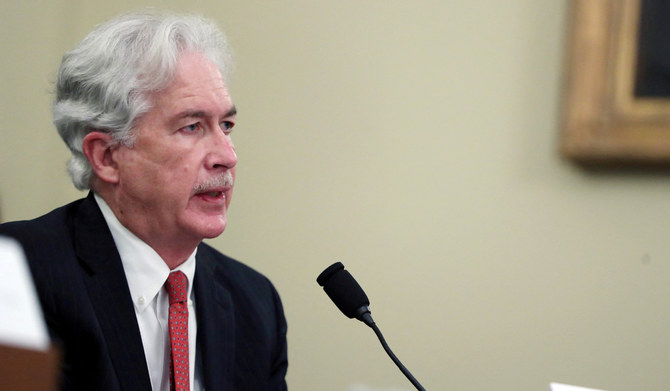
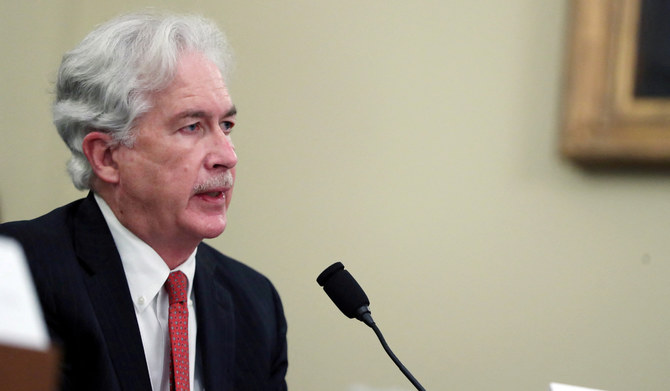
WASHINGTON: CIA Director Bill Burns met on Monday with his Russian intelligence counterpart to warn of consequences if Russia were to deploy a nuclear weapon in Ukraine, according to a White House National Security Council official.
The official, who was not authorized to comment publicly and spoke on the condition of anonymity, said Burns and Sergei Naryshkin, the head of Russia’s SVR spy agency, did not discuss settlement of the war in Ukraine during the meeting in Ankara, Turkiye. Ahead of the meeting, White House officials said Burns had also planned to raise the cases of Phoenix Mercury star Brittney Griner and Michigan corporate security executive Paul Whelan, two Americans detained in Russia whom the Biden administration has been pressing to release in a prisoner exchange.
The Burns-Naryshkin meeting was the highest-ranking face-to-face engagement between US and Russian officials since before Russian President Vladimir Putin ordered the February invasion.
The official said that Ukrainian officials were briefed ahead of Burns’ travel to Turkiye.
President Joe Biden, after meeting with China’s President Xi Jinping on the sidelines of the Group of 20 summit in Bali, Indonesia, told reporters that they discussed Russia’s war in Ukraine. Biden added they “reaffirmed our shared belief in the threat for the use of nuclear weapons is totally unacceptable.”
Kremlin spokesman Dmitry Peskov told the Russian state news agency Tass that the talks between Burns and Naryshkin “indeed took place.” Peskov said that “it was the American side’s initiative.”
In Turkiye, a top aide to President Recep Tayyip Erdogan confirmed that the country hosted the meeting between the heads of the Russian and US intelligence agencies on Monday. Communications Director Fahrettin Altun told The Associated Press that the meeting was “related to threats against international security, starting with the use of nuclear weapons.”
Turkiye earlier this year hosted Ukrainian and Russian officials for talks and played a key role in a UN-brokered deal that allowed Ukraine to resume exporting grain to world markets.
Turkiye’s state-run Anadolu Agency said Monday’s meeting was hosted by Turkiye’s intelligence agency, MIT.
Turkiye “will continue to negotiate with all relevant parties for peace and shall not refrain from taking initiative during this process,” Altun said.
The meeting between the spy chiefs came as the US Treasury Department on Monday announced an expanded list of sanctions on 14 people and 28 entities involved in supporting the Russian military-industrial complex. Many of those hit with new sanctions are located outside of Russia, including people and firms based in Switzerland, Taiwan and France.
Biden also heralded the retreat of Russian forces the southern region of Kherson, one of the four regions in Ukraine that Putin annexed in September.
“It’s a significant, significant victory for Ukraine. Significant victory. And I can do nothing but applaud the courage, determination and capacity of the Ukrainian people, the Ukrainian military,” Biden said.
Biden last month declared that the risk of nuclear “Armageddon” is at the highest level since the 1962 Cuban missile crisis, as Russian officials have raised using tactical nuclear weapons after suffering massive setbacks in the nearly nine-month invasion of Ukraine.
While US officials for months have warned of the prospect that Russia could use weapons of mass destruction in Ukraine as it has faced strategic setbacks on the battlefield, Biden administration officials have repeatedly said nothing has changed in US intelligence assessments to suggest that Putin has imminent plans to deploy nuclear weapons, according to US officials.
The National Security Council official added on Monday there has been no change in the US intelligence assessment and declined to offer further detail on timing of the decision to send Burns to meet with Naryshkin.
Putin has repeatedly alluded to using his country’s vast nuclear arsenal, including in September as he announced plans to conscript Russian men to serve in Ukraine. Biden has sought to make clear that use of a lower-yield tactical weapons could quickly spiral out of control into global destruction.
Speaking at a conference of international foreign policy experts late last month, Putin said it’s pointless for Russia to strike Ukraine with nuclear weapons.
“We see no need for that,” Putin said. “There is no point in that, neither political, nor military.”
Biden sent Burns, a former US ambassador to Russia, to Moscow last fall as the US intelligence community saw signs that Putin was preparing to invade Ukraine.
The CIA chief’s travels are normally closely held, but the White House, as it did last year, has made the calculation that it’s best that Burns’ interaction with the Russian spy chief is widely known.
Before Monday, the last publicly acknowledged face-to-face meeting between senior US and Russian officials took place in January in Switzerland: Secretary of State Antony Blinken held talks with Russia’s Foreign Minister Sergey Lavrov in Geneva on Jan. 21, before Russia’s invasion of Ukraine the next month.
Blinken and Lavrov have been in the same room for multilateral meetings since the Feb. 24 invasion, including at a G-20 foreign ministers meeting in Bali in early July and at the UN General Assembly, but have not had direct discussions.
They have, however, had at least one telephone conversation, which focused on a potential prisoner swap and occurred in late July. In the meantime, Defense Secretary Lloyd Austin and Joint Chiefs of Staff Chairman Gen. Mark Milley have also had phone calls with their Russian counterparts, as has national security adviser Jake Sullivan.


