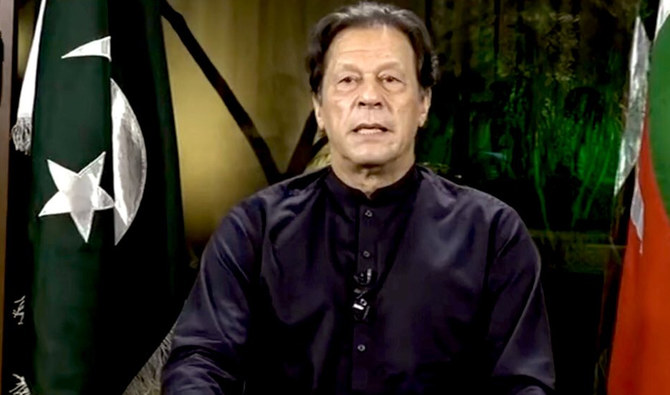
ISLAMABAD: Pakistan’s former prime minister Imran Khan has told an international publication in a recent interview that he wants to mend relations with the United States after accusing the administration in Washington for hatching a conspiracy to bring down his government earlier this year.
Khan was ousted from power in a no-confidence vote in April after losing his parliamentary majority. Since then, he held dozens of public rallies across the country in which he told his party workers and followers he was ousted from power as a result of a US conspiracy since he was striving to pursue an independent foreign policy.
The former prime minister also mentioned a diplomatic cypher sent by his country’s envoy in Washington, saying it revealed that a senior US official had threatened “regime change” in Pakistan. The American administration and Pakistan’s coalition government denied his allegations.
“As far as I’m concerned it’s over, it’s behind me,” Khan told the Financial Times when asked about the alleged foreign conspiracy. “The Pakistan I want to lead must have good relationships with everyone, especially the United States.”
“Our relationship with the US has been as of a master-servant relationship, or a master-slave relationship, and we’ve been used like a hired gun,” he continued. “But for that I blame my own governments more than the US.”
Khan criticized the government’s performance while reiterating that the country’s economy “could be beyond anyone” if early elections were not held in the country.
The Financial Times reported the former prime minister “did not outline specific plans for the economy,” though he criticized the International Monetary Fund (IMF) bailout plan, originally signed by his administration in 2019, which has been seeking austerity measures like higher fuel prices amid rising inflation.
“When you contract the economy, and some of the IMF measures make your economy shrink, how are you supposed to pay off your loans, because your loans keep increasing,” he asked. “Consumption has crashed … So my question is: How are we going to pay our debts? We are certainly going to head toward default.”
Asked about his public criticism of senior military officials since his ouster from power, Khan said the army would “play a constructive role in my future plans for Pakistan.”
“But it has to be that balance,” he continued. “You cannot have an elected government which has the responsibility given by the people, while the authority lies somewhere else.”


![]()

Ex-PM Khan seeks to mend fences with Washington after blaming it for his downfall
Short Url
https://arab.news/bun7n
Ex-PM Khan seeks to mend fences with Washington after blaming it for his downfall
- The former PM blames the IMF program for the economic woes of his country
- Khan says the army will ‘play a constructive role in my future plans for Pakistan’
Latest updates


© 2026 SAUDI RESEARCH & PUBLISHING COMPANY, All Rights Reserved And subject to Terms of Use Agreement.