

Jordan’s Queen Rania calls for shift in humanity’s response to global crises at Paris Peace Forum

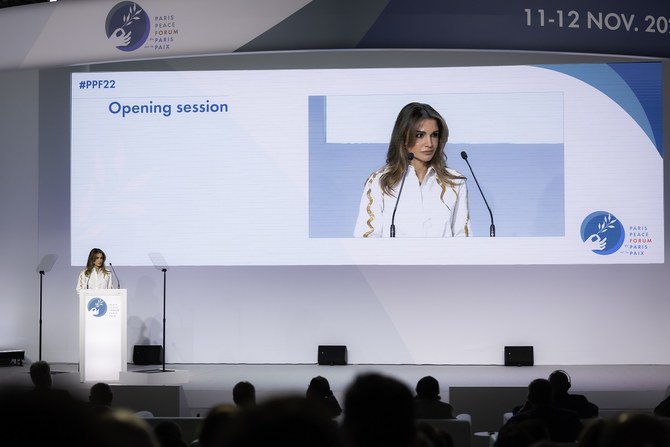
Queen Rania Al-Abdullah addressing audience at Paris Peace Forum. (Petra)
Short Url
Updated 12 November 2022
Follow

Jordan’s Queen Rania calls for shift in humanity’s response to global crises at Paris Peace Forum

  • Queen cites response to climate change as example of ‘chasm between promises and policies’
  • Disparity in reception of refugees from Ukraine to those from Syria, South Sudan and Myanmar also highlighted

LONDON: Jordan’s Queen Rania Al-Abdullah urged the international community to shift its response to the world’s multiplying crises on Friday at the Paris Peace Forum, Jordan News Agency reported. 

In her address to the fifth edition of the forum, Queen Rania stated that the world is facing “a convergence of crises,” including the COVID-19 pandemic, the war in Ukraine, climate change, inequality and a general erosion of trust. 

“Yet, too often, we are failing to meet our common threats with a spirit of common cause,” she said.

“Our world is off-balance; simply trying to keep things steady is not enough.”

Queen Rania called for four critical shifts in humanity’s approach to shared challenges: “Renewing our faith in truth, recognizing that we all have equal worth, safeguarding the future and believing in our ability to remake the world as we wish it could be.”

Expanding on the first point, the queen emphasized that speaking the truth must be followed by real action. 

“Honesty is the foundation of trust, but words are not enough. Cynicism flourishes in the gap between words and deeds,” she said.

She cited the global response to climate change as an example of the “chasm between promises and policies.”

She drew attention to the stark contrast between pledges made as part of the 2015 Paris Agreement to keep global temperatures from rising and recent UN climate report findings, which predict that temperatures will exceed safe levels. 

“It’s too late for wish lists. We need binding to-do lists to save both our credibility and our planet,” she cautioned.

Regarding her second point, the queen emphasized the importance of remembering common humanity, especially in the case of refugee populations. 

She said that the global refugee crisis has reached “epic proportions” with the number of displaced people now exceeding 100 million. She also highlighted the disparity in the reception of refugees from Ukraine to those from countries such as Syria, Myanmar, and South Sudan.

“What accounts for the contrast in compassion? Does skin color make all the difference?” she asked. “Too often, the barrier isn’t budgets. It’s bigotry and bias.”

“Until we embrace the reality of our connectedness, we’ll continue to bear the worst of its consequences,” she added. 

Moving onto her third point, the queen stated that humanity must “act in the service of future generations,” affirming that the decisions of the present will have a direct impact on those who will inherit the future. 

“What matters is not the next election, or the next financial quarter, or the next generation of smartphones. What matters is doing right by the next generation of humanity,” she said.

Queen Rania, in reaching her final point, underscored the value of “renewing hope and confidence in ourselves.”

On a more positive note, she stated that “despite the multi-crises we face, humanity has made enormous progress,” relaying that over the last few decades, 1 billion people have risen out of extreme poverty, infant mortality has dropped by more than half, more children are attending school and fewer are going hungry. 

She explained that hope is based on the ability to believe that things can improve.

“It’s not just technology that’s enabled these wins, it’s collaboration and trust. The instinct to help. The goodness that resides in human hearts,” she noted.

Queen Rania urged the audience to resist complacency and try to anticipate crises earlier, “so that we can fix problems before they become perils and prevent tomorrow’s crises before they start.” 

The Paris Peace Forum was founded in 2017 with the goal of bridging the governance gap by bringing together key stakeholders to advance concrete solutions to global issues.

Public and private organizations present their governance projects to global leaders, elected officials, experts and other stakeholders at the annual event.


Arab, Muslim countries slam US ambassador’s remarks on Israel’s right to Middle East land

Updated 47 min 36 sec ago
Follow

Arab, Muslim countries slam US ambassador’s remarks on Israel’s right to Middle East land

  • The backlash widened sharply on Sunday as more than a dozen Arab and Islamic governments issued a joint statement denouncing the US diplomat’s comments as “dangerous and inflammatory”

JERUSALEM: Arab and Islamic countries issued a joint condemnation on Sunday of remarks by US ambassador to Israel Mike Huckabee, who suggested Israel had a biblical right to a vast swath of the Middle East.
Huckabee, a former Baptist minister and a fervent Israel supporter, was speaking on the podcast of far-right commentator and Israel critic Tucker Carlson.
In an episode released Friday, Carlson pushed Huckabee on the meaning of a biblical verse sometimes interpreted as saying that Israel is entitled to the land between the river Nile in Egypt and the Euphrates in Syria and Iraq.
In response, Huckabee said: “It would be fine if they took it all.”
When pressed, however, he continued that Israel was “not asking to take all of that,” adding: “It was somewhat of a hyperbolic statement.”
The backlash widened sharply on Sunday as more than a dozen Arab and Islamic governments — alongside three major regional organizations — issued a joint statement denouncing the US diplomat’s comments as “dangerous and inflammatory.”
The statement, released by the United Arab Emirates’ foreign ministry, was signed by the UAE, Egypt, Jordan, Indonesia, Pakistan, Turkiye, Saudi Arabia, Qatar, Kuwait, Oman, Bahrain, Lebanon, Syria and the State of Palestine, as well as the Organization of Islamic Cooperation, the Arab League and the Gulf Cooperation Council.
They said the comments contravene the UN Charter and efforts to de-escalate the Gaza war and advance a political horizon for a comprehensive settlement.
Iran joined the chorus with its foreign ministry accusing Huckabee on X of revealing “American active complicity” in what it called Israel’s “expansionist wars of aggression” against Palestinians.
Earlier, several Arab states had issued unilateral condemnations.
Saudi Arabia described the ambassador’s words as “reckless” and “irresponsible,” while Jordan said it was “an assault on the sovereignty of the countries of the region.”
Kuwait decried what it called a “flagrant violation of the principles of international law,” while Oman said the comments “threatened the prospects for peace” and stability in the region.
Egypt’s foreign ministry reaffirmed “that Israel has no sovereignty over the occupied Palestinian territory or any other Arab lands.”
The Palestinian Authority said on X that Huckabee’s words “contradict US President Donald Trump’s rejection of (Israel) annexing the West Bank.”
On Saturday, Huckabee published two posts on X further clarifying his position on other topics touched upon in the interview, but did not address his remark about the biblical verse.
The speaker of the Israeli parliament, Amir Ohana, praised Huckabee on X for his general pro-Israel stance in the interview, and accused Carlson of “falsehoods and manipulations.”
Carlson has recently found himself facing accusations of antisemitism, particularly following a lengthy, uncritical interview with self-described white nationalist Nick Fuentes — a figure who has praised Hitler, denied the Holocaust and branded American Jews as disloyal.