BEIJING: Everyone in a district of 1.8 million people in China’s southern metropolis of Guangzhou was ordered to stay home Saturday to undergo virus testing and a major city in the southwest closed schools as another rise in infections was reported.
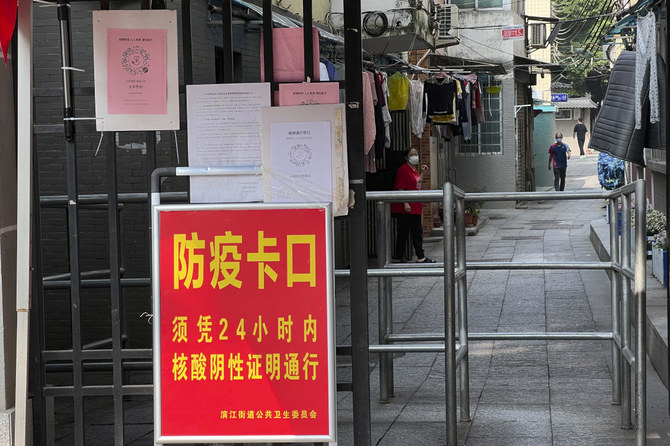
Nationwide, a total of 11,773 infections were found over the past 24 hours, including 10,351 in people with no symptoms, the National Health Commission announced. China’s numbers are low, but the increase over the past week is a challenge to a “zero-COVID” strategy that aims to isolate every infected person.
The quarantine for travelers arriving in China was shortened to five days from seven as part of changes in anti-virus controls announced Friday to reduce their cost and disruption. But the ruling Communist Party said it would stick to “zero COVID” even as other countries ease travel and other restrictions and try to shift to a long-term strategy of living with the virus.
A total of 3,775 infections were found in Guangzhou, a city of 13 million, including 2,996 in people who showed no symptoms, according to the NHC. That was an increase from Friday’s total of 3,030, including 2,461 people without symptoms.
People in the Guangzhou’s Haizhu district were ordered to stay home Saturday while testing was carried out, the district government announced on its social media account. One member of each household was allowed out to buy food.
Guangzhou has shut down schools and bus and subway service across much of the city as case numbers rise.
Flights from Guangzhou to the Chinese capital, Beijing, and other major cities have been canceled.
Nationwide, people who want to enter supermarkets, office buildings and other public buildings are required to show negative results of a virus test taken as often as once a day. That allows authorities to spot infections in people with no symptoms.
In the southwest, the industrial city of Chongqing closed schools in its Beibei district, which has 840,000 people. Residents were barred from leaving a series of apartment compounds in its Yubei district but the city gave no indication how many were affected.
The ruling party earlier this year shifted to isolating buildings or neighborhoods where infections are found instead of its previous approach of suspending access to cities following complaints that was too costly. But in outbreaks, such restrictions still can extend to areas with millions of inhabitants.
Public frustration and complaints that residents sometimes are left without access to food or medicine have boiled over into protests and clashes with local officials in some areas.
Elsewhere, mass testing also was being carried out Saturday in eight districts with a total of 6.6 million people in the central city of Zhengzhou.
Access to an industrial zone of Zhengzhou that is home to the world’s biggest iPhone factory was suspended last week following outbreaks. Apple Inc. warned deliveries of its new iPhone 14 model would be delayed.
Despite efforts to ease damage to the world’s second-largest economy, forecasters say business and consumer activity is weakening after growth rebounded to 3.9 percent over a year earlier in the three months ending in September from the first half’s 2.2 percent.
Economists have cut their forecast of China’s annual economic growth to as low as 3 percent, which would be among the lowest in decades.
President Xi Jinping’s government has refused to import foreign vaccines and defied requests to release more information about the source of the virus, which was first detected in the central city of Wuhan in late 2019.
Economists and public health experts say “zero COVID” might stay in place for as much as another year. They say millions of elderly people have to be vaccinated before the ruling party can consider lifting controls that keep most foreign visitors out of China.


China tightens restrictions as rise in COVID-19 cases reported
https://arab.news/v8y7r
China tightens restrictions as rise in COVID-19 cases reported

- Nationwide, a total of 11,773 infections were found over the past 24 hours
- A total of 3,775 infections were found in Guangzhou, a city of 13 million


Ukraine marks four years since Russian invasion
- Tuesday’s anniversary is expected to see the head of the European Commission, Ursula von der Leyen, and the president of the European Council, Antonio Costa, in Kyiv to mark the occasion
KYIV, Ukraine: Ukraine was on Tuesday marking the fourth anniversary of Russia’s full-scale invasion, with a show of solidarity from its staunchest allies and no immediate end in sight to Europe’s bloodiest conflict since World War II.
Tens of thousands of lives have been lost since the Kremlin ordered troops into Ukraine on February 24, 2022, confident of a quick victory but not expecting the fierce resistance that followed.
The worldwide fallout of the war has been immense, with many European countries increasing their own defense spending in anticipation of a possible confrontation of their own with Russia.
But diplomatic talks between the two sides, relaunched last year by the United States, have so far failed to halt the fighting, which has devastated Ukraine and left it facing the mammoth task — and bill — of reconstruction.
Tuesday’s anniversary is expected to see the head of the European Commission, Ursula von der Leyen, and the president of the European Council, Antonio Costa, in Kyiv to mark the occasion.
Both said they would take part in a “commemoration ceremony” and visit the site of a Ukrainian energy facility damaged by Russian strikes before attending a meeting with President Volodymyr Zelensky.
They are also due to take part in a videoconference meeting with Kyiv’s allies — the so-called “Coalition of the Willing” which includes Britain, France and Germany.
- Impasse -
Russia, which currently occupies nearly 20 percent of Ukrainian territory, bombs civilian areas and infrastructure on a daily basis.
The Russian bombardment has sparked the worst energy crisis since the start of the invasion, during a bitter winter.
Kyiv’s Western allies have slapped heavy sanctions on Moscow, forcing it to redirect its key oil exports toward new markets, particularly in Asia.
Despite heavy losses, Russian troops have in recent months advanced slowly on the frontline, particularly in the eastern Donbas region, which has been the epicenter of the bloody fighting and which Moscow wants to annex.
US-brokered talks are ongoing, with Zelensky unwavering in his demands for security guarantees from Washington before any talk of “compromise,” including on territory, with Russia.
Russia, though, has rejected Ukrainian proposals for the deployment of European troops in Ukraine after any ceasefire deal.
President Vladimir Putin has repeatedly warned that he will pursue his objectives by force if diplomacy fails.
- Reconstruction -
The grinding four-year war has devastated Ukraine, which even before the fighting was one of the poorest countries in Europe.
According to a joint World Bank, European Union and United Nations report with Kyiv, published on Monday, the cost of post-war reconstruction is estimated at around $558 billion over the next decade.
Russia justified sending troops into Ukraine to prevent Ukraine’s ambition to join NATO, arguing that Kyiv’s membership of the transatlantic alliance would threaten its own security.
On Monday, during a medal ceremony to mark “Defenders of the Fatherland Day,” Putin insisted that his soldiers were defending Russia’s “borders” in Ukraine, to ensure “strategic parity” between powers and fight for the country’s “future.”
Ukraine, a former Soviet republic, for its part considers the war to be a resurgence of Russian imperialism aimed at subjugating the Ukrainian people.
In an interview with the BBC broadcast on Sunday, Zelensky said he believed Putin had “already started” World War III.
“Russia wants to impose on the world a different way of life and change the lives people have chosen for themselves,” he told the British public broadcaster.


