

Israel’s Netanyahu given chance to form far-right government

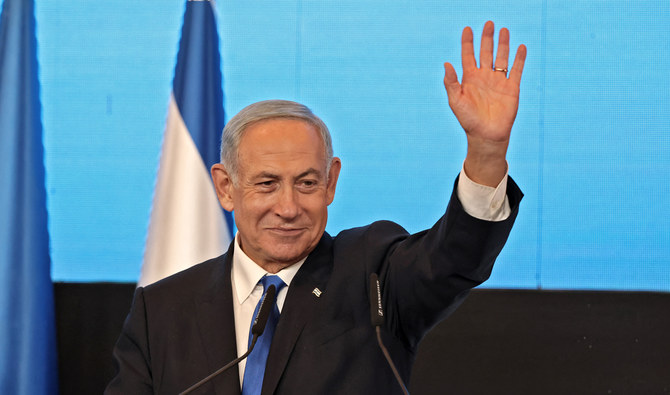
Israel's ex-premier and leader of the Likud party Benjamin Netanyahu addresses supporters at campaign headquarters in Jerusalem early on November 2, 2022, after the end of voting for national elections. (Photo courtesy: AFP)
Short Url
Updated 11 November 2022
Follow

Israel’s Netanyahu given chance to form far-right government

  • Netanyahu is currently standing trial on corruption charges
  • He governed Israel for 12 years before being ousted in 2021

JERUSALEM: Israel’s president on Friday asked former Prime Minister Benjamin Netanyahu to form a new government, presenting the longtime leader currently standing trial on corruption charges with the chance to end years of political instability in Israel with his partners on the far right.

The decision by President Isaac Herzog was announced by his office after he consulted with leaders of all of the parties elected to Israel’s parliament in last week’s national election. He will formally present Netanyahu with the task on Sunday and give him a month to cobble together a governing coalition with a majority in the 120-seat Knesset.

Netanyahu had governed Israel for 12 successive years before being ousted by a broad but fragile coalition in 2021. His comeback in last week’s election, the nation’s fifth vote in four years, seemed to ensure Israel would have a cohesive government with a comfortable majority for the first time since 2019.

But it will be the most right-wing and religious government in Israel’s history, after Netanyahu forged an alliance with an ultranationalist party that has grabbed headlines for its anti-Arab sentiment and threats to overhaul the judicial system.

One of Netanyahu’s coalition partners, far-right lawmaker Itamar Ben Gvir, has pledged to deport rival lawmakers, give soldiers more freedom to shoot Palestinians and end Palestinian autonomy in parts of the occupied West Bank.

On Thursday, Ben Gvir paid a glowing tribute to the late racist rabbi Meir Kahane, whose Kach party was banned in Israel and outlawed as a terrorist organization in the United States. Ben Gvir’s possible appointment to a key ministry, such as public security, could inflame tensions with Israel’s Arab minority and escalate hostilities in volatile Jerusalem.

Arab lawmaker Aida Touma-Sliman told The Associated Press that she expressed those fears to Herzog on Friday, saying the government’s potential inclusion of “people who were previously convicted of supporting terrorism ... is keeping us awake at night.”

Herzog said 64 members of the Knesset had recommended Netanyahu to be prime minister, giving him a clear majority in the parliament. Those recommending Netanyahu included Ben Gvir’s Jewish Power party, the ultranationalist Religious Zionist party, the openly homophobic Noam faction, and other ultra-Orthodox parties.

Like its previous repeated elections, Israel’s Nov. 1 vote was largely centered on Netanyahu’s fitness to rule. He was indicted three years ago on charges of bribery, fraud and breach of trust in three long-running cases.

His supporters view him as a champion of Israel’s nationalist right and a master statesman who is the victim of a witch hunt by political opponents in Israel’s judiciary, law enforcement and media. Critics see him as a crook who threatens Israel’s democratic institutions by placing his legal woes above the national interest.

Netanyahu has promised not use his authority to upend the judicial process. But some of his political allies want to enact changes to Israeli law that could halt his corruption trial and make the charges disappear.


Why did Xi hold back-to-back calls with Putin, Trump?

Updated 4 sec ago
Follow

Why did Xi hold back-to-back calls with Putin, Trump?

BEIJING: China’s leader Xi Jinping held back-to-back calls with Russia’s Vladimir Putin and US President Donald Trump this week, timing analysts said on Thursday was rare and significant as Beijing positions itself as a stable global power.
Here is what to know about the talks:
Why on the same day?
Xi’s video call with Putin on Wednesday afternoon was followed just hours later by a phone call with Trump.
“The timing of the call is rare and interesting. It is not common for Xi to have two calls with Putin and Trump,” George Chen, a partner at The Asia Group wrote in an online commentary.
Xi and Putin spoke for 1.5 hours, according to the Kremlin’s foreign policy aide, while Trump said they had a “long and thorough” conversation.
“It does demonstrate that Xi can hold court and easily pick up the phone to speak with the two ‘strong’ leaders of the world,” said Dylan Loh, an associate professor at Singapore’s Nanyang Technological University.
Russia and the United States are two of the “most consequential” countries to China, Loh said, though he cautioned that the timing could have been “a simple scheduling issue.”
What was discussed?
Trump said he and Xi discussed trade, Russia’s war in Ukraine and Iran.
He also said that China had committed to increasing soybean purchases from the United States to 20 million tons in the current season.
The call confirmed that “in spite of what’s happened around the world, there is going to be a short-term tactical stabilization of US-China relations,” Loh said.
The purchase of soybeans, he said, is a “low-hanging fruit.”
On Taiwan, however, Xi warned Washington to exercise caution in arms sales to the self-ruled island, which Beijing claims as its own territory and has vowed to retake by force if necessary.
Taiwan’s Deputy Foreign Minister Chen Ming-chi told AFP that “we don’t worry too much about this whole telephone communication.”
“In fact, we believe that it will contribute to stabilize the situation,” he said.
Meanwhile, Xi and Putin hailed the strengthening of Chinese-Russian ties as they try to present a united front against the West.
The two countries have drawn closer since Russia’s 2022 invasion of Ukraine, which left Moscow diplomatically isolated.
The calls took place as Russian, Ukrainian and US negotiators met in Abu Dhabi for a new round of talks on ending the almost four-year war.
Putin and Xi discussed their “opinions” on the United States, and “special attention was given to the tense situation in Iran,” the Kremlin said.
How important were the talks?
Xi is seeking to position himself as equidistant from Putin and Trump, Ho said.
“China is trying to seek international maneuver space to ensure that whatever happens globally, it does not get fenced into a corner,” he told AFP.
Domestically, China is reeling from a recent corruption probe into Zhang Youxia, a top military general in the People’s Liberation Army, which sent shockwaves through defense observers.
Analysts said that while Zhang’s investigation would likely not have been discussed with Putin and Trump, the timing of the calls could be a way for Xi to project confidence domestically.
Faced with uncertain and fragile domestic conditions, the “two-timing” calls were “probably for domestic posturing to demonstrate Xi’s political standing in the global theater,” Ho said.
What do the calls mean for ties?
Putin accepted invitations during the call to visit China in the first half of 2026, according to the Kremlin, while Trump said he was looking forward to his previously announced trip to Beijing in April.
Putin will also attend the APEC regional summit hosted by Xi in November.
The calls follow a slew of recent meetings between Xi and various leaders, as he seeks to present China as a stable alternative to Washington.
Some analysts cautioned that China-Russia relations “are not ironclad” while both Beijing and the mercurial Trump administration could yet make unattainable demands of each other.
Neither the US nor China will fully commit to Russia, as “both are primarily focused on stabilising their bilateral relationship,” said Yue Su at the Economist Intelligence Unit.
“Meaningful Chinese cooperation would likely require a very attractive deal from the US in exchange.”