



KARACHI: Where do ships, planes, trains and automobiles go when they die?
Many of the rudders, the propellers, the wings and the wheels that move us through the world — and back home — end up in Karachi’s Sher Shah Kabari Bazar, Pakistan’s largest scrap market, where they are cut-up and served up to recycle and resell — the many megatons of them.
“From a needle to parts of an airplane, it is all available here,” Aga Abdul Khaliq Jan, a scrap dealer at the Bazaar who is also the secretary general of the scrap market association, told Arab News.
Like him, Jan’s father too was in the scrap business, a pioneer since Pakistan’s independence from British India in 1947, and among the first scrap-dealers to set up shop at Sher Shah when the market was established in 1960.
“[Back then] this was just a landfill by the bank of the Layari River, flowing over with the waste of Karachi,” Jan, who was then a child assisting his father at his shop, said. “The first of the shops were built over that waste dump.”
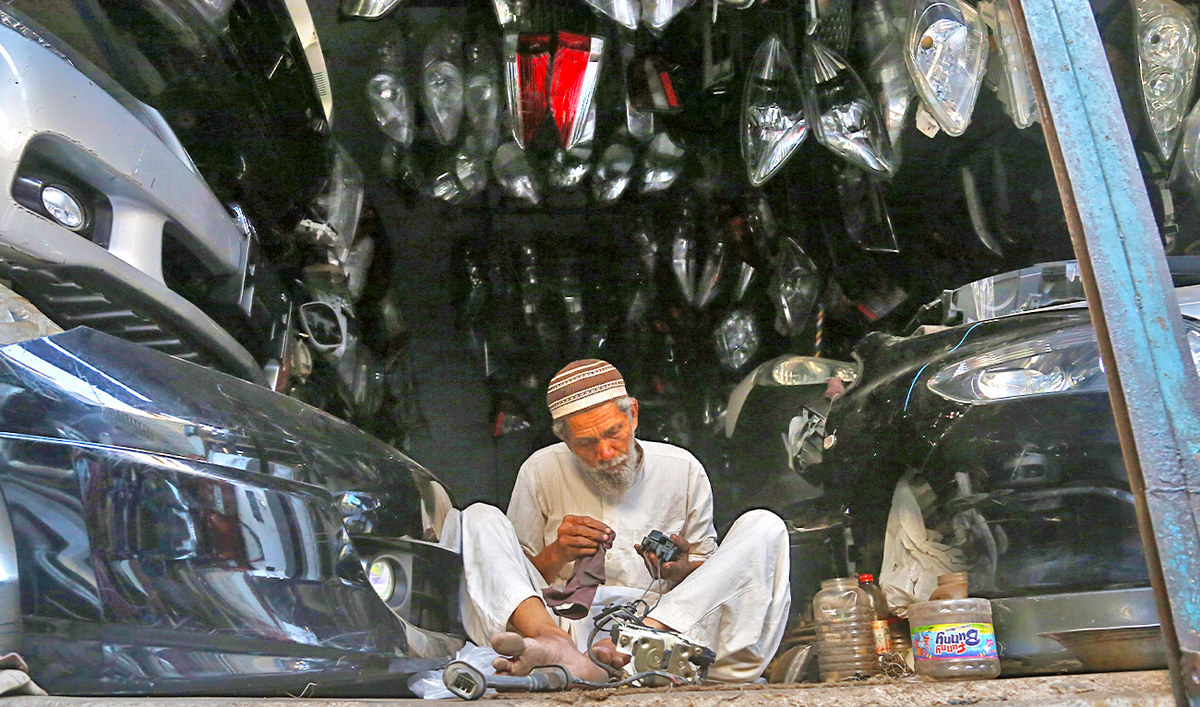
A man cleans a spare part in Sher Shah Bazaar in Karachi, Pakistan, November 1, 2022. (AN Photo)
Khaliq, dressed in white, and with a beard to match, now supervises his scrap-dealer sons at the market that has sustained three generations of his family. Over the decades, he has seen the market grow from a few hundred shops to a marketplace of thousands, encroaching into the adjoining area previously part of the SITE industrial estate.
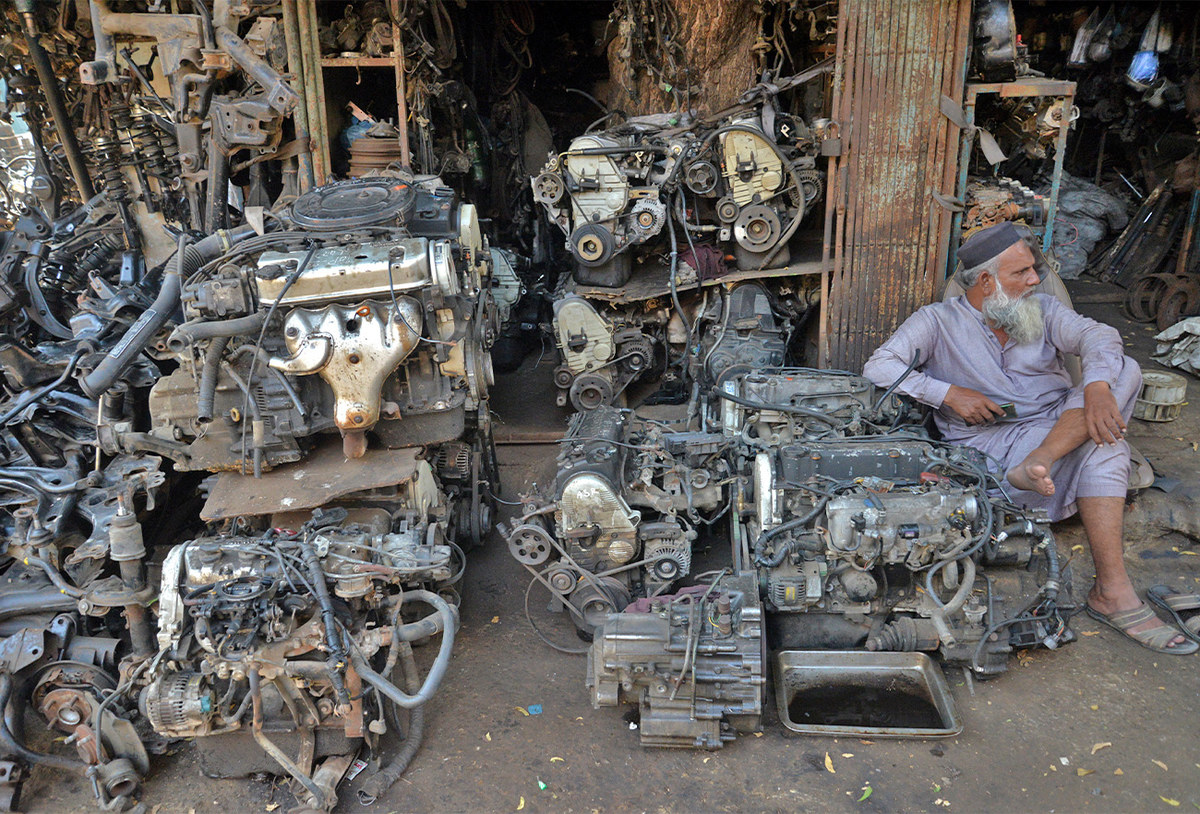
Today, it is easy to get lost among the bazaar’s many godowns, junkyards, warehouses, and the attendant chaos of row over row of spare metal-parts waiting to be bought by the kilo and refitted to repair machines and cars of all shades and sizes.
The scavengers also help supply to industries in Pakistan’s commercial hub of Karachi and beyond.
“There is constant increase [in the number of shops], [and] it is expanding,” Jan said as he guided his staff to deal with a buyer looking for electric wire.
A man sits near old batteries in Sher Shah Bazaar in Karachi, Pakistan, November 1, 2022. (AN Photo)
The bazaar’s proximity to Gaddani – a city in the neighboring Balochistan province with the world’s third largest ship-breaking yard, just 48 kilometers west of Karachi – has also helped to make the daytime market the largest hub of imported scrap in the country. From Karachi, where a lot of the parts are locally traded, they are also transported elsewhere in the country.
“The material scrapped abroad comes to this market,” Jan added. “Entire parts from the ship-breaking activity come here. When airplanes are discarded and scrapped, they [also] come here.”
Given the commerce in parts of mechanical nature, it is only natural for the bazaar to produce technical hands, adept at fixing and re-engineering the spare parts. People associated with the market have come to be called “engineers” with the passage of time, Jan said smilingly, now providing services to industrial units, whose owners often come seeking advice for installing plants and repairing them.
The bazaar also neighbors Lyari, a notorious town whose criminal gangs and syndicates have often targeted traders in Karachi. While the traders’ anxiety about security has been considerably allayed by Operation Layari, a government crackdown on criminal elements in 2013, the market that deals in imported merchandise now has a different concern to contend with.
“The security situation is a lot better,” Jan said “but the traders now suffer mental stress due to the depreciated Pakistani currency. The rate of the dollar has gone up, impacting our sales. There are few customers and even when they come, many leave without buying.”
Pakistan, one of the top markets for reconditioned cars in the region, has imported 87,000 used cars in the last four years. Registering a growth trend, the South Asian country has imported 20,000 units in just the first eight months of 2022 against 21,000 units in all of last year.
While reconditioned cars are comparatively cheaper, their parts are not easily available in Pakistan. That is where scrap markets like Sher Shah come in, helping keep used vehicles on the road.
“Parts for reconditioned vehicles are not available in the market; you have to purchase used ones from abroad,” Tahir Saeed, an auto-parts dealer at the bazaar, said. “A new part of an imported car that costs Rs 50,000 can be easily bought for just Rs 10,000 here.”


