RAMALLAH: Two Palestinians have been killed by Israeli soldiers in the occupied West Bank.
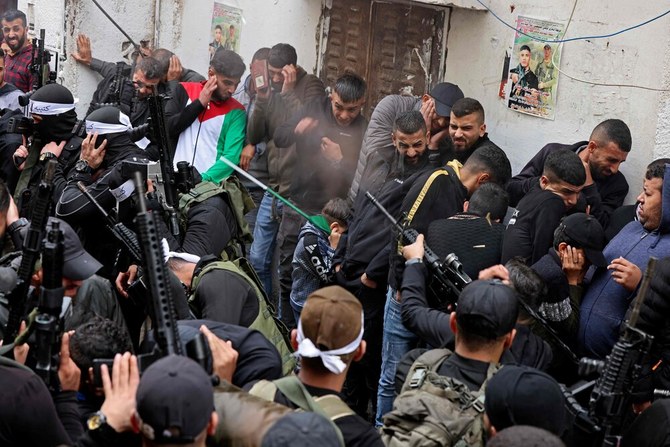
A teenager was shot and died later, while 56 were injured during an Israeli raid early on Wednesday in the city of Nablus. Palestinian officials identified the victim as Mahdi Hashash, 15.
Ali Issa, 29, another Palestinian, was killed by soldiers on Wednesday evening west of Jenin in the northern West Bank, the Palestinian Health Ministry announced.
The Palestinian Red Crescent Society said Hashash was seriously injured after being shot in the abdomen, and doctors later pronounced him dead. Three others were hit by rubber bullets while 53 suffered the effects of gas inhalation.
A branch of the militant Palestinian group Al-Aqsa Martyrs’ Brigade called the teenage victim “our martyr.”
Clashes occurred after dozens of Israeli settlers stormed the location after midnight, and the confrontations continued into the early hours of Wednesday.
Mourners at Hashish’s funeral chanted slogans condemning “the crimes of the Israeli occupation against the Palestinian people.”
Palestinian government spokesperson Ibrahim Melhem, speaking to Arab News, described incursions into the West Bank as “systematic state terrorism” coordinated between the Israeli armed forces and settlers.
He said: “There is no difference anymore between the Israeli armed forces and the systematic settler terrorism against the Palestinians, with no respect for the lives of Palestinians, including children.”
Hamas spokesman Hazem Qassem said that Palestinians’ continued resistance against Israeli aggression confirms their determination to continue their fight.
He added: “The blood of the martyrs has always been a fuel for the escalation of our people’s revolution and a motive to continue fighting the occupier until our people’s goals of freedom and independence are achieved.”
The Popular Front for the Liberation of Palestine called for the support of all resistance groups in the West Bank.
The Israeli daily newspaper Haaretz reported that a political event had been organized at Joseph’s Tomb on the outskirts of Nablus, with the approval of Brig. Gen. Avi Plaut, the military commander of the IDF in the West Bank.
Elected officials from the Knesset attended the event and it was reported the politicians were invited by the head of the settlement council in the West Bank, Yossi Dagan.
The decision was in the face of warnings by senior security officials who said that holding a political event there could lead to renewed confrontations in the Nablus area.
Israeli troops arrested 14 Palestinians in various locations in the West Bank and Jerusalem on Wednesday.
Soldiers also took into their possession two mobile homes east of Yatta, south of Hebron, in the West Bank.
Coordinator of the Protection and Resilience Committees in the South Hebron Mountains Fuad Al-Amour said the army’s move coincided with the onset of rains to put pressure on residents to leave their land, vacating it for settlers.
Israeli soldiers have killed 135 Palestinians in the West Bank since the start of the year.


![]()

Two Palestinians killed by Israeli soldiers
Short Url
https://arab.news/27yex
Two Palestinians killed by Israeli soldiers
- A teenager was shot and died later, while 56 were injured during an Israeli raid early on Wednesday in the city of Nablus
- A branch of the militant Palestinian group Al-Aqsa Martyrs’ Brigade called the teenage victim “our martyr”


Latest updates


Recommended


© 2026 SAUDI RESEARCH & PUBLISHING COMPANY, All Rights Reserved And subject to Terms of Use Agreement.