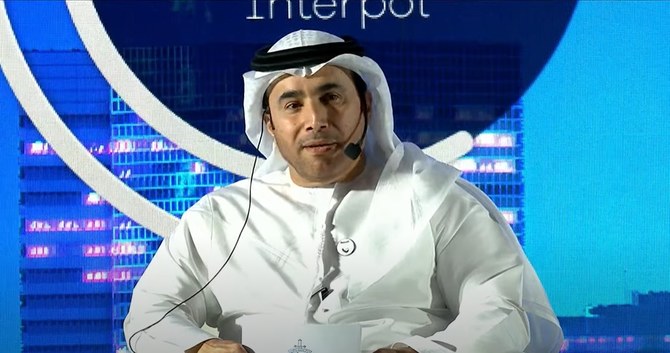

RIYADH: Exchanging information is important to protect citizens from cybercrimes, Interpol’s president Ahmed Naser Al-Raisi said.
Speaking at the Global Cybersecurity Forum in Riyadh, on Nov. 9, he said: “When we have a base to exchange information, even when there are no diplomatic relations between countries, it is important to protect citizens.”
Al-Raisi noted that in 2015, cybercrimes cost around $3 trillion in losses, in 2021, they reached $6 trillion and they are expected to reach $10.5 trillion in 2025.
“This number is more than natural disasters that occur in a year, in addition to profits made by all drug dealers around the world,” he said.
As the whole world is becoming a village through the vast space of the internet, a large field for all criminal operations in cyber-attacks has emerged.
Launched in 1923, the International Criminal Police Organization, commonly known as Interpol, is an international organization that facilitates worldwide police cooperation and crime control.
Al-Raisi, the first Arab to head the organization, said: “My past experience with smart transformation has led me to have my first strategy in the organization (Interpol) and to prioritize cybercrime,” he noted.
This has led to making the 195 member states have systems and capabilities of competencies that can not only respond to a cyber-attack but also be proactive against it, he added.
Also speaking at the forum, Interpol’s cybercrime director of global policing organization Craig Jones said organizations such as his are more suited to tackle commodity-based crimes, including drugs and human trafficking, because they fit into the police model of a particular jurisdiction.
“The legislation is different country to country. We see the European Union, you have 27 member countries with joint laws, joint inputs, joint political initiatives, to deal and combat cybercrime,” he said.
“But once you spread that out across the globe, there are different priorities. Some countries don't even have the requisite laws. So, if it appears criminals are operating from one country, another country then tries to come in and identify these criminals and look to prosecute them and extradite them,” he added.
In terms of law enforcement, he highlighted the role of Interpol across its 195 member countries.
“What we're seeking to do is to reduce the global impact of cybercrime and protect communities for a safer world and the model we're following as policing model,” he said.
“We’re looking from a global to local perspective. How can Interpol support and coordinate activities and operations, and we do it with people, process and technology,” he added.
Marco Gercke, director of the Cybercrime Research Institute, said financial interest is often a driving factor, and criminals are taking advantage of increased digitalization.
“They're realizing that they can make a lot of money by getting involved in this. The business models have changed. But it's quite lucrative and it's rather easy to set up. You don't need to be an organized crime business that is in the market for a long period of time to get involved in cybercrime,” he said.
“And we have to be smart on the other side, through having the appropriate laws in place and having self-defense measures as companies, as countries in place changing our behavior, how we use devices and how we protect ourselves, to respond to this increasing threat,” he added.
Cybersecurity’s evolution, economic impact, and accessibility are the key pillars of GSF 2022 being held Riyadh on Nov. 9 and 10.
In its third edition, the annual forum will be hearing the contributions of global leaders from different sectors to contribute to the safeguarding of global cyberspace under the theme “Rethinking the Global Cyber Order.”
The event hosts over 4,500 attendees from over 110 countries and convenes more than 120 speakers to discuss day-to-day cyber issues.