

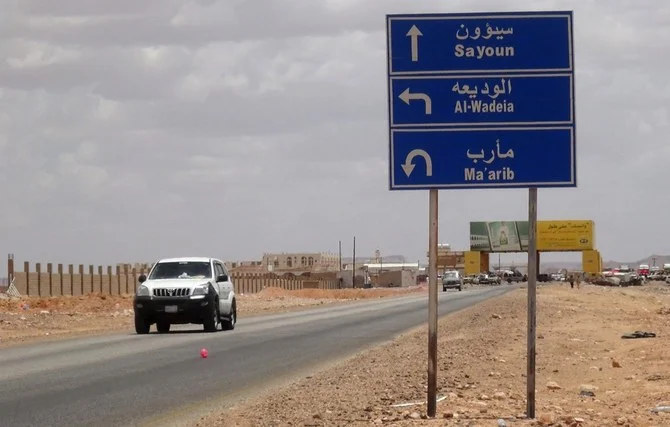
Yemen military leader gunned down in Marib

A Yemeni military leader who had fought the Iran-backed Houthis for the past seven years was assassinated on Tuesday in the central city of Marib. (AFP/File)
Short Url
Updated 08 November 2022
Follow

Yemen military leader gunned down in Marib

  • Although no one has claimed responsibility for the killing, Houthi sleeper cells in Marib are widely viewed as having been behind the attack

AL-MUKALLA: A Yemeni military leader who had fought the Iran-backed Houthis for the past seven years was assassinated on Tuesday in the central city of Marib, while local human rights groups blasted the Houthis for launching ballistic missiles on the city.

Local security officers and media reports said that unidentified men killed Brig. Gen. Mohammed Al-Jaradi, an adviser to Yemen’s defense minister, as well as his bodyguard outside the city of Marib.

Al-Jaradi was a former commander of an army brigade in Marib. He led troops in battle against the Houthis in the city. Al-Jaradi narrowly escaped death during combat beyond Marib, and survived a prior attempt on his life.

Although no one has claimed responsibility for the killing, Houthi sleeper cells in Marib are widely viewed as having been behind the attack.

Meanwhile, Yemeni rights groups, activists and government officials condemned the Houthis for carrying out a missile strike on Marib on Monday evening, killing four people and injuring five others.

Two ballistic missiles fired by the Houthis struck an army ammunition storage site in Marib, causing large explosions. The militia also fired rockets into densely populated camps for the internally displaced, a local military officer told Arab News.

Four individuals were killed instantly as a missile struck their makeshift home. Several other citizens were rushed to a Marib hospital.

Images posted on social media showed the mangled body of a child on a Marib hospital bed along with severely injured people receiving treatment nearby.

“The first missile struck close to the depot. The other missile hit the Katyusha rocket stockpile, launching them into the air,” an anonymous local official said.

Human rights organization Rights Radar criticized the strike, demanding that the Houthis refrain from targeting civilians and urging the international community to strive to cease atrocities against civilians in Yemen.

“Rights Radar calls on the international community to play a serious role to end assaults that violate civilians’ right to life and stability,” the organization tweeted, calling for immediate steps to safeguard the displaced.

The Yemeni Network for Rights and Freedoms accused the Houthis of sabotaging peace efforts and breaking international treaties that protect civilians during wartime.

It also urged foreign mediators to pressure the Houthis to cease targeting civilians. “The Houthi organization exploits international silence as justification and pretext for continuing its heinous crimes against Yemenis, endangering any efforts to achieve peace and end the conflict,” the group said.

The Houthis denied launching missiles toward Marib and accused their opponents of blowing up the facility, the militia-controlled Saba news agency reported.

Hundreds of civilians and combatants have been killed in and around the energy-rich city since early last year when the Houthis launched a military push to capture Marib, the seat of Yemen’s army and some Arab coalition military units.

The Houthi onslaught on Marib, which has mostly failed in its objective to seize the city, was halted during the UN-brokered truce, which went into force on April 2.


Syrian army pushes into Aleppo district after Kurdish groups reject withdrawal

Updated 10 January 2026
Follow

Syrian army pushes into Aleppo district after Kurdish groups reject withdrawal

  • Two Syrian security officials told Reuters the ceasefire efforts had failed and that the army would seize the neighborhood by force

ALEPPO, Syria: The Syrian army said it would push into the last Kurdish-held district of Aleppo ​city on Friday after Kurdish groups there rejected a government demand for their fighters to withdraw under a ceasefire deal.
The violence in Aleppo has brought into focus one of the main faultlines in Syria as the country tries to rebuild after a devastating war, with Kurdish forces resisting efforts by President Ahmed Al-Sharaa’s Islamist-led government to bring their fighters under centralized authority.
At least nine civilians have been killed and more than 140,000 have fled their homes in Aleppo, where Kurdish forces are trying to cling on to several neighborhoods they have run since the early days of the war, which began in 2011.

HIGHLIGHTS

• Standoff pits government against Kurdish forces

• Sharaa says Kurds are ‘fundamental’ part of Syria

• More than 140,000 have fled homes due to unrest

• Turkish, Syrian foreign ministers discuss Aleppo by phone

ِA ceasefire was announced by the defense ministry overnight, demanding the withdrawal of Kurdish forces to the Kurdish-held northeast. That would effectively end Kurdish control over the pockets of Aleppo that Kurdish forces have held.

CEASEFIRE ‘FAILED,’ SECURITY OFFICIALS SAY
But in a statement, Kurdish councils that run Aleppo’s Sheikh Maksoud and Ashrafiyah districts ‌said calls to leave ‌were “a call to surrender” and that Kurdish forces would instead “defend their neighborhoods,” accusing government forces ‌of intensive ⁠shelling.
Hours ​later, the ‌Syrian army said that the deadline for Kurdish fighters to withdraw had expired, and that it would begin a military operation to clear the last Kurdish-held neighborhood of Sheikh Maksoud.
Two Syrian security officials told Reuters the ceasefire efforts had failed and that the army would seize the neighborhood by force.
The Syrian defense ministry had earlier carried out strikes on parts of Sheikh Maksoud that it said were being used by the Kurdish-led Syrian Democratic Forces (SDF) to launch attacks on the “people of Aleppo.” It said on Friday that SDF strikes had killed three army soldiers.
Kurdish security forces in Aleppo said some of the strikes hit a hospital, calling it a war crime. The defense ministry disputed that, saying the structure was a large arms depot and that it had been destroyed in the resumption of strikes on Friday.
It ⁠posted an aerial video that it said showed the location after the strikes, and said secondary explosions were visible, proving it was a weapons cache.
Reuters could not immediately verify the claim.
The SDF is ‌a powerful Kurdish-led security force that controls northeastern Syria. It says it withdrew its fighters from ‍Aleppo last year, leaving Kurdish neighborhoods in the hands of the Kurdish ‍Asayish police.
Under an agreement with Damascus last March the SDF was due to integrate with the defense ministry by the end of 2025, ‍but there has been little progress.

FRANCE, US SEEK DE-ESCALATION
France’s foreign ministry said it was working with the United States to de-escalate.
A ministry statement said President Emmanuel Macron had urged Sharaa on Thursday “to exercise restraint and reiterated France’s commitment to a united Syria where all segments of Syrian society are represented and protected.”
A Western diplomat told Reuters that mediation efforts were focused on calming the situation and producing a deal that would see Kurdish forces leave Aleppo and provide security guarantees for Kurds who remained.
The diplomat ​said US envoy Tom Barrack was en route to Damascus. A spokesperson for Barrack declined to comment. Washington has been closely involved in efforts to promote integration between the SDF — which has long enjoyed US military support — and Damascus, with which the ⁠United States has developed close ties under President Donald Trump.
The ceasefire declared by the government overnight said Kurdish forces should withdraw by 9 a.m. (0600 GMT) on Friday, but no one withdrew overnight, Syrian security sources said.
Barrack had welcomed what he called a “temporary ceasefire” and said Washington was working intensively to extend it beyond the 9 a.m. deadline. “We are hopeful this weekend will bring a more enduring calm and deeper dialogue,” he wrote on X.

TURKISH WARNING
Turkiye views the SDF as a terrorist organization linked to the outlawed Kurdistan Workers’ Party and has warned of military action if it does not honor the integration agreement.
Turkish Foreign Minister Hakan Fidan, speaking on Thursday, expressed hope that the situation in Aleppo would be normalized “through the withdrawal of SDF elements.”
Though Sharaa, a former Al-Qaeda commander who belongs to the Sunni Muslim majority, has repeatedly vowed to protect minorities, bouts of violence in which government-aligned fighters have killed hundreds of Alawites and Druze have spread alarm in minority communities over the last year.
The Kurdish councils in Aleppo said Damascus could not be trusted “with our security and our neighborhoods,” and that attacks on the areas aimed to bring about displacement.
Sharaa, in a phone call with Iraqi Kurdish leader Masoud Barzani on Friday, affirmed that the Kurds were “a fundamental part ‌of the Syrian national fabric,” the Syrian presidency said.
Neither the government nor the Kurdish forces have announced a toll of casualties among their fighters from the recent clashes.