Philippine prisons chief ordered murder of journalist: Police

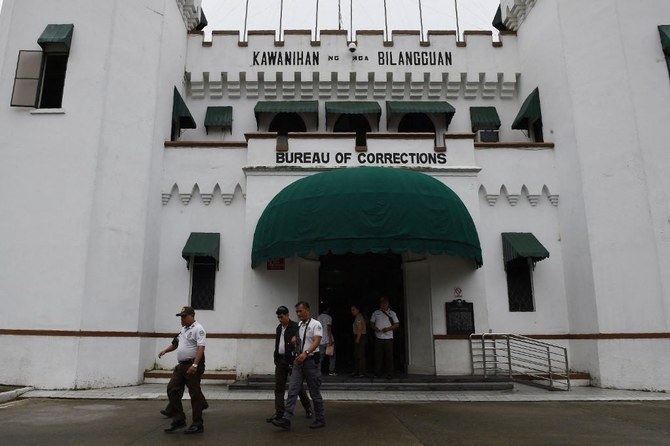
Police filed murder complaints against Bureau of Corrections director general Gerald Bantag, who is currently suspended from duty. (AFP file photo)
Short Url
Updated 07 November 2022
Follow

Philippine prisons chief ordered murder of journalist: Police

  • Police filed murder complaints against Bureau of Corrections director general Gerald Bantag

MANILA: Philippine police accused Monday the country’s prisons chief of ordering the killing of a prominent radio journalist, whose death sparked international alarm.

Radio personality Percival Mabasa, 63, who went by the name “Percy Lapid” in his program, was shot dead in a Manila suburb on October 3 as he drove to his studio.

Police filed murder complaints against Bureau of Corrections director general Gerald Bantag, who is currently suspended from duty, and his deputy security officer Ricardo Zulueta.

The alleged gunman, Joel Escorial, surrendered to authorities last month out of fear for his safety after police broadcast his face from security footage, officials said previously.

“He (Bantag) will probably be the highest official of this land ever charged with a case of this gravity,” Justice Secretary Crispin Remulla said.

Bantag allegedly ordered the murder of Mabasa following the “continued expose by the latter of the issues against the former on his show,” Eugene Javier of the National Bureau of Investigation told reporters, reading from a statement.

Bantag and Zulueta have also been accused of ordering the killing of Cristito Villamor Palana, one of the prison inmates who allegedly passed on the kill order to Escorial.

Escorial had identified Palana to police.

Palana was suffocated with a plastic bag by members of his own gang, Javier said.

Criminal complaints also have been filed against 10 inmates.

Prosecutors at the Department of Justice will decide if there is enough evidence to file charges in court.

Mabasa was an outspoken critic of former president Rodrigo Duterte as well as his successor Ferdinand Marcos’s policies and aides.

He also had been critical of “red-tagging” — accusing someone of being a communist sympathizer — as well as online gambling operations and misinformation around martial law.

He was the second journalist to be killed since Marcos took office on June 30.

While the Philippines is ranked as one of the most dangerous countries in the world for journalists, such murders rarely happen in Manila.

Javier said the investigation into the murders had exposed “the institutionalization of a criminal organization within the government.”

“This will be the cause of many reforms in government and the strengthening of current mechanisms to ensure that nothing of this nature will happen again,” he said, describing it as a “war against impunity.”


ICE agents can’t make warrantless arrests in Oregon unless there’s a risk of escape, US judge rules

Updated 2 sec ago
Follow

ICE agents can’t make warrantless arrests in Oregon unless there’s a risk of escape, US judge rules

  • US District Judge Mustafa Kasubhai issued a preliminary injunction in a proposed class-action lawsuit
  • Case targets Department of Homeland Security’s practice of arresting immigrants they happen to come across
PORTLAND, Oregon: US immigration agents in Oregon must stop arresting people without warrants unless there’s a likelihood of escape, a federal judge ruled Wednesday.
US District Judge Mustafa Kasubhai issued a preliminary injunction in a proposed class-action lawsuit targeting the Department of Homeland Security’s practice of arresting immigrants they happen to come across while conducting ramped-up enforcement operations — which critics have described as “arrest first, justify later.”
The department, which is named as a defendant in the suit, did not immediately comment in response to a request from The Associated Press.
Similar actions, including immigration agents entering private property without a warrant issued by a court, have drawn concern from civil rights groups across the country amid President Donald Trump’s mass deportation efforts.
Courts in Colorado and Washington, D.C., have issued rulings like Kasubhai’s, and the government has appealed them.
In a memo last week, Todd Lyons, the acting head of US Immigration and Customs Enforcement, emphasized that agents should not make an arrest without an administrative arrest warrant issued by a supervisor unless they develop probable cause to believe that the person is in the US illegally and likely to escape from the scene before a warrant can be obtained.
But the judge heard evidence that agents in Oregon have arrested people in immigration sweeps without such warrants or determining escape was likely.
The daylong hearing included testimony from one plaintiff, Victor Cruz Gamez, a 56-year-old grandfather who has been in the US since 1999. He told the court he was arrested and held in an immigration detention facility for three weeks even though he has a valid work permit and a pending visa application.
Cruz Gamez testified that he was driving home from work in October when he was pulled over by immigration agents. Despite showing his driver’s license and work permit, he was detained and taken to the ICE building in Portland before being sent to an immigration detention center in Tacoma, Washington. After three weeks there, he was set to be deported until a lawyer secured his release, he said.
He teared up as he recounted how the arrest impacted his family, especially his wife. Once he was home they did not open the door for three weeks out of fear and one of his grandchildren did not want to go to school, he said through a Spanish interpreter.
Afterward a lawyer for the federal government told Cruz Gamez he was sorry about what he went through and the effect it had on them.
Kasubhai said the actions of agents in Oregon — including drawing guns on people while detaining them for civil immigration violations — have been “violent and brutal,” and he was concerned about the administration denying due process to those swept up in immigration raids.
“Due process calls for those who have great power to exercise great restraint,” he said. “That is the bedrock of a democratic republic founded on this great constitution. I think we’re losing that.”
The lawsuit was brought by the nonprofit law firm Innovation Law Lab, whose executive director, Stephen Manning, said he was confident the case will be a “catalyst for change here in Oregon.”
“That is fundamentally what this case is about: asking the government to follow the law,” he said during the hearing.
The preliminary injunction will remain in effect while the lawsuit proceeds.