

Yemeni push forces Al-Qaeda out of Abyan valley hideout

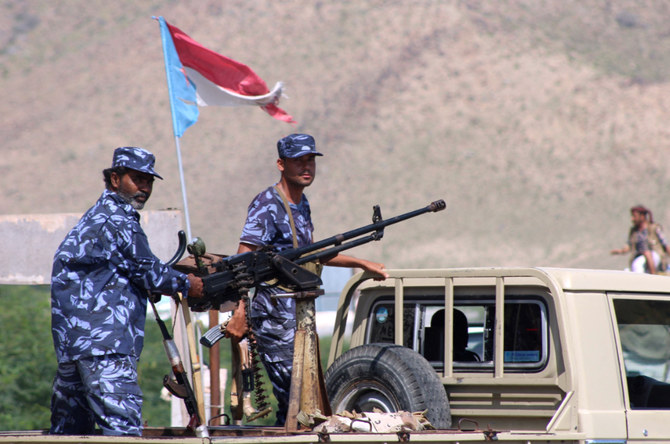
Yemeni security forces stand on the back of a pick up truck mounted with a heavy machine gun at a checkpoint in Yemen's coastal southern Hadramawt province. (AFP)
Short Url
Updated 06 November 2022
Follow

Yemeni push forces Al-Qaeda out of Abyan valley hideout

  • Children hurt in Houthi mortar strikes on villages near southern city of Taiz

AL-MUKALLA: Yemeni military forces have advanced into a large valley in Yemen’s southern province of Abyan to dislodge Al-Qaeda militants who have long used the area for recruiting, storing arms and staging deadly attacks against government-controlled areas, a military spokesperson told Arab News on Saturday.

Mohammed Al-Naqeeb, a spokesman for the pro-independence Southern Transitional Council, which commands the military operations, said that forces pushed into Al-Khealah valley, south of Al-Mahfad district, to flush out Al-Qaeda militants who had taken refuge there after being forced out of other strongholds in the past two months.

A lengthy column of armed vehicles carrying dozens of soldiers was seen heading into rugged mountainous terrain, meeting little resistance from Al-Qaeda militants who fled before the military arrived.

We are dealing with a stealthy, mobile and camouflaged enemy employing insurgent methods.

Mohammed Al-Naqeeb, Spokesman Southern Transitional Council

Militants placed explosive devices on roads in an attempt to halt the troops’ advance.

Three soldiers were killed and four others injured on Friday when their vehicle was destroyed by a roadside bomb, Al-Naqeeb said.

A total of 46 government troops have been killed and and 136 wounded since the start of the East Arrow military operations against Al-Qaeda in the Abyan and Shabwa provinces two months ago.

Fleeing Al-Qaeda fighters sought sanctuary in the rocky highlands that link Abyan, Al-Bayda and Shabwa, while some hid in Wadi Hadramout, and others crept into Abyan’s urban areas, creating “sleeper cells” responsible for killing security and military officials, and laying IEDs.

Security authorities in Al-Mahfad have enforced a nighttime curfew from 8 p.m. to 5 a.m. to restrict Al-Qaeda militants’ activities and stop fighters infiltrating urban areas.

“We are dealing with a stealthy, mobile and camouflaged enemy employing insurgent methods,” Al-Naqeeb said.

In September, the pro-independence security and military groups launched a coordinated military operation in Abyan and Shabwa provinces to eject Al-Qaeda militants from isolated mountainous areas and valleys that have long served as hiding spots.

Yemeni forces have pushed Al-Qaeda out of Lawder, Moudia and Al-Mahfad in Abyan, as well as the Omaran Valley in Abyan, and have also dislodged militants from Al-Mousenah in Shabwa.

Separately, Yemen’s state news agency said on Friday that Iran-backed Houthis launched mortar rounds at two villages controlled by the Yemeni government in the southern city of Taiz, wounding five people.

Two children and a pregnant woman were among those hurt when the mortar barrage struck Salo and Dhabab, south and west of Taiz.

Yemen’s army said on Friday that three Houthis were killed and many more injured in clashes west of Taiz as the militants attempted to storm government positions.

Since April 2, when the UN-brokered truce came into force, dozens of civilians and combatants have been killed or injured in Houthi ground operations and bombardments in and around the besieged city.


Trump warns Iran of ‘very traumatic’ outcome if no nuclear deal

Updated 12 February 2026
Follow

Trump warns Iran of ‘very traumatic’ outcome if no nuclear deal

  • Speaking a day after he hosted Netanyahu at the White House, Trump said he hoped for a result “over the next month”

WASHINGTON: US President Donald Trump threatened Iran Thursday with “very traumatic” consequences if it fails to make a nuclear deal — but Israeli Prime Minister Benjamin Netanyahu said he was skeptical about the quality of any such agreement.
Speaking a day after he hosted Netanyahu at the White House, Trump said he hoped for a result “over the next month” from Washington’s negotiations with Tehran over its nuclear program.
“We have to make a deal, otherwise it’s going to be very traumatic, very traumatic. I don’t want that to happen, but we have to make a deal,” Trump told reporters.
“This will be very traumatic for Iran if they don’t make a deal.”
Trump — who is considering sending a second aircraft carrier to the Middle East to pressure Iran — recalled the US military strikes he ordered on Tehran’s nuclear facilities during Israel’s 12-day war with Iran in July last year.
“We’ll see if we can get a deal with them, and if we can’t, we’ll have to go to phase two. Phase two will be very tough for them,” Trump said.
Netanyahu had traveled to Washington to push Trump to take a harder line in the Iran nuclear talks, particularly on including the Islamic Republic’s arsenal of ballistic missiles.
But the Israeli and US leaders apparently remained at odds, with Trump saying after their meeting at the White House on Wednesday that he had insisted the negotiations should continue.

- ‘General skepticism’ -

Netanyahu said in Washington on Thursday before departing for Israel that Trump believed he was laying the ground for a deal.
“He believes that the conditions he is creating, combined with the fact that they surely understand they made a mistake last time when they didn’t reach an agreement, may create the conditions for achieving a good deal,” Netanyahu said, according to a video statement from his office.
But the Israeli premier added: “I will not hide from you that I expressed general skepticism regarding the quality of any agreement with Iran.”
Any deal “must include the elements that are very important from our perspective,” Netanyahu continued, listing Iran’s ballistic missile program and its support for armed groups such as the Palestinian movement Hamas, Yemen’s Houthi rebels and Hezbollah in Lebanon.
“It’s not just the nuclear issue,” he said.
Despite their differences on Iran, Trump signaled his strong personal support for Netanyahu as he criticized Israeli President Isaac Herzog for rejecting his request to pardon the prime minister on corruption charges.
“You have a president that refuses to give him a pardon. I think that man should be ashamed of himself,” Trump said on Thursday.
Trump has repeatedly hinted at potential US military action against Iran following its deadly crackdown on protests last month, even as Washington and Tehran restarted talks last week with a meeting in Oman.
The last round of talks between the two foes was cut short by Israel’s war with Iran and the US strikes.
So far, Iran has rejected expanding the new talks beyond the issue of its nuclear program. Tehran denies seeking a nuclear weapon, and has said it will not give in to “excessive demands” on the subject.