Pakistan assured of $13 billion support from China and Saudi Arabia — finance minister 

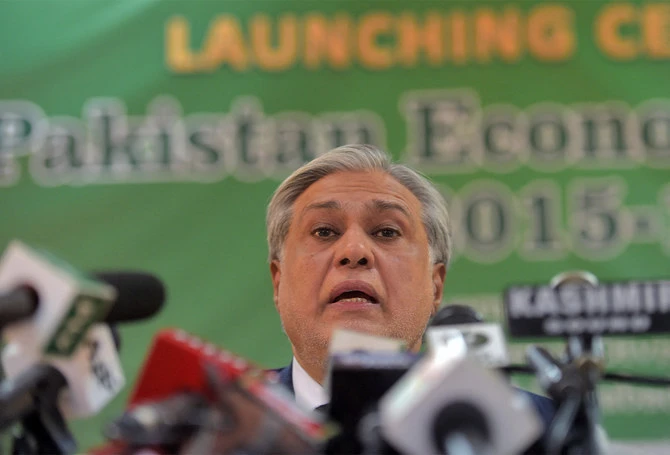
Pakistan's former finance minister Ishaq Dar is pictured in Islamabad, Pakistan, on June 2, 2016. (AFP/File)
Short Url
Updated 06 November 2022
Follow

Pakistan assured of $13 billion support from China and Saudi Arabia — finance minister 

  • China will roll over $4bn sovereign debts, refinance $3.3bn commercial loans, raise currency swap by $1.45bn 
  • Ishaq Dar says Riyadh has promised an additional $4.2 billion in financing and deferred oil payment facility 

KARACHI: China and Saudi Arabia have assured of $13 billion financial support to Pakistan, in addition to around $20 billion investment, to keep the cash-strapped South Asian economy afloat, Pakistan’s finance minister said on Friday. 

Ishaq Dar, who recently accompanied Prime Minister Shehbaz Sharif, on a visit to China told reporters in Islamabad the incoming financial assistance included rollover of sovereign loan deposits, commercial loans and currency swaps from China as well as an increase in financing and deferred payment facility on oil imports from Saudi Arabia. 

Top officials in Beijing have assured of over $8.7 billion support while Riyadh has promised an additional $4.2 billion for the current fiscal year, Dar said, giving a breakdown of the inflows. 

The financial assistance from China includes the rollover of $4 billion in sovereign loans, refinancing of $3.3 billion commercial loans and increase in currency swap by around $1.45 billion. 

“Don’t worry, we will not let you down,” Dar quoted Chinese President Xi Jinping as telling PM Sharif. 

The Chinese president assured Beijing’s financial support to Islamabad at a meeting with Sharif on Wednesday. 

Both leaders agreed to strengthen the China-Pakistan strategic partnership as well as multilateral cooperation in areas, including the China-Pakistan Economic Corridor (CPEC), a $65 billion network of roads, railways, pipelines and ports in Pakistan that will connect China to the Arabian Sea and help Islamabad expand and modernize its economy. 

Dar informed that Chinese authorities had also agreed to fast-track the processing of the $9.8 billion Main Line-1 project for dualization of railway tracks from Karachi to Peshawar. 

About financial support from Saudi Arabia, he said the Kingdom had given a positive response for increasing its financing by another $3 billion to $6 billion and doubling its deferred oil payment facility to $2.4 billion. 

Saudi Arabia has also agreed to revive the around $10 billion oil refinery and petrochemical project in Pakistan, he said. 

The finance minister also informed that an additional $1.4 billion inflows were about to mature. These included $500 million from the Asian Infrastructure Investment Bank (AIIB) and two World Bank loans of $900 million, he added. 


Pakistan urges equal application of international law, flags Indus treaty at UN debate

Updated 4 sec ago
Follow

Pakistan urges equal application of international law, flags Indus treaty at UN debate

  • Pakistani envoy says silence over violations of international law are fueling conflicts from South Asia to Gaza
  • He urges the UN secretary-general to use the Charter’s preventive tools more proactively to help avert conflicts

ISLAMABAD: Pakistan’s UN ambassador on Monday called for equal application of international law in resolving global conflicts, warning that India’s decision to hold the 1960 Indus Waters Treaty in abeyance and the unresolved dispute over Kashmir continued to threaten stability in South Asia.

Speaking at an open debate of the UN Security Council on “Leadership for Peace,” Ambassador Asim Iftikhar Ahmad said selective enforcement of international law and silence in the face of violations were fueling conflicts worldwide, undermining confidence in multilateral institutions.

His remarks come months after a brief but intense military escalation between India and Pakistan in May, following a gun attack on tourists in Indian-administered Kashmir. India blamed the attack on Pakistan, a charge Islamabad denied while calling for a transparent international probe.

The attack triggered a military standoff between the two South Asian nuclear neighbors and prompted New Delhi to suspend the World Bank-brokered Indus Waters Treaty, a move Pakistan says has no basis in international law and has described as “an act of war.”

“India’s unilateral suspension of the Indus Waters Treaty — a rare and enduring example of successful diplomacy — is yet another blatant breach of international obligations that undermines regional stability and endangers the lives and livelihoods of millions,” Ahmad told the council.

He said Jammu and Kashmir remained one of the oldest unresolved disputes on the Security Council’s agenda and required a just settlement in line with UN resolutions and the wishes of the Kashmiri people, a position India has long rejected.

Ahmad broadened his remarks to global conflicts, citing Gaza, Ukraine, Sudan and other crises, and said peace could not be sustained through “selective application of international law” or by sidelining the United Nations when violations occur.

The Pakistani envoy also referred to the Pact for the Future, a political declaration adopted by UN member states this year aimed at strengthening multilateral cooperation, accelerating progress toward the 2030 development goals and reforming global governance institutions.

While welcoming the pact, Ahmad warned that words alone would not deliver peace, pointing to widening development financing gaps, rising debt distress and climate shocks that he said were reversing development gains across much of the Global South.

He called for a stronger and more proactive role for the UN Secretary-General, including earlier use of preventive tools under the UN Charter, and urged the Security Council to demonstrate credibility through consistency, conflict prevention and greater respect for international court rulings.

“No nation can secure peace alone,” Ahmad said. “It is a collective endeavor, requiring leadership, cooperation and genuine multilateralism.”