

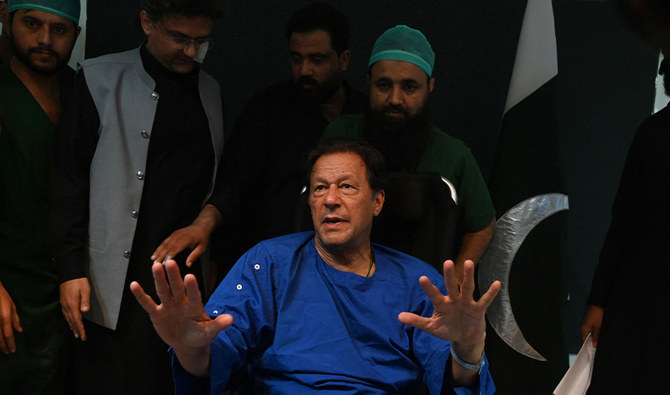

ISLAMABAD: Former prime minister Imran Khan’s party on Saturday questioned the military’s response to its allegations a major general was among officials who had plotted a gun attack on the ex-premier this week, questioning why individual officers were above criticism.
Khan was shot in the legs on Thursday as he led a protest caravan to the capital, Islamabad, from Lahore, aiming to force the government to call snap elections.
The ex-premier was removed from office in a no-trust vote by parliament in April. Since then, he has frequently criticized the army for not blocking his ouster, which he says was part of a United States-backed “foreign conspiracy.”
Washington, Khan’s opponents and the military deny the claim.
Since Thursday’s attack, Khan has held three officials responsible: Prime Minister Shehbaz Sharif, Interior Minister Rana Sanaullah and ISI director-general for counter intelligence, Major General Faisal Naseer.
On Friday night, the army released a strongly worded statement calling the accusations against Naseer “baseless and irresponsible.”
“No one will be allowed to defame the institution or its soldiers with impunity,” the media wing of the army said, adding that it had requested the Pakistan government “to investigate the matter and initiate legal action against those responsible for defamation and false accusations against the institution and its officials without any evidence whatsoever.”
Several senior leaders of Khan’s Tehreek-e-Insaf party responded to the army’s statement on Saturday, saying criticism of individual officers should not be equated with criticism of the military as an institution.
Close Khan aide and senior PTI leader Asad Umar questioned why officers had faced court martial trials in the past if no serviceman had ever committed wrongs.
“Even general officers have been court martialed in the past. If they do carry out acts which can be subject to court martial why cannot they be criticized as individuals,” Umar, himself the son of a military general, wrote on Twitter.
“Any attempt to equate criticism of individuals with criticism of the institution is rejected. The institution deserves love and respect based on the sacrifices made by its members to protect the nation. Each and every individual is not necessarily worthy of that love & respect.”
Speaking to international media on Friday night, Khan said Pakistan needed a strong army.
“However, when you remove entirely the element of criticism and say that someone is above the law, then no system can work like this,” the former PM told a group of foreign correspondents at Shaukat Khanum Memorial Hospital, where he is being treated for gunshot wounds.
PTI leader Omar Ayub Khan, the grandson of former military ruler Ayub Khan, also took to Twitter and called for accountability of officers crossing the “red line” of service rules.
“Imran Khan has directly mentioned Maj Gen Faisal as being involved. He should be removed & an impartial investigation conducted.”
Commenting on the fact that no FIR (police complaint) had as yet been filed in Thursday’s attack, Azhar Mashwani, Khan’s focal person on social media, said cases had been registered in the past against sitting and former prime ministers and questioned why a military general was above being named in an FIR.
“An FIR (first information report) can be registered against [ex-PM Zulfiqar Ali] Bhutto. An FIR can be lodged against Imran Khan under terrorism clauses,” Mashwani said, questioning why an FIR could not be registered against Maj Gen Naseer.
In a press talk on Friday, Information Minister Marriyum Aurangzeb called on Khan to abstain from hurling allegations at top officials without proof, and allow the police to lodge a first information report (FIR) in the case.
She alleged Khan’s party was pressurizing the police to ensure the registration of an FIR “as per Khan’s will.”
Pakistan’s powerful military has ruled the South Asian country for around half of its 75-year history and is often accused of engineering the ascent of political figures to power. The army denies it interferes in politics.
Khan was voted into power in 2018 by an electorate tired of corruption and dynastic politics, but his mishandling of the economy — and falling out with a military that many say helped him rise — sealed his fate in April.
Since then, Khan has rallied against the establishment and PM Sharif’s government. He has repeatedly told supporters he was prepared to die for the country, and aides have long warned of unspecified threats to his life.


