- Gun attack on Khan represents drastic escalation of power struggle between ex-PM and government
- Thursday’s assault, in which Khan was shot in the leg, has set off fresh round of violent street protests
ISLAMABAD: Pakistani political and security experts said on Friday negotiations between all stakeholders, namely former Prime Minister Imran Khan, the government of PM Shehbaz Sharif and the all-powerful army, were the way forward as political tensions swell in Pakistan following a gun attack on Thursday in which the ex-PM was wounded.
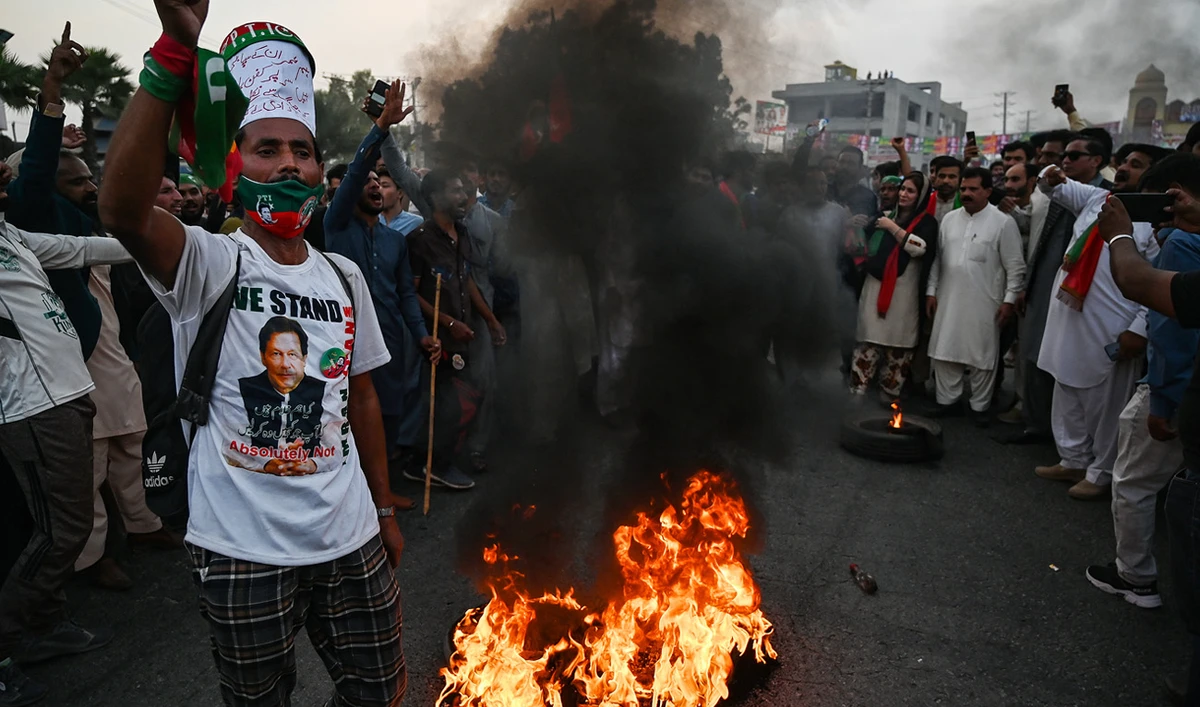
The assault represents a drastic escalation of the power struggle between Pakistan’s current government and its former leader and has set off a fresh round of public unrest and violent street protests.
The former premier was shot in the leg on Thursday as he led an anti-government march to Islamabad from Lahore, hoping to force the government of PM Shehbaz Sharif to announce snap elections.
The ex-premier, ousted in April in a parliamentary vote of no-confidence, has blamed his removal on a United States-backed plot and held rallies in the country since, calling for elections to be immediately announced. Polls are scheduled for late 2023.
“There needs to be, from the government, public, sustained and generous offers of engagement with Imran Khan, and openness to early elections,” political analyst Mosharraf Zaidi told Arab News.
The founder and CEO of Tabadlab, an Islamabad-based policy think-tank, said Pakistan needed “a clean, and uncontroversial change of leadership in the military with an announcement about the new leadership as soon as possible.”
He was referring to the appointment of a new army chief, as current chief General Qamar Javed Bajwa retires at the end of November. Khan has repeatedly said the unelected government of PM Sharif, cobbled together through a parliamentary vote after his ouster, does not have the right to appoint a new chief, and should wait for an elected government to make the crucial selection.
Zaidi also said Khan too needed to end his “protest mania,” which he said had held the country hostage for nearly six months:
“We should pray for better sense but prepare for more senseless brinksmanship.”
Former defense secretary Lt. Gen. (retired) Naeem Khalid Lodhi said all three stakeholders, the government, the opposition and the military, needed to sit together and “broker a peaceful solution in the best interest of the nation.”
“Imran Khan is not denying sitting with anyone for talks, rather he is saying he is only willing to talk on the date of elections, which in my opinion is not a very unconstitutional demand ... Otherwise, things are going to a very nasty side.”
Ahmed Bilal Mehboob, president of the Pakistan Institute of Legislative Development and Transparency, also supported negotiations and called on the army, which has ruled Pakistan for half of its 75-year history and is often accused of political engineering in the country, to remain “neutral” and follow the government’s lead.
“The best thing for the establishment is to not act at all and remain neutral as they already announced,” he said. “They should just follow the instructions of the government and play their role, if the government asks them to maintain law and order under constitutional provisions.”
Security expert Lt. Gen. (retired) Amjad Shoaib called on the government and the establishment to accept the “will of the people” — early elections — and adopt legal and constitutional ways to bring about change in a peaceful manner.
“The steps they are taking against the will of the people will not produce good results either for the government or the country,” he said, adding that “he only way forward is an election.”
“All stakeholders have to accept the ground realities,” he said. “It is a better way to adopt legal and constitutional ways to bring change in a peaceful manner instead of bloodshed.”
Dr. Huma Baqai, a political analyst, also called for “strategic restraint ” from all stakeholders.
“Everyone should take a step backward to reach some workable solution,” she told Arab News, lamenting that no side was showing the desired “flexibility.”
Ultimately, Baqai said, the solution was focused talks to decide on a date for an early election:
“The only solution is inching toward elections to come out of this crisis, otherwise things can go to some undemocratic interventions, which are not good for any party.”