



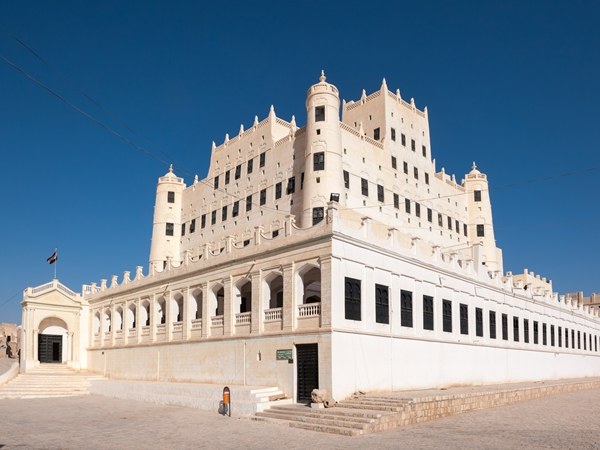

MAKKAH: Saudi Minister of Culture Prince Badr bin Farhan announced the restoration of the historic Seiyun Palace in Hadhramaut Governorate in Yemen.
The restoration project will be funded by the Saudi Development and Reconstruction Program for Yemen and implemented by UNESCO.
“This project represents our compliance to the directives of our country in support of Yemen,” stated Prince Badr.
Muammar Al-Eryani, Yemeni minister of information, culture and tourism, told Arab News: “The initiative conducted by Saudi Arabia, and their generous response to the Yemeni government’s request ... is an extension of the constructive role and the sincere and noble brotherly relationships between the Kingdom and Yemen. It is the translation of the generous directives issued by King Salman and Crown Prince Mohammed bin Salman towards supporting both Yemen and Yemenis at all levels.
“The historic Seiyun Palace in Hadhramaut was specific to the sultans of the Kathiri state that ruled the Hadhramaut valley. Sultan Badr Abu Tuwaireq resided in the palace in 992 H (1584 A.D.) after he restored it and built a mosque right next to it. Ever since, Seiyun has become the capital of the Kathiri state as well as Hadhramaut valley,” he added.
According to Al-Eryani, Seiyun Palace is a prominent historical monument in Yemen — one of the largest and rarest mud-brick palaces in the world.
“This palace is characterized by its beauty, symmetry, and large size, as it consists of seven floors and comprises 45 rooms in addition to several outbuildings and stores. In 1984, a museum was inaugurated in the palace, comprising various artifacts collected after the conduction of scientific-related excavation missions, namely the Yemeni-Soviet mission,” he said.
Al-Eryani highlighted that the artifacts date back to prehistoric eras, the oldest around 1.3 million years old. He noted that the government selected Seiyun Palace to be the new image on Yemen’s 1,000 riyal banknote, being one of the most prominent monuments in the country.
He also stated that many archaeological sites and historical monuments in Yemen were exposed to natural and unnatural dangers, which arose from the civil war triggered by the Iran-backed Houthi militia.
“The Houthis transformed the buildings, as well as the archaeological and historical sites, into military sites and weapon stores to manage their battles against the state of Yemen, the Yemenis, their history, and their identity,” Al-Eryani said.
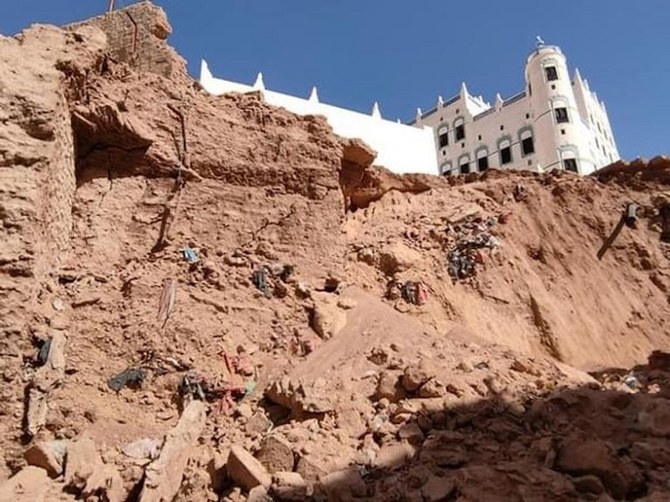
He added that the signing of the Seiyun Palace’s restoration agreement comes at a very sensitive time, as one of the palace’s walls had recently collapsed due to heavy rains in Seiyun. “The restoration of the palace will contribute to the minimization of the damage extent that took place in the last period. It will also strengthen the existing weaknesses and increase the palace’s resistance and endurance capacities,” he said.
Dr. Mohammed Balafir, a university professor of Islamic history and Islamic civilization at the Faculty of Arts at the University of Aden, told Arab News: “The Kingdom of Saudi Arabia has always been distinguished by its balanced policies and flexible relations with all countries, namely the Arab surrounding countries, particularly the southern strategic depth of Yemen.”
He added: “The initiative was conducted right on time, as it is considered an extension of the efforts exerted by UNESCO, which announced its global campaign to preserve the city of Shibam and the ruins of Hadhramaut valley by including them in the World Heritage List.”
Dr. Mohammed Mansour Ali Belaid, professor of Islamic history and civilization at Abyan University in Yemen, said: “Many parts of the palace were subject to systematic destruction and encroachment for the past short period.
“Our people admire the historical and cultural efforts exerted by the Kingdom,” he added.
Saudi Ambassador to Yemen Mohammed bin Saeed Al-Jaber said: “It is well known that culture is important for any sort of sustainable development. Therefore, the Seiyun Palace restoration project, funded by the SDRPY in partnership with UNESCO, is of great importance. In fact, the project falls within the scope of work of the SDRPY, which is conducting projects as well as sustainable and qualitative development initiatives in various sectors.”
Al-Jaber, who is also the supervisor general of the SDRPY, added that the Kingdom is keen to preserve the heritage of Yemen.
“The initiative will enable the effective development of the country and lead to positive results by enhancing the economic benefits in the governorates through providing job opportunities, training manpower, and providing Yemeni institutions with … expertise,” he said.


