

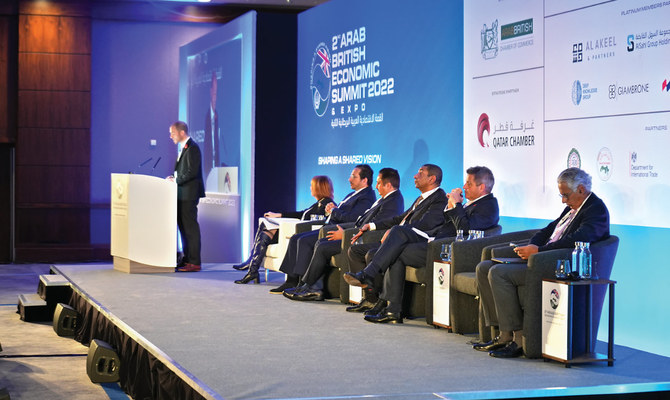

LONDON: The long-standing relationship between the UK and the Arab world will continue irrespective of the issues of the day, which include the coronavirus pandemic, Brexit and the global economy, a senior British government official has said.
“The Gulf total trade both ways, just prior to COVID-19, was £44 billion ($50.4 billion). It fell nearly 30 percent during the pandemic but, I’m delighted to say actually, that the most recent numbers show that the trade between the UK and the Arab countries has actually returned to almost exactly the same number it was before,” Simon Penney, UK trade commissioner for the Middle East, told Arab News.
“So you’ll see that we’ll have these cyclical events, but I think what it demonstrates is the underlying strength and depth of the trading relationship, which has huge potential to grow much, much further, and a free trade agreement will obviously be one part of enabling that further growth.”
His comments came during the second Arab-British Economic Summit, organized by the UK-based Arab-British Chamber of Commerce in London, and attended by around 750 senior government and private sector officials.
Penney added: “One of the really big differences for me, or accomplishments, is when I was here in 2019 we said that we wanted to do a free trade agreement with the GCC (Gulf Cooperation Council).
“Standing here today in 2022, I’m delighted to say that we’ve now officially launched negotiations for a free trade agreement, we’ve spearheaded toward Brexit and we’ve passed a negotiation stage toward exiting the European Union.
“Brexit and the pandemic basically have created new opportunities between the Arab world and the UK. It opened the gap for countries to be replaced as new trade partners with the UK.
“In terms of COVID-19, the UK was one of the key players, providing food and medical supplies to the Arab world, and especially the GCC countries.”
Sheikh Khalifa bin Jassim, chairman of the Qatar Chamber of Commerce and Industry, said the Gulf countries have special relations with the UK in various fields, especially regarding trade and the economy, and the GCC nations are considered the seventh largest market for UK exports, the total volume of trade exchange between them amounting to more than £33 billion in the last year.
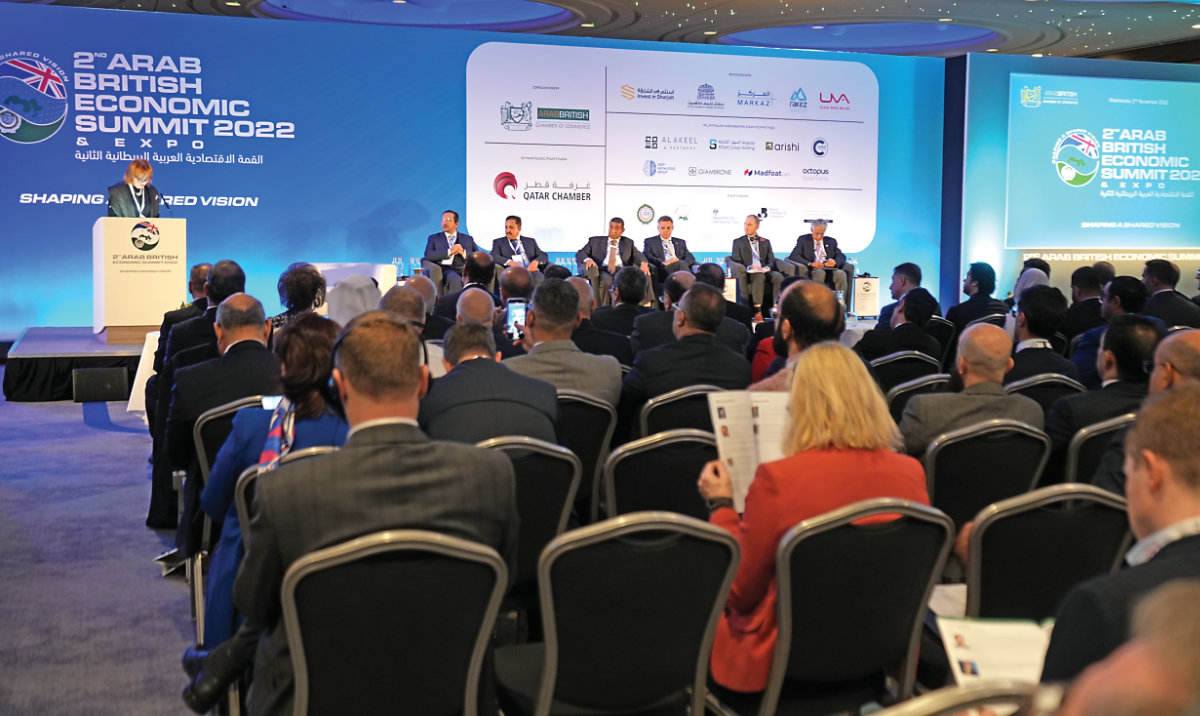
The London Chamber of Commerce and Industry seeks to look at opportunities for investment, business growth and development in the Arab world. (Supplied)
He said: “While we welcome the free trade negotiations between the United Kingdom and the Gulf Cooperation Council, which began a few months ago and comes in the wake of the British exit from the European Union, we hope that an agreement will be reached soon, as the signing of a free trade agreement is expected to lead to the two parties increasing the volume of intra-regional trade to higher levels, in addition to providing more investment opportunities between both parties.”
Chief Executive of the London Chamber of Commerce and Industry Richard Burge said that London, as a global city, was “particularly interested in a post-pandemic world of learning, joining together and pulling together the lessons both the Arab world and London have learned during that period.”
He added that London could look at new ventures and opportunities for investment, business growth and development in the Arab world.
Regarding its relationship with Saudi Arabia, Burge said the LCCI was looking for long-term partnerships and warned that “the danger at the moment, particularly with exciting projects like Neom, is everyone is in a rush at trying to do something that starts to yield fruit this year or next year.”
He added that he believes the focus should be on the next decade and the one after that.
Sameer Nass, president of the Union of Arab Chambers, said countries like Saudi Arabia, the UAE and Egypt are looking to become hubs in specific fields and will enhance the economies of Arab countries for the next 20 years.
“Saudi Arabia is taking a quantum leap in renewable energy, we are seeing a huge transformation, and are looking at harnessing energy production,” he said, adding that the same applied to Jordan, which is leading the way in solar energy production, and Morocco.
“I think it (Saudi Arabia) is just going to be an economy to be reckoned with in the world, and I’m very confident the way they are moving and I think it will be very hard to catch up with them, but I believe that the Arab countries should complement each other.
“My ambition and my wish is to create an Arab-Arab trade, to increase the trade between Arab countries, as well as investments with each other.”
Bandar Reda, secretary-general and CEO of ABCC, said the whole idea of the first and second summits was to bring both regions together.
He said: “The Arabs and the UK, especially now the UK, has been going through a tough time with Brexit and so many other turnarounds, and the world economy is getting affected.”
Reda added he believes the UK is looking for new partners with which to engage, and that “the 22 Arab countries are the best partners from our perspective for the UK.”


