
JEDDAH: Arab leaders on Wednesday called for unity in defense of the Palestinian cause and the protection of Jerusalem.
The Arab League summit in Algiers concluded with a pledge of continued Arab support for Palestine, and condemnation of Israel’s use of violence and its blockade of Gaza.
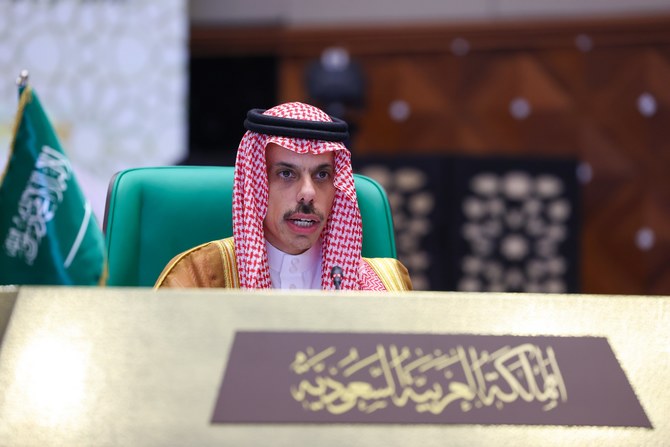
Calls for unity were led by the Saudi Foreign Minister, Prince Faisal bin Farhan. “We must intensify coordination and consultation and reject our internal differences and prioritize our common interests,” Prince Faisal said.
“We stress the importance of continuous coordination among our Arab countries to enhance our national and regional security and renew our total rejection and response to the approach of expansion and domination at the expense of others.
“We will not allow others to impose their values on us, and since we respect the values and cultures of others, we hope others will respect that.”
Deputizing for King Salman, Prince Faisal said that the Palestinian cause will always remain at the center of the Arab nation’s concerns, until the establishment of an independent and sovereign state along June 1967 lines, with East Jerusalem as its capital, the Saudi Press Agency reported.
He added: “The Kingdom welcomes the results of the meetings hosted by Algeria as part of the reconciliation efforts between the Palestinian factions, and hopes that these efforts will lead to the unity of the Palestinian ranks.”
Prince Faisal addressed food security, saying that global crises highlighted the importance of economic integration among Arab countries, stressing that Saudi Arabia always attempts to create favorable conditions for this to occur.
He added that the country values collective Arab action, utilizing the potential of natural resources in oceans, investing in human resources, promoting biological and food diversity, and meeting the needs of food markets.
The foreign minister added that in line with Vision 2030, the Kingdom seeks to advance in various fields, in collaboration with its Arab brothers, and in a way that contributes to confronting challenges that directly affect its citizens.
Prince Faisal said that the Kingdom continues to support efforts to achieve peace in Yemen, and that it has made every effort to support the UN envoy's proposal to extend the armistice there.
While highlighting the rejection of the Houthis to the proposal, he emphasized the importance of the international community maintaining political pressure on them.
He went on to say that achieving long-term peace in Yemen should be based on the Gulf initiative and its implementation mechanism, as well as the outcomes of the comprehensive Yemeni national dialogue and relevant UN Security Council resolutions.
He also stressed the importance of providing necessary support to Yemen’s Presidential Leadership Council, noting Saudi Arabia’s humanitarian, relief, and development assistance to Yemen.
Prince Faisal welcomed the formation of the new Iraqi government and wished it success.
He reaffirmed the Kingdom’s commitment to assisting the country in achieving security, stability and future development, while in the process deepening bilateral cooperation in a variety of fields.
The foreign minister also said Lebanon’s sovereignty, security and stability are critical to the Kingdom, and that Saudi Arabia was looking forward to the election of a president who can unite the Lebanese people and work to resolve the current crisis.
Regarding Libya, he said his country’s position was that the solution to its conflict must be found away from external interference.
Prince Faisal said that the Kingdom supports all Arab and international efforts to find a political solution to Syria’s crisis which preserves its identity, unity, sovereignty and territorial integrity.
He also expressed support for Sudan, noting that the Kingdom provides significant humanitarian assistance there.
The foreign minister concluded by expressing Saudi Arabia’s hope that the summit’s outcomes will contribute to the Arab world’s prioritized issues.