North Korea warns US of ‘powerful’ response to allied drills

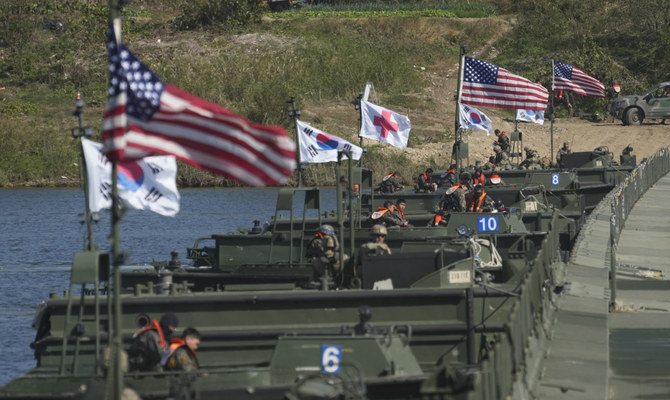
Flags of South Korea and the United States flutter before a joint river-crossing drill between South Korea and the United States in Yeoju, South Korea on Oct. 19, 2022. (AP/File)
Short Url
Updated 01 November 2022
Follow

North Korea warns US of ‘powerful’ response to allied drills

  • North Korea has ramped up its weapons demonstrations to a record place this year, launching more than 40 ballistic missiles

SEOUL, South Korea: North Korea’s Foreign Ministry criticized the United States for expanding joint military exercises with South Korea that it claims are practice for a potential invasion, and it warned Tuesday of “more powerful follow-up measures” in response.
The statement from the ministry came as the US and South Korea conduct aerial drills involving more than 200 warplanes, including their advanced F-35 fighter jets, as they step up their defense posture in the face of North Korea’s increased weapons testing and growing nuclear threat.
North Korea has ramped up its weapons demonstrations to a record place this year, launching more than 40 ballistic missiles, including developmental intercontinental ballistic missiles and an intermediate-range missile fired over Japan. The North has punctuated those tests with an escalatory nuclear doctrine that authorizes preemptive nuclear attacks in loosely defined crisis situations.
The US and South Korea have resumed large-scale military drills this year after downsizing or suspending them in past years as part of efforts to create diplomatic space with Pyongyang and because of the pandemic.
The United States and South Korea’s “Vigilant Storm” air force drills, which are to continue through Friday, came after South Korea completed its annual 12-day “Hoguk” field exercises that officials say also involved an unspecified number of American troops.
North Korea’s latest statement came just days after the country fired two short-range ballistic missiles into the sea, extending a barrage of launches since late September. Some of those launches have been described by the North as simulated nuclear attacks on South Korean and US targets.
North Korea has said its testing activities are meant as a warning amid the joint military drills. But some experts say Pyongyang has also used the drills as a chance to test new weapons systems, boost its nuclear capability and increase its leverage in future dealings with Washington and Seoul.
In comments attributed to an unidentified spokesperson, the North Korean Foreign Ministry statement said the military drills exposed the United States as the “chief culprit in destroying peace and security.” It said the North was ready to take “all necessary measures” to defend against outside military threats.
“If the US continuously persists in the grave military provocations, the DPRK will take into account more powerful follow-up measures,” the spokesperson said, using North Korea’s formal name, the Democratic People’s Republic of Korea. The statement did not specify what those measures could be.
South Korean officials have said North Korea could up the ante in coming weeks by detonating its first nuclear test device since September 2017, which could possibly take the country a step closer to its goals of building a full-fledged nuclear arsenal capable of threatening regional US allies and the American mainland.
In recent weeks, North Korea has also fired hundreds of shells in inter-Korean maritime buffer zones that the two Koreas established in 2018 to reduce frontline military tensions. North Korea has said that firing was in reaction to South Korean live-fire exercises at land border areas. The rival Koreas exchanged warning shots Oct. 24 along their disputed western sea boundary, a scene of past bloodshed and naval battles, as they accused each other of violating the boundary.


UK pays Guantanamo detainee ‘substantial’ compensation over US torture questions

Updated 5 sec ago
Follow

UK pays Guantanamo detainee ‘substantial’ compensation over US torture questions

  • Abu Zubaydah has been held at Guantanamo Bay without charge for 20 years
  • British security services knew he was subjected to ‘enhanced interrogation’ but failed to raise concerns for 4 years

LONDON: A Saudi-born Palestinian being held without trial by the US has received a “substantial” compensation payment from the UK government, the BBC reported.

Abu Zubaydah has been imprisoned at Guantanamo Bay in Cuba for almost 20 years following his capture in Pakistan in 2002, and was subjected to “enhanced interrogation” techniques by the CIA.

He was accused of being a senior member of Al-Qaeda in the aftermath of the Sept. 11 terror attacks on the US. The allegations were later dropped but he remains in detention.

The compensation follows revelations that UK security services submitted questions to the US to be put to Abu Zubaydah by their US counterparts despite knowledge of his mistreatment.

He alleged that MI5 and MI6 had been “complicit” in torture, leading to a legal case and the subsequent compensation.

Dominic Grieve, the UK’s former attorney general, chaired a panel reviewing Abu Zubaydah’s case.

He described the compensation as “very unusual” but said the treatment of Abu Zubaydah had been “plainly” wrong, the BBC reported.

Grieve added that the security services had evidence that the “Americans were behaving in a way that should have given us cause for real concern,” and that “we (UK authorities) should have raised it with the US and, if necessary, closed down co-operation, but we failed to do that for a considerable period of time.”

Abu Zubaydah’s international legal counsel, Prof. Helen Duffy, said: “The compensation is important, it’s significant, but it’s insufficient.”

She added that more needs to be done to secure his release, stating: “These violations of his rights are not historic, they are ongoing.”

Duffy said Abu Zubaydah would continue to fight for his freedom, adding: “I am hopeful that the payment of the substantial sums will enable him to do that and to support himself when he’s in the outside world.”

He is one of 15 people still being held at Guantanamo, many without charge. Following his initial detention, he arrived at the prison camp having been the first person to be taken to a so-called CIA “black site.”

He spent time at six such locations, including in Lithuania and Poland, outside of US legal jurisdiction. 

Internal MI6 messages revealed that the “enhanced interrogation” techniques he was subjected to would have “broken” the resolve of an estimated 98 percent of US special forces members had they been subjected to them.

CIA officers later decided he would be permanently cut off from the outside world, with then-President George W. Bush publicly saying Abu Zubaydah had been “plotting and planning murder.”

However, the US has since withdrawn the allegations and no longer says he was a member of Al-Qaeda.

A report by the US Senate Select Committee on Intelligence said Abu Zubaydah had been waterboarded at least 83 times, was locked in a coffin-like box for extended periods, and had been regularly assaulted. Much of his treatment would be considered torture under UK law.

Despite knowledge of his treatment, it was four years before British security services raised concerns with their American counterparts, and their submission of questions within that period had “created a market” for the torture of detainees, Duffy said.

A 2018 report by the UK Parliament’s Intelligence and Security Committee was deeply critical of the behavior of MI5 and MI6 in relation to Abu Zubaydah. 

It also criticized conduct relating to Guantanamo detainee Khalid Sheikh Mohammed, widely regarded as a key architect of the Sept. 11 attacks, warning that the precedent set by Abu Zubaydah’s legal action could be used by Mohammed to bring a separate case against the UK.

MI5 and MI6 failed to comment on Abu Zubaydah’s case. Neither the UK government nor Mohammed’s legal team would comment on a possible case over his treatment.