

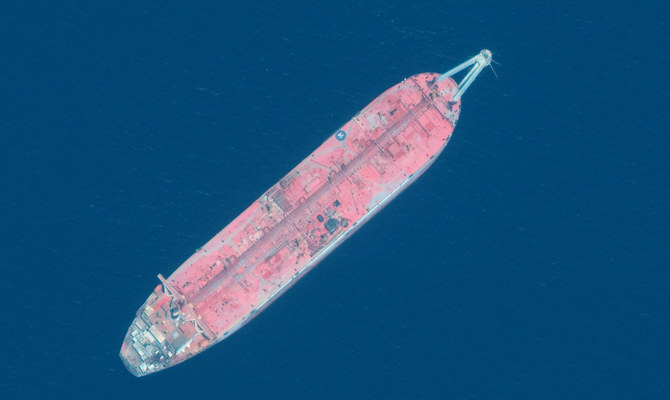

AL-MUKALLA: The UN has begun phase one of an emergency plan to rescue a deteriorating oil tanker near Yemen’s western city of Hodeidah after obtaining funding from donors, a UN official told Arab News, boosting hopes of defusing the country’s “ticking time bomb.”
Russell Geekie, communication officer for UN Humanitarian Coordinator David Gressly, said that the UN is in negotiations with a company to rescue the tanker as well as secure a vessel to offload the oil, and that a team is working on drafting a rescue strategy.
“Preparatory work for the operation has already begun, including the processes to contract the salvage company and procure the vessel that will hold the oil,” Geekie said.
“Completion of a detailed operational plan and procurement of the vessel are the two major steps ahead of the work on the water,” he added.
The UN “will be able to provide a timetable for the work upon completion of the detailed operational plan,” Geekie said.
“We expect the salvage company will send a team to Yemen in November to finalize the detailed plan.”
The 45-year-old floating FSO Safer tanker, carrying more than 1 million barrels of crude oil, has been deprived of crucial routine maintenance since the Houthis forcefully took control of much of Yemen in late 2014, triggering a civil war.
The FSO Safer has drawn concern from around the world over the past three years since seawater began seeping into the tanker’s chambers due to corrosion.
International and local environmentalists have warned that if the ship exploded or sunk, it would cause a severe environmental disaster in the Red Sea that would be worse than the Exxon Valdez oil spill in Alaska in 1989.
Geekie said that even if the UN mission begins repair work on the ship by the end of 2022, oil may not be transferred off the corroding tanker until next year.
“We are still hopeful that the work on the water can begin before the end of the year (contingent upon procurement of a suitable vessel), but the transfer of the oil would most likely be next year,” he added.
On Oct. 21, the Houthis demanded that the UN submit an operational plan for approval before commencing operations on the sea, accusing the organization of causing delays in carrying out the emergency strategy to repair the tanker.
Despite criticism of the UN mission, the Houthis voiced approval for the idea, according to Geekie.
“They have expressed that they are eager to receive a detailed operational plan, which is a critical step ahead of the start of the operation.”
With reference to the Houthi last-minute backtracking on a commitment to grant the UN access to the ship, the Yemeni government accused the militia of using the crisis as a negotiating weapon.
The UN raised $75 million through a crowdfunding campaign that started in June for phase one of the strategy, which includes draining the oil from the tanker.


