



QAMISHLI, Syria: For thousands of years, the land between the Euphrates and Tigris Rivers has seen dozens of civilizations rise and fall — civilizations that depended on the rivers and the surrounding lush geography to sustain themselves.
But now, after a decade of conflict and drought, the land between the rivers, and more specifically, Syria’s northeast, is a shell of what it once was.
The great rivers and their tributaries, once flowing strong with clear water, have dried to a trickle and are full of garbage and sewage. The rich soil that once nourished all kinds of trees has dried up, and its forests are gone along with it.
Not all hope is lost, however. Small groups of environmentalists and volunteers refuse to remain helpless in the face of the crisis, and are striving to make northeast Syria green again.
To plant four million trees in a country threatened by climate change, desertification and war may seem a daunting task, but it is one that the local Green Tress ecological initiative has taken on.

“We are in one of the most dangerous countries in the world, but that doesn’t mean that we can’t do anything, or that we are a helpless society. We can create initiatives and take responsibility in our society,” Ziwar Sheikho, the administrator of Green Tress, told Arab News at the initiative’s nursery in the city of Qamishli.
“Pollution has the potential to kill more people than bullets,” Sheikho said, stooping down to check if any of the thousands of seeds he had planted had begun to germinate. “Everyone understands that the loss of the environment is the loss of humanity.”
The local initiative began in 2020, after the municipality of Tel Kocher built a series of cement palm trees along the town’s main road. Sheikho wrote a letter to the municipality and the local ecology board criticizing the construction and urging the town to adopt a more eco-friendly approach. Eventually the fake trees were removed and replaced with real ones.
Not satisfied with one small victory, Sheikho knew that he had to do more. Sheikho, a journalist by trade, along with a local writer and a cinematographer, began to consider how to make their homeland a more environmentally responsible place.
In addition to the planting of four million trees, Green Tress also aims to bring the percentage of green areas in Syria’s north and east to 18. Many of the once-lush forests along the border in the north were destroyed during the crisis, when desperate locals were forced to cut trees to use for firewood as fuel sources ran out.
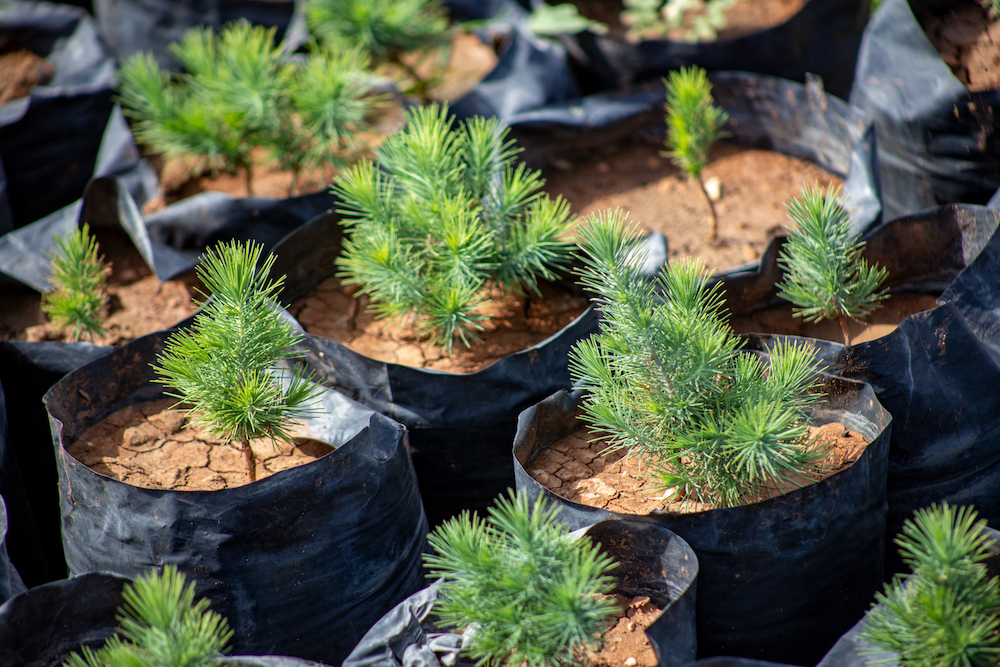
A pine seedling blooms at the Green Tress nursery in Qamishli, Syria. (AN Photo/Ali Ali)
According to the US-based online monitoring tool Global Forest Watch, Syria has lost more than 26,000 hectares of tree cover since 2001.
The initiative has met with many challenges, chief among them being a lack of support. “We are all volunteers. The land that we are using now was donated to us. Our water tanker was donated to us. Because we are an independent organization, and not tied to any government, we have to get all of our tools from donors,” Sheikho said.
Saudi Vision 2030, announced by Crown Prince Mohammed bin Salman in 2016, has been a major source of inspiration for Green Tress, Sheikho said. The Saudi Green Initiative, which was launched in 2021 in line with Vision 2030’s goals, has committed to the rehabilitation of 40 million hectares of land and has already planted 8.4 million trees in the Kingdom.
“We have seen that many developments in the Middle East have proved destructive for the environment. For example, because of the 23 dams that Turkey built on the Euphrates, 178 rivers, streams and springs that were previously in (northern Syria) have dried up. The Tigris and Euphrates are in a bad state because of this.
“Saudi Vision 2030, and the Saudi Green Initiative, changed our opinion. It gave us a lot of hope. It aims to plant billions of trees in the Middle East. We launched our initiative at the same time that this was announced. We hope that it will spread to many other countries,” he said.
Saudi Arabia’s ambitions have of course expanded beyond its own borders in the form of the Middle East Green Initiative, which aims to plant 50 billion trees across the region among other climate-change-mitigation initiatives.
For its part, Green Tress has thought beyond the simple planting of trees. The initiative holds workshops in northeast Syria’s villages to teach locals the fundamentals of composting in order to reduce reliance on harmful chemical fertilizers, which the agricultural department says is among the main causes of desertification.
INNUMBERS
- 59 percent - Syrian land threatened by desertification.
- 26,000 hectares - Syrian forests lost since 2001.
- 34 million cubic meters - Groundwater pumped out by Syrians annually.
During the time in which the Syrian regime controlled the northeast, it designated these regions as agricultural areas, particularly for the production of cotton as well as wheat and other cereals. Decades of repeated production of grains have left much of the rich soil between the Tigris and Euphrates vulnerable to desertification.
Overcultivation of the same crop coupled with water shortages leads to desertification in windy areas such as Syria’s northeast, according to the UN’s Food and Agriculture Organization. FAO’s 2022 report says Syrian wheat production this year was down to one million tons, or 75 percent less than pre-war levels, due to heavy reliance on rain-fed agriculture after the collapse of irrigation systems and repeated water cutoffs and shortages.
According to the Agricultural Department of the Autonomous Administration of North and East Syria (AANES), studies have shown that desertification threatens at least 59 percent of the country’s agricultural land.
Water erosion due to excessive logging of trees, wind erosion owing to lack of vegetative cover, and a rise in salinity of ground water due to a lack of effective drainage systems have all contributed to rapid desertification, an agricultural department spokesman told Arab News.
In the wake of these policies, AANES, which was established as an autonomous zone in Syria’s north and east separate from both the regime and the opposition, created an ecology board to try and rectify the damage done by years of war and mismanagement.
“The work we are doing is not just for this region, but the whole world. Our aim is the protection of the planet,” Berivan Omer, vice co-chair of the ecology board of AANES’ Jazira region, told Arab News.
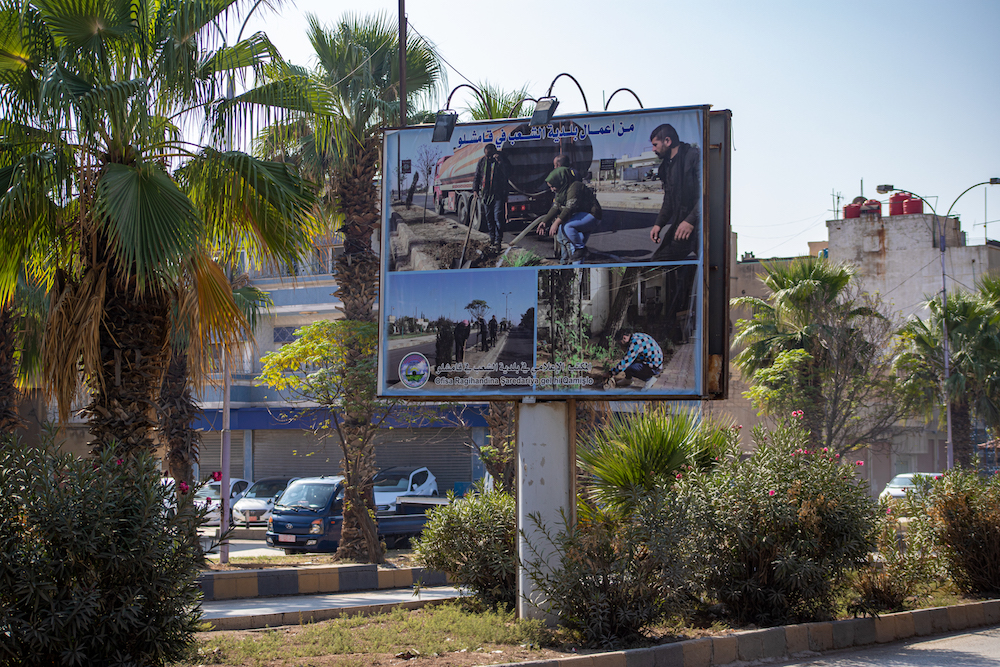
A sign showing environmental initiatives carried out with the help of the Qamishli People's Municipality. (AN Photo/Ali Ali)
The ecology board has successfully lobbied for the implementation of two laws in the past year — the cleanliness law, and the environmental protection law. The hygiene law prohibits throwing waste in non-designated areas at non-designated times, littering, and dumping waste into rivers, streams and springs.
It also forbids industrial facilities from dumping their waste in random locations, and punishes those who cut down trees in public or private gardens without proper permissions with a fine of up to 250,000 Syrian pounds (about $45).
The Jaghjagh River, a tributary of the Euphrates, was once clear and flowed swiftly through the city of Qamishli. Now, it is full of waste and garbage, its overpowering stench wafting over several city blocks. Low water levels in all of Syria’s rivers and streams has contributed to the spread of diseases such as leishmaniasis and even cholera, which has recently made a comeback in the country and has infected more than 15,000.
Though the local municipality, ecology board and volunteers have carried out several cleaning operations over the past few years, the river invariably returns to its former state after a short time.
Many things are out of the local administration’s control, says Omer. Houses which dump their waste directly into the river were built on its banks decades ago, and short of evicting the residents, there seem to be no easy solutions.
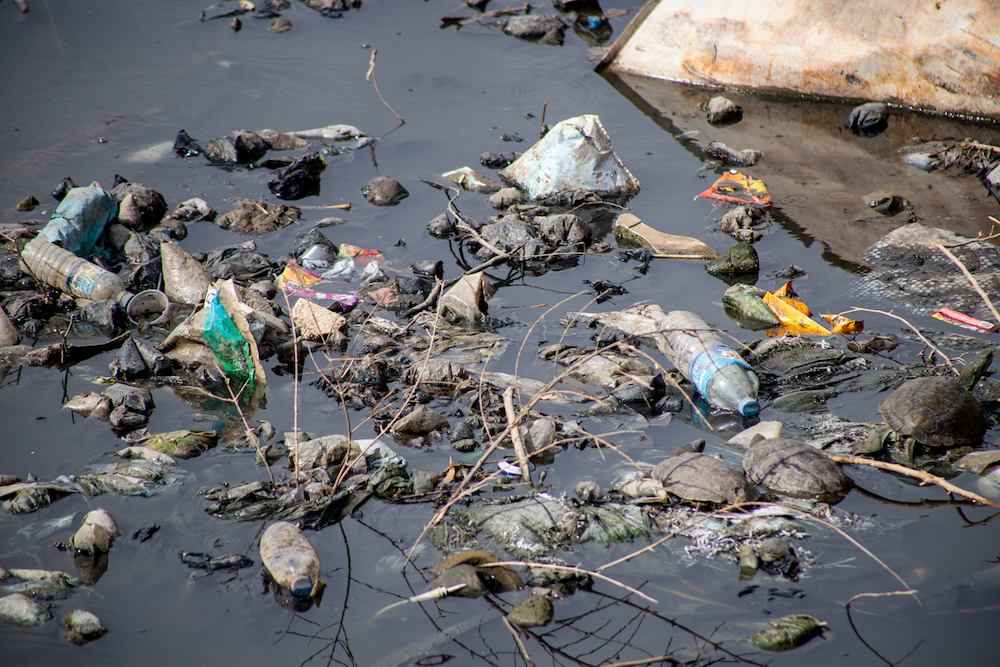
Household waste clogs the Jaghjagh River in Syria's Qamishli. (AN Photo/Ali Ali)
“For the river, we are now researching. We will carry out six months of research to figure out how to clean it properly,” he told Arab News. ” We will try and see if the problem can be solved with simple cleaning or if we need to divert the entire sewer system.”
Other environmental problems abound in the region: A lack of advanced petroleum refineries has led to the use of primitive burners to produce fuel. The gaseous and liquid waste from the fuel-making process ends up in the air, water and soil, which has caused increased respiratory illnesses and cases of cancer across the Jazira region, where more than 200 of these burners operate.
Though the ecological board has attempted to promote the use of alternative energy sources such as solar power, the materials available to them are expensive and of poor quality. With the main power grid left working below capacity since the beginning of the war, the majority of northeast Syria relies on neighborhood generators, which are loud and produce toxic fumes.
Both Omer and Sheikho believe the most important change lies with the mentality of the community.
“People here say, ‘if I clean my surroundings, I will only clean my home. Everything else is the responsibility of the state or the municipality,’” Omer said.
Sheikho explained that Green Tress held meetings with the Democratic Islam Community, a council of local Muslim religious officials, to ask them to include lessons about the benefit of environmental protection in their sermons.
The ecology board has also held workshops among local village councils to teach people how to separate their waste for recycling.
“We must start at the household level. It takes a lot of money, work and special tools to separate waste for recycling. But if it starts in the home, it will be much easier,” Omer said.
“People used to live as a part of nature, but now, they are separate from it. They see themselves as the center of nature instead of as just a component. As humans on this planet, we can live in harmony with all living things.”


