Environmentalists warn of long-term impacts from Bangladesh depot fire

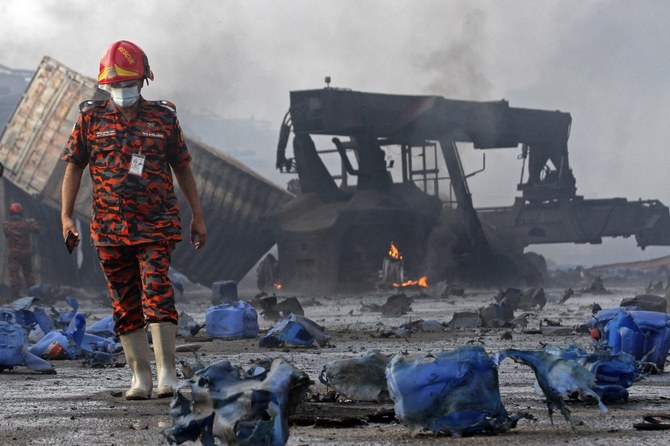
Fire that broke out on June 4 and took three days to douse was one of the country’s worst industrial disasters in years. (Supplied)
Short Url
Updated 15 June 2022
Follow

Environmentalists warn of long-term impacts from Bangladesh depot fire

  • More than 40 people were killed in blaze and explosions at cargo depot near Chittagong port
  • Increased air pollution has already been observed in area

DHAKA: As Bangladeshi authorities investigate the causes of a deadly cargo depot fire that shook the country earlier this month, scientists have warned that the disaster will have a longer-term impact on the environment and health of local communities.  

More than 40 people were killed and 200 injured — mostly port workers and firefighters — in the fire and subsequent explosions at the depot in Sitakunda, near the southeastern port of Chittagong, which handles most of the country’s garment exports.

The fire that broke out on June 4 and took three days to douse was one of the country’s worst industrial disasters in years.

Authorities have not determined the exact cause of the fire but said that leakage from a container of hydrogen peroxide was likely the source of the initial blaze. An official report is expected to be released this month.

Environmental assessment may take longer. The testing of samples from the area is underway, but Prof. Mohammad Aftab Ali Sheikh, chairman of the Bangladesh Council of Scientific and Industrial Research, said that it was already clear that the region will be affected, especially its soil and water bodies.


“Definitely the explosion and fire have some subsequent impacts on the environment in that area. The soil of that area will be contaminated through the water mixed with different chemicals. A portion of chemical-mixed water has flown to water bodies, which will create some hazards. In addition, that area witnessed some rainfall also which carried this chemical-mixed water to the rivers,” he told Arab News on Wednesday.

Air pollution resulting from the fire may reach places hundreds of kilometers away. “The gas generated from the explosions and burning had spread over in the air. This air might have flown over the adjunct districts,” Sheikh said. “It might even travel to Dhaka.”

In the depot area, increased air pollution has already been observed.

“We have noticed increased dust particles in the air of the Sitakundu area,” Mofidul Alam, director of Chittagong Division Department of Environment, said. “This dust will have some negative impact on the trees, plants and biodiversity of this area.”

The disaster reflected the haphazard safety standards that continue to affect Bangladesh. The country already has a devastating track record of industrial accidents, including factories catching fire with workers trapped inside.

Its deadliest fire was in 2012, when a blaze swept through a garment factory in Dhaka, killing 112 workers. Last year, a huge blaze engulfed a food and beverage factory, also in the capital, killing at least 52 people.

The fire department told Arab News last week that from initial observations, it appeared that safety guidelines and precautions were likely ignored at the depot.

Mohammad Manikuzzaman, assistant director at Bangladesh Fire Service and Civil Defense, said that authorities had “only noticed a few fire extinguishers inside the depot” and nothing else related to fire preparedness.

But it was not only the preventive measures that were lacking.

Environmental scientist Sharif Jamil, who serves as secretary general of Bangladesh Poribesh Andolon, a civic movement to protect the country’s environment, said that there should be special zones for handling any type of chemicals, but that such standard practices have been ignored — and not only at the cargo depot.

“These types of explosions are not only causing deaths of human beings. The aftermath of these accidents have a long-term effect on air, soil and water,” he told Arab News.

“We need to prepare some particular zones to handle sensitive chemicals with proper preparedness and monitoring by the management. Otherwise, these types of incidents would take place again and again.”


Airspace closed, flights canceled as US-Iran conflict flares

Updated 01 March 2026
Follow

Airspace closed, flights canceled as US-Iran conflict flares

  • Major carriers from the Middle East, Europe, Asia-Pacific and the US announced widespread cancelations
  • FlightAware said more than 19,000 flights had been delayed globally and more than 2,600 were canceled as of Sunday

PARIS: Thousands of flights have been delayed or canceled in the biggest disruption to global air transport since the Covid pandemic as airlines suspend services to the Middle East following the US and Israeli attacks on Iran.
Iran, Iraq, Israel, Syria, Kuwait and the United Arab Emirates all announced at least partial closures of their skies after Saturday’s strikes and Iran launching missiles at capital cities around the wealthy Gulf region.
Major carriers from the Middle East, Europe, Asia-Pacific and the United States announced widespread cancelations, leaving thousands of passengers stranded.
Notable airlines that canceled services included Emirates, Etihad, Air France, British Airways, Air India, Turkish Airlines, and Lufthansa.
According to aviation analytics company Cirium, of around 4,218 flights scheduled to land in Middle Eastern countries on Saturday, 966 (22.9 percent) were canceled, with the figure rising above 1,800 if also including outbound flights.
For Sunday, 716 flights out of 4,329 scheduled to the Middle East have been canceled, Cirium said.
Flight tracking website FlightAware meanwhile said more than 19,000 flights had been delayed globally and more than 2,600 were canceled as of 0230 GMT Sunday.
Airspace closures
Iran swiftly closed its airspace as the strikes began “until further notice,” said the spokesman of Iran’s Civil Aviation Organization, quoted by the Tasnim news agency.
Israel also closed its airspace to civilian flights, Transport Minister Miri Regev announced.
Qatar’s civil aviation authority said it had temporarily closed the Gulf state’s airspace.
Iraq shut down airspace, state media said.
The United Arab Emirates said it was closing its skies “partially and temporarily.”
Syria closed part of its airspace in the south along the border with Israel for 12 hours, the Civil Aviation Authority said.
Jordan’s air force was conducting drills to “defend the kingdom’s skies,” its military said.
Kuwait closed its airspace.
Middle East and North Africa airlines
Gulf carriers Emirates and Etihad canceled 38 percent and 30 percent of their flights respectively, Cirium said.
Qatar Airways suspended all flights from Doha. It canceled 41 percent of total flights, according to Cirium.
Syria Air, the country’s national carrier, canceled all flights until further notice.
Egypt’s national airline, EgyptAir, announced the suspension of its flights to cities across the Middle East, including Dubai, Doha, Manama, Abu Dhabi, Beirut and Baghdad among others.
European airlines
Russia’s air transport authority Rosaviatsia said all commercial flights to Israel and Iran were canceled “until further notice.”
Turkish Airlines canceled flights to Lebanon, Syria, Iraq, Iran, and Jordan until March 2.
Air France canceled its Dubai, Riyadh and Beirut flights for Saturday, and flights to Tel Aviv until Sunday.
British Airways said it was not flying to Tel Aviv and Bahrain until March 4, and canceled flights to the Jordanian capital Amman on Saturday.
Swiss International Air Lines suspended flights to and from Tel Aviv until March 7, and canceled flights from Zurich to Dubai scheduled for Saturday and Sunday.
Germany’s Lufthansa, which comprises Swiss and ITA Airways, canceled its flights to and from Tel Aviv, Beirut, Amman, Irbil and Tehran until March 7.
The airline group and its subsidiaries suspended flights to and from Dubai and Abu Dhabi until Sunday.
North America airlines
Delta Air Lines suspended New York-Tel Aviv flights until Sunday.
American Airlines “temporarily suspended” Doha-Philadelphia flights.
United flights to Tel Aviv are canceled until Monday, and flights to Dubai until Sunday.
Air Canada said it canceled flights from Canada to Israel until March 8 and to Dubai until March 3.
Asia-Pacific airlines
India’s two largest private carriers IndiGo and Air India suspended flights to all destinations in the Middle East.
Pakistan International Airlines, the flag carrier of the country that borders Iran, said it had suspended flights to the UAE, Bahrain, Doha and Kuwait.
Hong Kong’s Cathay Pacific suspended flights to Dubai and Riyadh.
Garuda Indonesia, Indonesia’s flag carrier, temporarily suspended flights to and from Doha “until further notice,” the company said in a statement Sunday.
Singapore Airlines and Singapore’s Scoot canceled six flight routes in the region until the end of Sunday, local media reported.
Philippine Airlines flights from Manila to Doha, Riyadh to Manila, and Dubai to Manila were canceled on Saturday, as well as one Doha-Manila flight on Sunday.
Other major airlines including Australia’s Qantas and Japan’s All Nippon Airways did not announce any flight cancelations.
Africa airlines
Ethiopian Airlines canceled its flights to Amman, Tel Aviv, Dammam, and Beirut.
Kenya Airways has suspended its flights to Dubai and Sharjah until further notice.