

Journalists reporting on Mahsa Amini’s death accused of spying for CIA, says Iranian regime

1 / 2
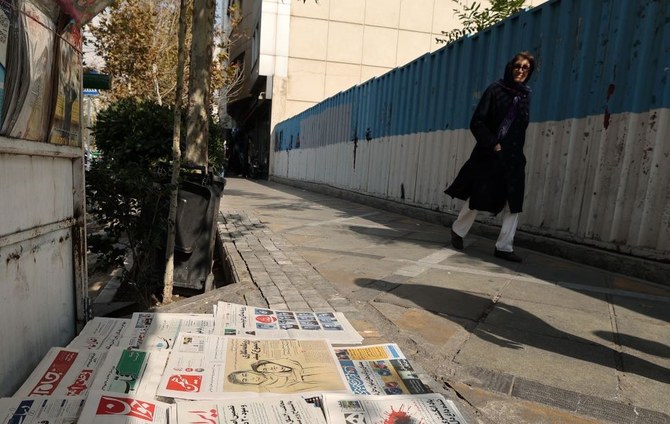
A woman walks past a kiosk displaying copies of the Hammihan newspaper featuring Niloufar Hamedi and Elaheh Mohammadi, who helped publicize the case of Masha Amini, Tehran, Oct. 30, 2022. (AFP)
2 / 2
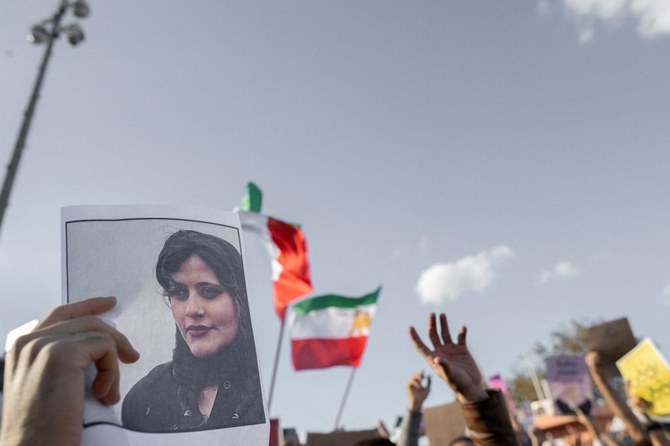
Iranian journalists have called for the release of jailed colleagues covering Mahsa Amini’s death. (AFP)
Short Url
Updated 30 October 2022
Follow

Journalists reporting on Mahsa Amini’s death accused of spying for CIA, says Iranian regime

  • Niloofar Hamedi and Elahe Mohammadi have been accused of being “primary sources of news for foreign media”
  • Hamedi and Mohammadi are reportedly currently being held in the notorious Evin prison that saw fires break out earlier this month

LONDON: Niloofar Hamedi and Elahe Mohammadi, the two female journalists who first broke and reported the news of Mahsa Amini’s death at the hands of Iran’s morality police, have been labeled CIA agents in a statement released by Iran’s Ministry of Intelligence and the intelligence organization of the Islamic Revolutionary Guard Corps.

The statement accused both women of being “primary sources of news for foreign media” and claimed the nationwide protests were launched by the CIA and Israeli intelligence organization Mossad as a pre-planned operation.

Hamedi and Mohammadi are reportedly currently being held in the notorious Evin prison that saw fires break out earlier this month, leaving four dead and several injured.

The former, who was the first journalist to report on Amini’s killing, was accused of posing as a reporter and pushing the 22-year-old’s family into revealing information regarding her death.

Mohammadi was cited as having received training as a foreign agent abroad following her reporting on Amini’s funeral.


What began as outrage over Mahsa Amini’s death on Sept. 16 has evolved into a popular revolt by people from all layers of society. (AFP)


Journalists across the country were shocked at the statement as the regime attempts to clamp down on the uprisings by suffocating the media.

“They’re closely monitoring us and I have been advised to cut all ties with foreign correspondents. I have received calls from abroad on my cellphone and if they monitor my phone records and find that someone from the west was calling, even if it’s a friend, that’ll be a huge risk,” one Iranian journalist told The Guardian.

Another said that the regime will “waste no time punishing the journalists. They know that there are people inside Iran, like myself, who are in touch with friends or media abroad. They’ll use this statement and conclusion to make more arrests, or worse, execute their own citizens for espionage.”

The popular protests, which kicked off over 40 days ago, have seen scores of protesters killed at the hands of the IRGC. Despite that, the movement has shown no signs of abating.


To infinity and beyond: Grendizer’s 50 years of inspiring Arabs

Updated 27 December 2025
Follow

To infinity and beyond: Grendizer’s 50 years of inspiring Arabs

  • ⁠ ⁠50 years after its creation, the Grendizer anime series continues to capture Arab imagination
  • ⁠ ⁠⁠Arab News Japan speaks to creator Go Nagai, Middle Eastern fans and retells the story behind the UFO Robot tasked with protecting our planet

LONDON: Few cultural imports have crossed borders as unexpectedly, or as powerfully, as Grendizer, the Japanese giant robot that half a century ago became a childhood hero across the Arab world, nowhere more so than in Saudi Arabia.

Created in Japan in the mid-1970s by manga artist Go Nagai, Grendizer was part of the “mecha” tradition of giant robots. The genre was shaped by Japan’s experience during the Second World War, and explored themes of invasion, resistance and loss through the medium of science fiction.

But while the series enjoyed moderate success in Japan, its true legacy was established thousands of kilometers away in the Middle East.

By the early 1980s, “Grendizer” had spread across the Middle East, inspiring fandoms in Saudi Arabia, Kuwait, Iraq and beyond. (Supplied)

The anime “UFO Robot Grendizer” arrived on television in the region in 1979, dubbed into Arabic and initially broadcast in Lebanon during the Lebanese civil war. The story it told of the heroic Duke Fleed, a displaced prince whose planet had been destroyed by alien invaders, struck a chord with children growing up amid regional conflict and occupation by Israel.

Its themes of defending one’s homeland, standing up to aggression and protecting the innocent were painfully relevant in the region, transforming the series from mere entertainment into a kind of emotional refuge.

Much of the show’s impact came from its successful Arabization. The powerful Arabic dubbing and emotionally charged voice-acting, especially by Lebanese actor Jihad El-Atrash as Duke Fleed, lent the show a moral gravity unmatched by other cartoons of the era.

While the series enjoyed moderate success in Japan, its true legacy was established thousands of kilometers away in the Middle East. (Supplied)

The theme song for the series, performed by Sami Clark, became an anthem that the Lebanese singer continued to perform at concerts and festivals right up until his death in 2022.

By the early 1980s, “Grendizer” had spread across the Middle East, inspiring fandoms in Saudi Arabia, Kuwait, Iraq and beyond. For many, it was not only their first exposure to anime, it also delivered lessons on values such as justice and honor.

Grendizer was so influential in the region that it became the subject of scholarly research, which in addition to recognizing the ways in which the plight of the show’s characters resonated with the audience in the Middle East, also linked the show’s popularity to generational memories of displacement, particularly the Palestinian Nakba.

By the early 1980s, “Grendizer” had spread across the Middle East, inspiring fandoms in Saudi Arabia, Kuwait, Iraq and beyond. (Supplied)

Half a century later, “Grendizer” remains culturally alive and relevant in the region. In Saudi Arabia, which embraced the original version of the show wholeheartedly, Manga Productions is now introducing a new generation of fans to a modernized version of the character, through a video game, The Feast of The Wolves, which is available in Arabic and eight other languages on platforms including PlayStation, Xbox and Nintendo Switch, and a new Arabic-language anime series, “Grendizer U,” which was broadcast last year.

Fifty years after the debut of the show, “Grendizer” is back — although to a generation of fans of the original series, their shelves still full of merchandise and memorabilia, it never really went away.


Grendizer at 50
The anime that conquered Arab hearts and minds
Enter
keywords