

Iran protests rage overnight after Mahsa Amini commemoration

In a picture verified by AFP, a young woman is seen standing on the roof of a car without a hijab, looking into the distance at the highway packed with scores of vehicles and people. (AFP)
Short Url
Updated 27 October 2022
Follow

Iran protests rage overnight after Mahsa Amini commemoration

  • Thousands of mourners mark 40 days since the death of Mahsa Amini

PARIS: Protests raged through the night in Iran after thousands of mourners marked 40 days since the death of Mahsa Amini which sparked a wave of unrest across the Islamic republic.
Amini, a 22-year-old Iranian of Kurdish origin, died on September 16, three days after her arrest in Tehran by the notorious morality police for allegedly breaching the Islamic dress code for women.
Anger flared at her funeral last month and quickly sparked protests led by young women who have burned their headscarves and confronted security forces, in the biggest wave of unrest in Iran for years.

‘Death to the dictator’
“Death to the dictator,” chanted protesters in the nearby city of Bukan where bonfires burned in the streets, the rights group said.
Protesters also surrounded a base of the Basij militia in Sanandaj, a flashpoint city in Kurdistan province, starting fires and driving security forces back, it added.
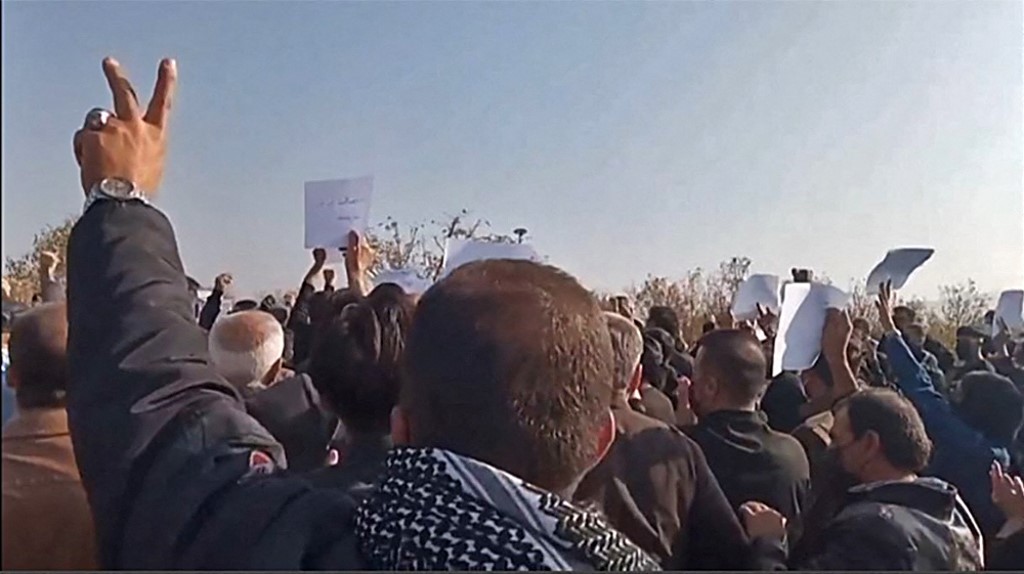


More than five weeks after Amini’s death, the demonstrations show no signs of ending, fueled by public outrage over a crackdown that has claimed the lives of other young women and girls. (AFP)


There were similar scenes in Ilam city, near Iran’s western border with Iraq.
Iran’s ISNA news agency said the Internet had been cut in Saqez for “security reasons,” and that nearly 10,000 people had gathered in the city.
But many thousands more were seen making their way in cars, on motorbikes and on foot along a highway, through fields and even across a river, in videos widely shared online.


Noisily clapping, shouting and honking car horns, mourners packed the highway linking Saqez to the cemetery eight kilometers (five miles) away, in images Hengaw said it had verified.
ISNA said some of the crowd returning from the cemetery had “intended to attack an army base,” until they were dispersed by other participants.
A police checkpoint was torched and fires burned beside a bridge in the Qavakh neighborhood of Saqez, according to a verified video.
“This year is the year of blood, Seyed Ali will be toppled,” a group of them chanted in footage verified by AFP, referring to Iran’s supreme leader Ayatollah Ali Khamenei.
Hengaw said workers went on strike in Saqez as well as Divandarreh, Marivan, Kamyaran and Sanandaj, and in Javanrud and Ravansar in the western province of Kermanshah.
More than five weeks after Amini’s death, the demonstrations show no signs of ending, fueled by public outrage over a crackdown that has claimed the lives of other young women and girls.
Despite heightened security measures, columns of mourners had poured into Saqez on Wednesday, paying tribute to Amini at her grave at the end of the traditional mourning period.
In a virally-shared picture verified by AFP, a young woman was seen standing on the roof of a car without a hijab head covering, looking into the distance at the highway packed with scores of vehicles and people.
Mourners chanted at the Aichi cemetery outside Saqez, before many were seen heading to the governor’s office in the city center, where Iranian media outlets said some were poised to attack an army base.
“Security forces have shot tear gas and opened fire on people in Zindan square, Saqez city,” the Hengaw rights group said, without specifying whether there were any dead or wounded.
After nightfall, blasts were heard as security forces fired on protesters in Marivan, Kurdistan province, in a video published by Hengaw, a Norway-based organization.


Sudan’s prime minister takes his peace plan to the UN, but US urges humanitarian truce now

Updated 8 sec ago
Follow

Sudan’s prime minister takes his peace plan to the UN, but US urges humanitarian truce now

  • Sudan’s prime minister is proposing a wide-ranging peace initiative to end a nearly 1,000-day war with a rival paramilitary force
  • It seems unlikely the RSF would support the proposal, which would essentially give government forces a victory and take away their military power
UNITED NATIONS: Sudan’s prime minister on Monday proposed a wide-ranging peace initiative to end a nearly 1,000-day war with a rival paramilitary force, but the United States urged both sides to accept the Trump administration’s call for an immediate humanitarian truce.
Kamil Idris, who heads Sudan’s transitional civilian government, told the Security Council his plan calls for a ceasefire monitored by the United Nations, African Union and Arab League, and the withdrawal of paramilitary forces from all areas they occupy, their placement in supervised camps and their disarmament.
Sudan plunged into chaos in April 2023 when a power struggle between the military and the powerful paramilitary Rapid Support Forces exploded into open fighting, with widespread mass killings and rapes, and ethnically motivated violence. This has amounted to war crimes and crimes against humanity, according to the UN and international rights groups.
It seemed highly unlikely the RSF would support the prime minister’s proposal, which would essentially give government forces a victory and take away their military power.
In an indirect reference to the truce supported by the US and key mediators Saudi Arabia, Egypt and the United Arab Emirates, known as the Quad, Idris stressed to the UN Security Council that the government’s proposal is “homemade — not imposed on us.”
In early November, the Rapid Support Forces agreed to a humanitarian truce. At that time, a Sudanese military official told The Associated Press the army welcomed the Quad’s proposal but would only agree to a truce when the RSF completely withdraws from civilian areas and gives up their weapons — key provisions in the plan Idris put forward on Monday.
Idris said unless the paramilitary forces were confined to camps, a truce had “no chance for success.” He challenged the 15 members of the Security Council to back his proposal.
“This initiative can mark the moment when Sudan steps back from the edge and the international community — You! You! — stood on the right side of history,” the Sudanese prime minister said. He said the council should “be remembered not as a witness to collapse, but as a partner in recovery.”
US deputy ambassador Jeffrey Bartos, who spoke to the council before Idris, said the Trump administration has offered a humanitarian truce as a way forward and “We urge both belligerents to accept this plan without preconditions immediately.”
Bartos said the Trump administration strongly condemns the horrific violence across Darfur and the Kordofan region — and the atrocities committed by both the Sudanese Armed Forces and the Rapid Support Forces, who must be held accountable.
UAE Ambassador Mohamed Abushahab, a member of the Quad, said there is an immediate opportunity to implement the humanitarian truce and get aid to Sudanese civilians in desperate need.
“Lessons of history and present realities make it clear that unilateral efforts by either of the warring parties are not sustainable and will only prolong the war,” he warned.
Abushahab said a humanitarian truce must be followed by a permanent ceasefire “and a pathway toward civilian rule independent of the warring parties.”
UN Assistant Secretary-General for political affairs Khaled Khiari reflected escalating council concerns about the Sudan war, which has been fueled by the continuing supply of increasingly sophisticated weapons.
He criticized unnamed countries that refuse to stop supplying weapons, and both government and paramilitary forces for remaining unwilling to compromise or de-escalate.
“While they were able to stop fighting to preserve oil revenues, they have so far failed to do the same to protect their population,” Khiari said. “The backers of both sides must use their influence to help stop the slaughter, not to cause further devastation.”
The devastating war in Sudan has killed more than 40,000 people according to UN figures, but aid groups say the true number could be many times higher. The conflict has created the world’s largest humanitarian crisis, with over 14 million people displaced, disease outbreaks and famine spreading in parts of the country.