Deaf Pakistani, author of 120 published books, hopes to finish 300 works by 2023 end

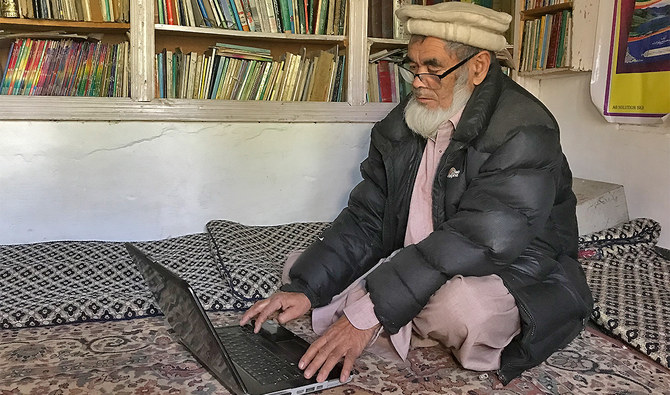
Ghulam Hassan Hassanu, who has published 120 books, is writing on his laptop at his residence in Khaplu, Pakistan, on October 23, 2022. (AN Photo)
Short Url
Updated 30 October 2022
Follow

Deaf Pakistani, author of 120 published books, hopes to finish 300 works by 2023 end

  • Ghulam Hassan Hassanu has written 270 books on religion, history out of which 120 have already been published
  • He was nominated for the Presidential Pride of Performance award in August for contributing to national literature

KHAPLU, Gilgit-Baltistan: A deaf Pakistani man from the northern Gilgit-Baltistan region, who has published 120 books on various religious and historical subjects since the late 1970s, said on Sunday he was hoping to be recognized as the author of 300 works by the end of the next year.

Born and raised in the scenic Khaplu valley, 67-year-old Ghulam Hassan Hassanu launched his latest publication during a ceremony in September which was also attended by the chairman of the Pakistan Academy of Letters.

He was also nominated for the Presidential Pride of Performance award in August for contributing to national literature.

Speaking to Arab News, Hassanu said he did not experience any hearing impairment as a student and “was brilliant during childhood.” He added that his passion for knowledge convinced his family to send him to a seminary in Lahore after finishing eighth grade to secure religious education.

“When I was in Lahore, I started writing essays and news stories for different publications which were printed with my name,” he recalled. “The process encouraged me to start writing books.”
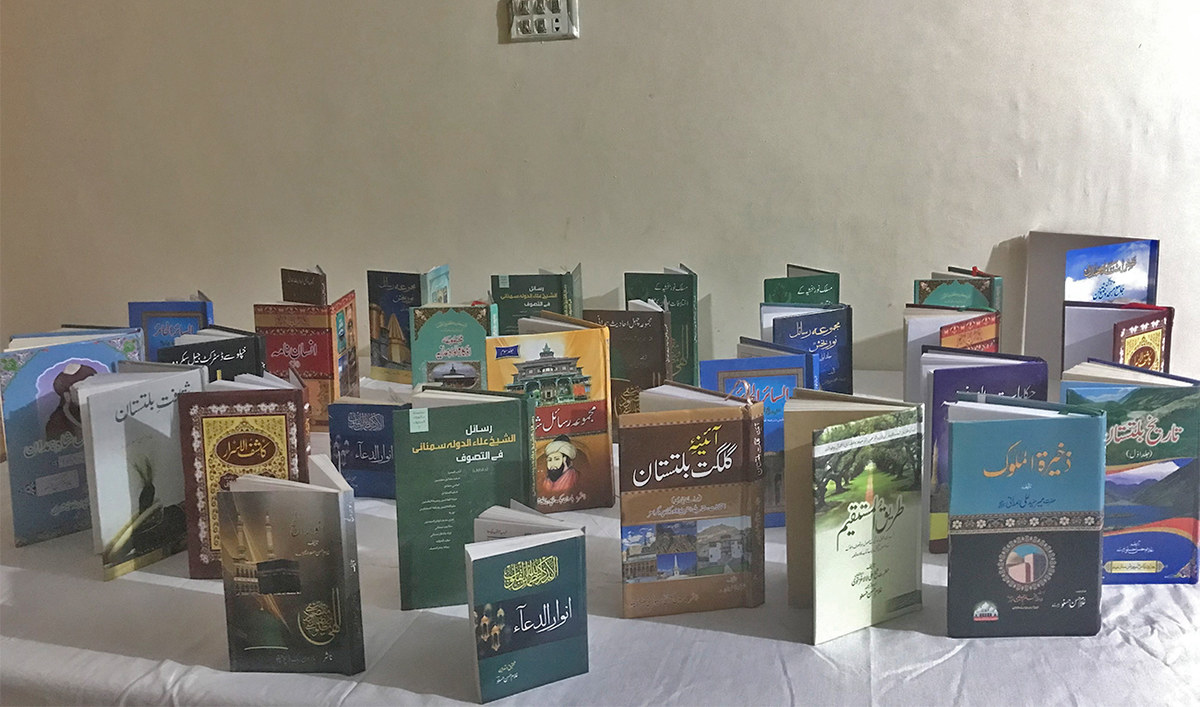


Ghulam Hassan Hassanu’s books of are displayed at a ceremony in Khaplu, Pakistan, to launch his latest publication on September 23, 2022. (AN Photo)

Hassanu said his first book was published in 1978 while pointing out that the process was still continuing.

“So far, I have written 270 books out of which 120 have been published. The rest of them are at different stages of publication,” he informed, adding he was optimistic about completing 300 books by the end of 2023.

“At least 29 of my books were published in 2022,” he continued, “and 50 more will be published in 2023.”

Hassanu said he was happy the government had chosen him for the presidential award.

“This government’s measures have encouraged writers belonging to underprivileged areas of the country,” he maintained. “This will also yield fruitful results [in future].”

The 67-year-old author said he was deeply inspired by Maulana Abul Ala Maududi, Dr. Ghulam Jilani and Syed Ali Sharfuddin.

He added a majority of his works were Urdu translations of Arabic and Persian books, though he had also written extensively on the history of Baltistan.

Asked if he had any advice to give to the young generation, he said they should patiently work toward their chosen objectives in life.

“If you are interested in any work, go to any extent to fulfil it,” he said. “Nothing can stop you. Everything is possible.”


Pakistan, UK launch £10 million higher education partnership

Updated 5 sec ago
Follow

Pakistan, UK launch £10 million higher education partnership

  • Pak-UK Education Gateway second phase expands climate research, scholarships, university exchanges
  • First phase was launched in 2018 and delivered 165 partnerships, 2,000 joint studies and £5 million in grants

ISLAMABAD: Pakistan’s Higher Education Commission (HEC) and the British Council have launched the £10 million second phase of the Pak-UK Education Gateway, the HEC said on Monday, a joint initiative aimed at deepening collaboration between universities in both countries on research, mobility and higher-education reform.

The program, funded equally by the HEC and the British Council, builds on a partnership launched in 2018 and seeks to strengthen institutional ties between Pakistani and British universities, focusing on shared challenges including climate change, skills development and economic growth.

Education cooperation has become an increasingly important pillar of broader Pakistan-UK relations, as both countries look to expand academic mobility, research collaboration and international recognition of qualifications at a time when higher-education systems face pressure to respond to climate risks, labor-market shifts and funding constraints.

“This £10 million partnership is set to deepen collaboration between UK and Pakistani universities on critical issues like Climate Change and Mobility. A true system-to-system commitment,” the HEC said in an X post. 

According to the British Council and HEC, the first phase of the Pak-UK Education Gateway supported 165 institutional partnerships, generated around 2,000 joint research papers and awarded £5 million in research grants. Officials say the second phase aims to build on that foundation as part of a longer-term effort to internationalize Pakistan’s higher-education sector.

“Education is the building block of growth and prosperity. Our work on education in Pakistan supports people throughout their lives: from helping reform education policy at the school level, to our strong partnership in higher education,” British High Commissioner Jane Marriott said in a statement.

“This next phase builds on our already strong relationship, and will unlock opportunities to help both our higher education sectors thrive.”

Opportunities under the second phase include increased funding for scholarships, joint research grants and faculty exchanges, alongside a Start-Up Challenge Fund to support Pakistan-UK university collaborations pursuing commercial opportunities and access to new markets.

The program will also focus on leadership and governance reforms within Pakistan’s higher-education system, including quality assurance, improved campus accessibility for people with disabilities, and greater participation of women in senior leadership roles. It further aims to expand opportunities for Pakistani students to study UK-accredited courses without leaving their home cities, alongside a commitment to mutual recognition of qualifications.

Pakistan’s Minister for Federal Education and Professional Training Khalid Maqbool Siddiqui said the initiative had already delivered concrete results since its launch in 2018, calling education “the bridge that connects people, cultures, and futures.”

Acting HEC Chairperson Nadeem Mahbub described the Gateway as a system-to-system partnership rather than a stand-alone program, noting that it had benefited institutions and students in both countries.