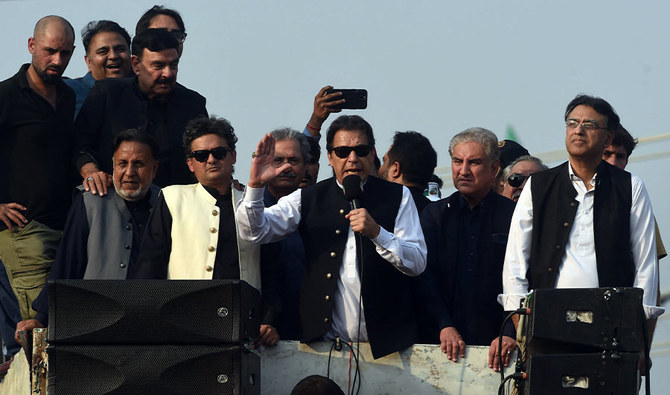

ISLAMABAD: Former prime minister Imran Khan on Friday lashed out at top officials of Pakistan’s premier intelligence agency, the Inter-Services Intelligence (ISI), while speaking at a protest march to the capital he had launched earlier in the day.
Khan, once widely believed to have been supported by Pakistan’s powerful military establishment, is now considered to have fallen out with the army since his ouster through a parliamentary vote of no-confidence in April.
The former premier as well as members and supporters of his Pakistan Tehreek-e-Insaf (PTI) party have been criticizing the Pakistani military, which has ruled the South Asian country for almost half of its 75-year history, and the army chief, for not intervening to block his ouster, which he says was part of a United States-backed “foreign conspiracy.”
Washington, Khan’s political rivals who are now in power and the military deny the allegations.
Khan on Friday afternoon set out northwards from Lahore up the Grand Trunk Road to march on the capital, an agitation some fear could lead to violence in a country already reeling from a dwindling economy and losses in billions of dollars from devastating floods.
The former premier says the protest march is aimed at demanding snap elections.
“When I talk of injustice... I today want to name Azam Swati,” Khan told a crowd of supporters in Lahore on Friday, referring to a top aide who was recently arrested for anti-military remarks but is now out on bail. In a recent speech, Swati said he was tortured in custody and named two intelligence officials behind the violence.
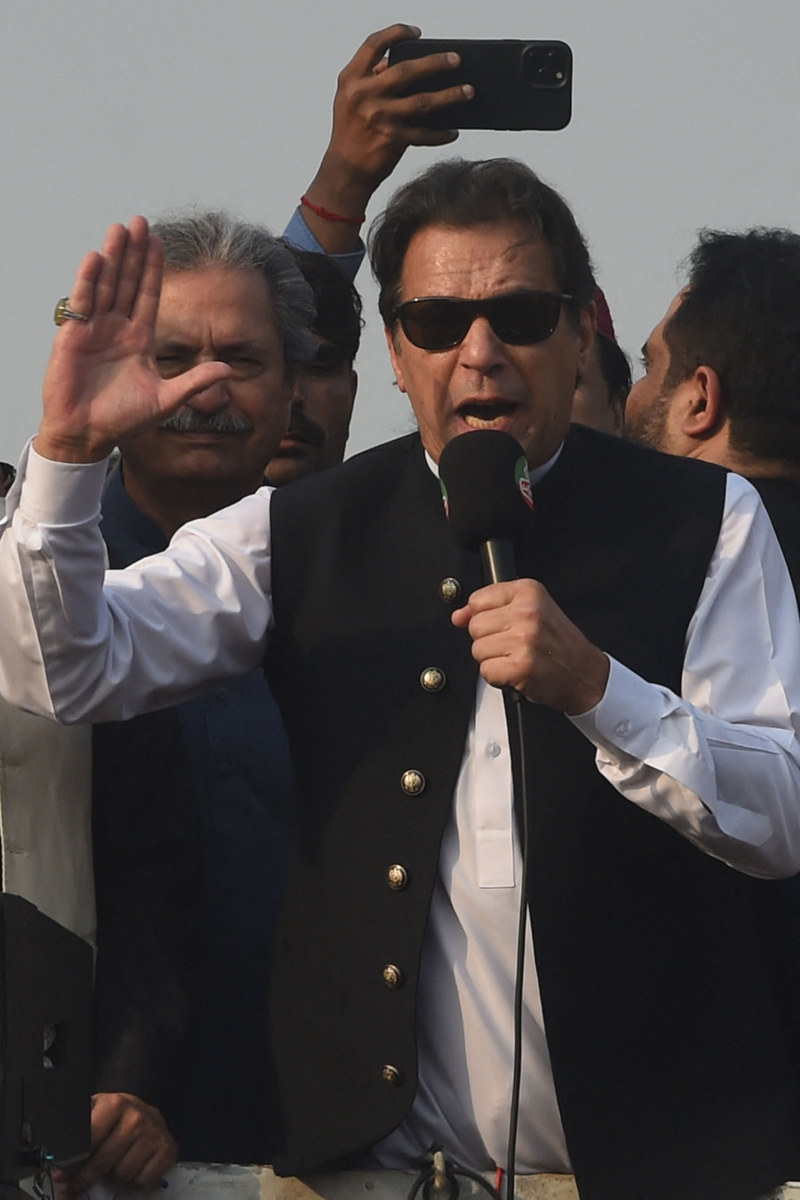
Former Pakistan prime minister Imran Khan (C) addresses his supporters during an anti-government long march towards Islamabad to demand early elections, in Lahore on October 28, 2022. (AFP)
The ISI or army have not commented on Swati’s statement or Khan’s remarks at the rally.
“Azam Swati has named two people. One is Fahim and the other is Faisal. Faisal, since this Dirty Harry has come to Islamabad, he is subjecting people to brutality.”
The former premier was referring to ISI director-general for counter intelligence, Major General Faisal Naseer, and the agency’s Islamabad sector commander, Brig. Fahim Raza.
Swati was arrested this month in a case registered against him over a controversial tweet directed at Army Chief General Qamar Javed Bajwa.
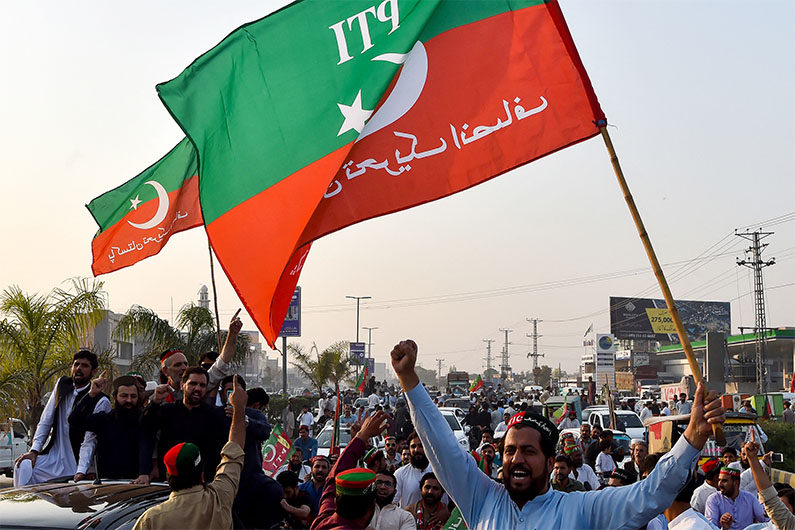
Activists of opposition party Pakistan Tehreek-e-Insaf (PTI) take part of anti-government rally demanding early election in Peshawar on October 28, 2022. (AFP)
“He (Maj Gen Naseer) first had Azam picked up illegally. He (Swati) was tortured in front of his grandchildren, after that he was handed over to the facilitators of Fahim and Faisal,” Khan said.
“He (Swati) was arrested, stripped naked and subjected to torture.”
Khan said prior to Swati’s arrest, another one of his loyalists and chief of staff, Dr. Shahbaz Gill, was picked up in the same way.
“Police picked him (Gill) up, police handed [him] over to Fahim and Faisal’s men. They striped naked him, tortured him and made pictures of him,.”
Khan’s comments came a day after ISI chief Lt. Gen. Nadeem Anjum criticized Khan for anti-military comments and portraying General Bajwa as a “traitor” among his followers. This was the first time in the history of Pakistan that a sitting ISI chief addressed a press talk.
Khan, while kicking off his anti-government march to the capital from Lahore’s Liberty Chowk Friday afternoon, slammed the spy master for addressing what he called a “political” press conference.
“You [DG ISI] said that you are apolitical, that we [army] are not involved in politics,” Khan said, addressing Lt Gen Anjum.
“DG ISI, I haven’t even seen Sheikh Rashid [local politician] conduct a more political press conference [than the one you addressed].”
“DG ISI, listen carefully, the things I know, I am staying silent for my institutions and the country. I don’t want to damage my country,” Khan said as the crowd cheered. “When we criticize [army], it is constructive and for your betterment.”
“I am saying this again, I can say a lot and can respond to you. But I don’t want the institutions to get weak.”
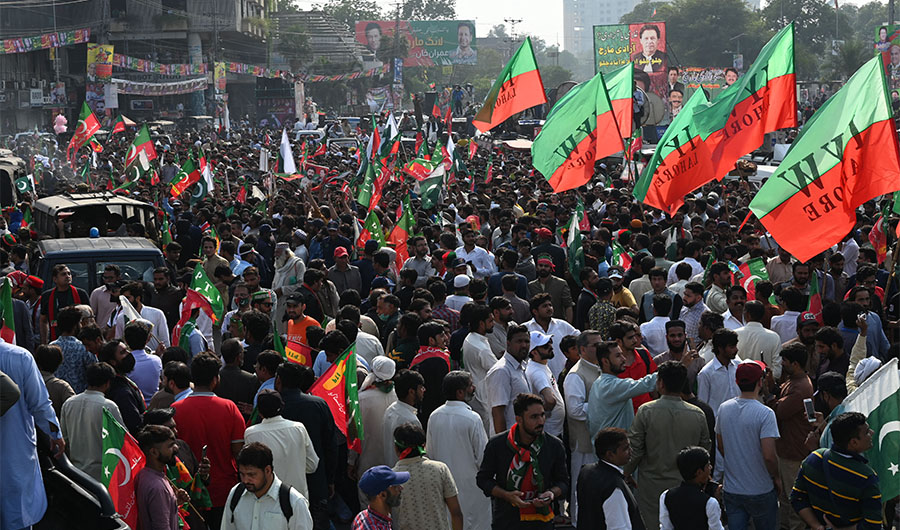
Activists and supporters of opposition party Pakistan Tehreek-e-Insaf (PTI) gather before the start of an anti-government long march towards Islamabad to demand early elections, in Lahore on October 28, 2022. (AFP)
In remarks to journalists on Thursday, Anjum, who was dressed in civilian clothing, said he was aware that the media was “surprised by my presence,” but he could not remain silent while the military was being “targeted for no reason.”
“If you (Khan) are convinced that the head of your army is a traitor, then why did you praise him so much just in the recent past?” Anjum said. “If he was really a traitor in your point of view, then why do you still meet him behind closed doors?”
“Don’t do this, that you meet us in the dark of night behind closed doors to express your constitutional and unconstitutional wishes and then in the light of day call the same person a traitor.”
Since his ouster, Khan has held rallies across the country to force the government into holding fresh polls. In May, he rallied his supporters to the federal capital to bring down the government but called off the protest after his supporters clashed with police.
Since then, he has been threatening to launch another “long march” against the government.
“This march of mine, this is not for politics, this is not for elections or for personal gains,” Khan told the crowd. “It has one purpose, that I free my nation … that this nation’s decisions aren’t made in another country.”
“We will stay peaceful,” he added.
The government has warned the ex-premier it will deal with protesters with “an iron fist” if marchers break the law or resort to violence.