

Ex-PM Khan's party says Sharif government 'biggest beneficiary' of Arshad Sharif killing

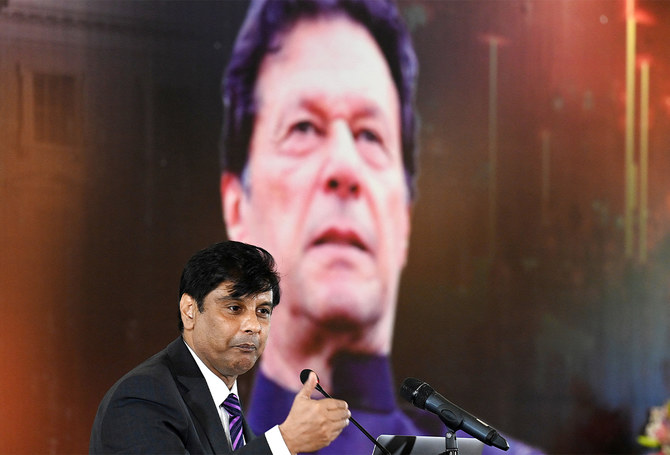
In this picture taken on June 22, 2022, a top Pakistani news anchor Arshad Sharif speaks during an event on "Regime Change Conspiracy and Pakistan’s Destabilisation" in Islamabad. (AFP/File)
Short Url
Updated 27 October 2022
Follow

Ex-PM Khan's party says Sharif government 'biggest beneficiary' of Arshad Sharif killing

  • Interior minister says all fingers point at ex-PM Khan, owner of ARY News where Sharif worked
  • Government has announced judicial commission to probe circumstances of Sharif’s killing in Kenya

ISLAMABAD: A senior leader of former prime minister Imran Khan’s Pakistan Tehreek-e-Insaf (PTI) party has said the "biggest beneficiary" of Pakistani journalist Arshad Sharif’s murder was the government of Prime Minister Shehbaz Sharif since the late anchorman was a major critic of the administration.

Sharif, who was widely viewed as a staunch supporter of Khan and his PTI party, faced a slew of court cases related to charges of sedition and others by the time he fled the country in August, citing threats to his life.

Before and after his departure, he criticized the military and the ruling coalition which brought down Khan’s administration in a parliamentary no-confidence vote in April.

Sharif was killed in Kenya on Sunday by police officials in what they have called a case of "mistaken identity."

In a Twitter Space hosted by Arab News on Wednesday night, PTI senior vice president Chaudhry Fawad Hussain rejected the government’s decision to form a judicial commission to probe the circumstances of Sharif’s killing. 

On Wednesday, the government also announced it would send a two-member joint investigation team to Kenya to gather more information on Sharif’s killing.

"I would say the biggest beneficiary of this killing is the government of Shehbaz Sharif," Hussain said in response to a question. "He criticized them, he uncovered their scandals, corruption."

In a press conference in Islamabad on Thursday, Pakistan’s interior minister Rana Sanaullah said the government had received fresh information about journalist Arshad Sharif’s killing in Kenya last week, and evidence gathered so far pointed at two main suspects, ex-PM Khan and Salman Iqbal, the CEO of the news channel in which the anchorman was last employed.

Independent analysts have said the country should request the United Nations to carry out the probe.

“This is a multi-jurisdictional case because we are talking here about someone who received very, very serious threats and harassments in Pakistan, who subsequently went to another jurisdiction where he clearly did not feel safe enough to stay,” said Omar Waraich, an international journalist and human rights activist who is an advisor with the Open Society Foundation, said on the Arab News Twitter Space.

“In such cases, you may turn to the UN for a commission of inquiry and in multiple ways that can be done,” he added. “One way is that it can be done through the Human Rights Council that Pakistan is a member [of] … It can make a request there through a resolution. The UN High Commissioner for Human Rights, Volker Türk, can order [an inquiry] himself.”

He said the government could also go to the UN General Assembly or Security Council to request the world body to investigate the killing.

Asked what he thought of the suggestion, Hussain said he agreed with Waraich and he was “on the dot.”

“Much of the evidence [in the case] point to two people, one of them is Imran Khan while the other is Salman Iqbal," Sanaullah told reporters on Thursday, referring to the CEO of ARY News. “The facts which have so far come to light are currently being verified ... After that process, we will inform the nation about them.”

The minister said more information was being gathered about two people, Khurram and Waqar, who were allegedly hosting Sharif in Kenya.

“Khurram is an ARY employee,” he said. “This fact has not only come to light but has also been confirmed.”

He said the government would share information on Waqar and his role in Sharif’s killing as well as about a “controversial farmhouse” which the slain journalist visited on the day he was shot dead.

Sanaullah said his ministry would also probe a threat alert issued by the Khyber Pakhtunkhwa administration in August that said Sharif’s life was in danger and he could be assassinated by the Pakistani Taliban in Islamabad or its surrounding areas.

Sharif left Pakistan in August after going into hiding in his own country in July to avoid arrest following a citizen’s complaint against him on allegations of maligning the country’s national institutions, a reference to the military. His whereabouts were not publicly known.

A month later, Sharif’s employer, the private ARY Television, fired him, saying he had violated the TV station’s social media policy. His talk show Power Play was discontinued.

The TV channel had earlier in the year remained critical of Pakistan’s prime minister Shehbaz Sharif following the ouster of his predecessor, Imran Khan, in a no-confidence vote in parliament in April. ARY and Sharif were widely considered to report in support of Khan and his party.


Tens of thousands flee northwest Pakistan over fears of military operation

Updated 28 January 2026
Follow

Tens of thousands flee northwest Pakistan over fears of military operation

  • More than 70,000 people, mostly women and children, have fled remote Tirah region bordering Afghanistan 
  • Government says no military operation underway or planned in Tirah, a town in Khyber Pakhtunkhwa province

BARA, Pakistan: More than 70,000 people, mostly women and children, have fled a remote region in northwestern Pakistan bordering Afghanistan over uncertainty of a military operation against the Pakistani Taliban, residents and officials said Tuesday.

Pakistan’s Defense Minister Khawaja Mohammad Asif has denied the claim by residents and provincial authorities. He said no military operation was underway or planned in Tirah, a town in Khyber Pakhtunkhwa province.

Speaking at a news conference in Islamabad, he said harsh weather, rather than military action, was driving the migration. His comments came weeks after residents started fleeing Tirah over fears of a possible army operation.

The exodus began a month after mosque loudspeakers urged residents to leave Tirah by Jan. 23 to avoid potential fighting. Last August, Pakistan launched a military operation against Pakistani Taliban in the Bajau r district in the northwest, displacing hundreds of thousands of people.

Shafi Jan, a spokesman for the provincial government in Khyber Pakhtunkhwa, posted on X that he held the federal government responsible for the ordeal of the displaced people, saying authorities in Islamabad were retracting their earlier position about the military operation.

Khyber Pakhtunkhwa Chief Minister Suhail Afridi, whose party is led by imprisoned former Prime Minister Imran Khan, has criticized the military and said his government will not allow troops to launch a full-scale operation in Tirah.

The military says it will continue intelligence-based operations against Pakistani Taliban, who are known as Tehrik-e-Taliban Pakistan, or TTP. Though a separate group, it has been emboldened since the Afghan

Taliban returned to power in 2021. Authorities say many TTP leaders and fighters have found sanctuary in Afghanistan and that hundreds of them have crossed into Tirah, often using residents as human shields when militant hideouts are raided.

Caught in the middle are the residents of Tirah, who continued arriving in Bara.

So far, local authorities have registered roughly 10,000 families — about 70,000 people — from Tirah, which has a population of around 150,000, said Talha Rafiq Alam, a local government administrator overseeing the relief effort. He said the registration deadline, originally set for Jan. 23, has been extended to Feb. 5.

He said the displaced would be able to return once the law-and-order situation improves.

Among those arriving in Bara and nearby towns was 35-year-old Zar Badshah, who said he left with his wife and four children after the authorities ordered an evacuation. He said mortar shells had exploded in villages in recent weeks, killing a woman and wounding four children in his village. “Community elders told us to leave. They instructed us to evacuate to safer places,” he said.

At a government school in Bara, hundreds of displaced lined up outside registration centers, waiting to be enrolled to receive government assistance. Many complained the process was slow.

Narendra Singh, 27, said members of the minority Sikh community also fled Tirah after food shortages worsened, exacerbated by heavy snowfall and uncertain security.

“There was a severe shortage of food items in Tirah, and that forced us to leave,” he said.

Tirah gained national attention in September, after an explosion at a compound allegedly used to store bomb-making materials killed at least 24 people. Authorities said most of the dead were militants linked to the TTP, though local leaders disputed that account, saying civilians, including women and children, were among the dead.
