

Ukrainians hold out in east, prepare battle for Kherson

1 / 3
A passerby looks at a car damaged by Russian shelling in central Bakhmut, the site of the heaviest battle in Ukraine's Donetsk region on Oct. 26, 2022. (AP Photo/Efrem Lukatsky)
2 / 3
Ukrainian tankers flash the victory sign in Bakhmut, the site of the heaviest battle in Ukraine's Donetsk region on Oct. 26, 2022. (AP Photo)
3 / 3
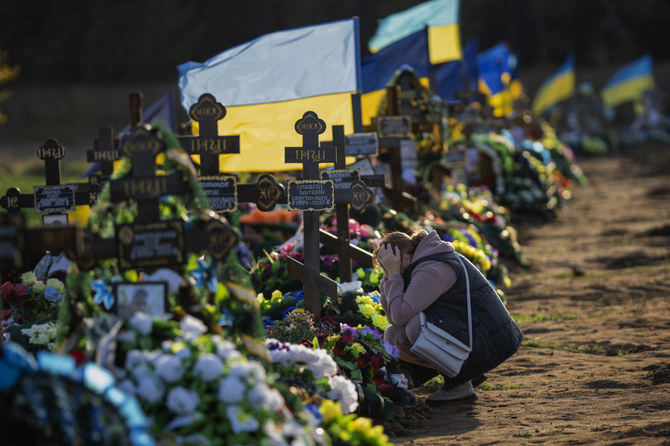
A mother mourns at the grave of only son at a cemetery in Mykolaiv on Oct. 26, 2022. His son, a soldier, was killed during a Russian bombing raid four months ago. (AP)
Short Url
Updated 27 October 2022
Follow

Ukrainians hold out in east, prepare battle for Kherson

  • Ukrainian counter-offensive in Kherson slows as Russian forces dig in

FRONT LINES NORTH OF KHERSON, Ukraine: Ukrainian troops are holding out against repeated attacks by Russian forces in two eastern towns while those at the southern front are poised to battle for the strategic Kherson region, which Russia appears to be reinforcing.
Ukrainian President Volodymyr Zelensky said in a Wednesday evening video address that there would be good news from the front but he gave no details.
He did not mention what was happening in Kherson, which officials and military analysts have predicted will be one of the most consequential battles of the war since Russia invaded Ukraine eight months ago.
The most severe fighting in eastern Ukraine was taking place near Avdiivka, outside Donetsk, and Bakhmut, Zelensky said.
“This is where the craziness of the Russian command is most evident. Day after day, for months, they are driving people to their deaths there, concentrating the highest level of artillery strikes,” he said.
Russian forces have repeatedly tried to seize Bakhmut, which sits on a main road leading to the Ukrainian-held cities of Sloviansk and Kramatorsk.
The looming battle for Kherson city at the mouth of the Dnipro River will determine whether Ukraine can loosen Russia’s grip on the south.

Fresh recruits inserted

While much of the front line remains off limits to journalists, at one section of the front north of the Russian-occupied pocket on the west bank of the Dnipro, Ukrainian soldiers said Russian shelling was stepping up again after having tailed off in recent weeks.
Radio intercepts indicated freshly mobilized recruits had been sent to the front and Russian forces were firmly dug in.
“They have good defensive lines with deep trenches, and they are sitting deep underground,” said Vitalii, a Ukrainian soldier squatting in a weed-choked irrigation canal, concealed from any prowling enemy drones by overhanging trees.
Ukrainian forces advanced along the Dnipro River in a dramatic push in the south at the start of this month, but progress appears to have slowed. Russia has been evacuating civilians on the west bank but says it has no plans to pull out its troops.
Oleksii Reznikov, Ukraine’s defense minister, said wet weather and rough terrain were making Kyiv’s counter-offensive in Kherson harder than it was in the northeast, where it pushed Russia back in September.
At the front, intermittent artillery fire echoed from both sides, with towers of smoke rising in the distance.
A Ukrainian helicopter gunship swept low over the fields, loosed rockets at the Russian positions and wheeled around spitting flares to distract any heat-seeking anti-aircraft rockets fired at it.
“In this area, they are very active. They shell every day and are digging trenches and preparing for defense,” a unit commander at the front, who asked to be quoted by his nickname, Nikifor, said of the Russians.
His location in Mykolaiv province could not be identified under Ukrainian military regulations.
The unit holds a network of well fortified trenches dug into tree lines opposite the Russian fortifications, and rain has turned the dirt tracks that access them to mud, especially where tank treads have churned them up.

Australia said it was sending 30 more armored vehicles and deploying 70 soldiers to Britain to help train Ukrainian troops there to bolster Kyiv’s war effort.
“We’re mindful that Ukraine needs to now be supported over the longer term if we’re going to put Ukraine in a position where it can resolve this conflict on its own terms,” Defense Minister Richard Marles told ABC television.

Nuclear rehearsal
Since Russia began losing ground in a counter-offensive in September, Russian President Vladimir Putin has taken a series of steps to intensify the conflict, calling up hundreds of thousands of Russian reservists, proclaiming the annexation of occupied land and repeatedly threatening to use nuclear weapons to defend Russia.
This month, Russia launched a new campaign of strikes using missiles and Iranian-made drones against Ukraine’s energy infrastructure, also hitting parks and homes across the country.
In Russia, the military staged a high-profile rehearsal for nuclear war, with state television broadcasts dominated by footage of submarines, strategic bombers and missile forces practicing launches in retaliation for an atomic attack.
Moscow has conducted a diplomatic campaign this week to promote an accusation that Kyiv is preparing to release nuclear material with a so-called “dirty bomb,” an allegation the West calls baseless and a potential pretext for Russian escalation.
Despite the rising tensions, United Nations aid chief Martin Griffiths said he was “relatively optimistic” that a UN-brokered deal that allowed a resumption of Ukraine Black Sea grain exports would be extended beyond mid-November.


Progress for Ukraine talks in Paris uncertain with US focus shifting to Venezuela

Updated 06 January 2026
Follow

Progress for Ukraine talks in Paris uncertain with US focus shifting to Venezuela

  • Ukraine’s allies are meeting in Paris to discuss security guarantees after a potential ceasefire with Russia. The Trump administration’s focus on Venezuela could complicate progress
  • France and the UK lead efforts to strengthen post-ceasefire defenses for Ukraine, possibly with European forces

PARIS: Ukraine’s allies are meeting Tuesday in Paris for key talks that could help determine the country’s security after a potential ceasefire with Russia. But prospects for progress are uncertain with the Trump administration’s focus shifting to Venezuela.
Before the US capture of Venezuelan leader Nicolás Maduro, French President Emmanuel Macron had expressed optimism about the latest gathering of so-called “coalition of the willing” nations. For months, they have been exploring how to deter any future Russian aggression should it agree to stop fighting Ukraine.
In a Dec. 31 address, Macron said that allies would “make concrete commitments” at the summit “to protect Ukraine and ensure a just and lasting peace.”
Macron’s office said Tuesday’s meeting will gather an unprecedented number of officials attending in person, with 35 participants including 27 heads of state and government. The US will be represented by President Donald Trump’s envoys, Steve Witkoff and Jared Kushner.
Macron’s office said the US delegation was initially set to be led by Secretary of State Marco Rubio, who changed his plans for reasons related to the military intervention in Venezuela.
Participants seek concrete outcomes on five key priorities once fighting ends: ways to monitor a ceasefire; support for Ukraine’s armed forces; deployment of a multinational force on land, at sea and in the air; commitments in case there’s another Russian aggression; and long-term defense cooperation with Ukraine.
But whether that’s still achievable Tuesday isn’t so clear now, as Trump deals with the aftermath of his decision to effect leadership change in Venezuela.
Ukraine seeks firm guarantees from Washington of military and other support seen as crucial to securing similar commitments from other allies. Kyiv has been wary of any ceasefire that it fears could provide time for Russia to regroup and attack again.
Recent progress in talks
Before the US military operation targeting Maduro, Witkoff had indicated progress in talks about protecting and reassuring Ukraine.
In a Dec. 31 post, Witkoff tweeted that “productive” discussions with him, Rubio, and Kushner on the US side and, on the other, national security advisers of Britain, France, Germany and Ukraine had focused on “strengthening security guarantees and developing effective deconfliction mechanisms to help end the war and ensure it does not restart.”
France, which with the United Kingdom has coordinated the monthslong, multination effort to shore up a ceasefire, has only given broad-brush details about the plan’s scope. It says Ukraine’s first line of defense against a Russian resumption of war would be the Ukrainian military and that the coalition intends to strengthen it with training, weaponry and other support.
Macron has also spoken of European forces potentially being deployed away from Ukraine’s front lines to help deter future Russian aggression.
Important details unfinalized
Ukraine’s President Volodymyr Zelensky said during the weekend that potential European troop deployments still face hurdles, important details remain unfinalized, and “not everyone is ready” to commit forces.
He noted that many countries would need approval from parliament even if leaders agreed to military support for Ukraine. But he recognized that support could come in forms other than troops, such as “through weapons, technologies and intelligence.”
Zelensky said that post-ceasefire deployments in Ukraine by Britain and France, Western Europe’s only nuclear-armed nations, would be “essential” because some other coalition members ”cannot provide military assistance in the form of troops, but they do provide support through sanctions, financial assistance, humanitarian aid and so on.”
“Speaking frankly as president, even the very existence of the coalition depends on whether certain countries are ready to step up their presence,” Zelensky said. “If they are not ready at all, then it is not really a ‘coalition of the willing.’”