

Gunmen in southwestern Pakistan attack polio vaccination team, killing police guard

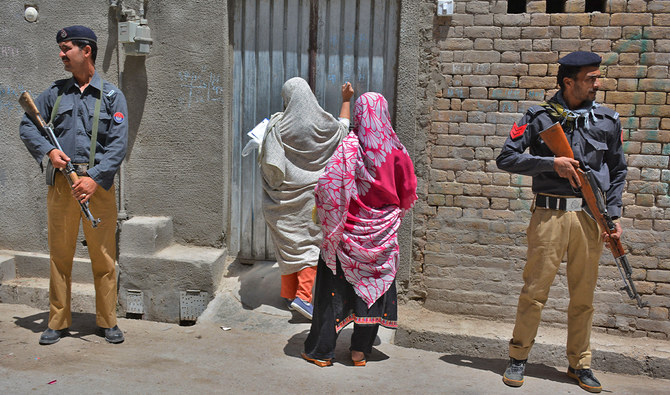
Pakistani police personnel stand guard as a health workers visit a home during a polio vaccination campaign in Quetta on April 26, 2016. (AFP/File)
Short Url
Updated 25 October 2022
Follow

Gunmen in southwestern Pakistan attack polio vaccination team, killing police guard

  • Pakistan and Afghanistan only remaining countries in the world where polio is still endemic despite immunization drives
  • Polio workers have come under attack in Pakistan where hardline clerics and militants say vaccines are foreign ploy to sterilize Muslims

QUETTA: Gunmen in southwestern Pakistan shot and killed a police officer guarding a polio immunization team on Tuesday morning, the latest attack on efforts to protect children from the crippling and sometimes deadly disease.

The assault took place in Kili Tarata in District Pishin in the impoverished Balochistan province. Yasir Bazai, the deputy commissioner of Pihsin, said the gunmen targeted the police constable, Muhammad Hashim, as women polio volunteers were entering a house to administer vaccine drops.

“The constable was killed on the spot and shifted to the District Headquarter Hospital but the polio team remained unhurt in the attack,” Bazai told Arab News. “The district administration along with law enforcement agencies are investigating the attack and the hunt for the killers is underway.”

The attack comes a day after the provincial government in Balochistan launched a five-day anti-polio drive in 19 districts of the province on Monday, October 24, commemorated around the world as World Polio Day.

Pakistan and Afghanistan are the only remaining countries in the world where polio is still endemic despite immunization drives that have been ongoing for decades. Twenty new cases of the disease have been reported in Pakistan this year.

Polio workers have come under attack in some parts of the word, including Pakistan where hardline clerics and militants say the polio vaccine is a foreign ploy to sterilize Muslims and campaign workers are Western spies.

Suspicion of immunization drives also threatens to undermine the government campaign. In 2019, a dozen people were arrested in northern Khyber Pakhtunkhwa province, accused of organizing a campaign against polio vaccination and setting fire to public health facilities in the provincial capital Peshawar.

The coordinator for the polio Emergency Operation Center (EOC) Balochistan, Syed Zahid Shah said security arrangements for polio teams had been beefed-up in all districts of the province after Tuesday's attack.

“Despite the attack on the polio team in district Pishin, the anti-polio drive is continuing in all 19 districts and will continue for the next three days because these cowardly attacks can’t stop us from performing our duties for the nobel cause,” Shah told Arab News.

Last week, global leaders committed $2.6 billion in funding at the World Health Summit, the World Health Organization said, to support global efforts to overcome the final hurdles to polio eradication, vaccinate 370 million children annually over the next five years and continue disease surveillance across 50 countries.


Pakistan stocks close at record high over current account surplus, falling bond yields

Updated 18 December 2025
Follow

Pakistan stocks close at record high over current account surplus, falling bond yields

  • KSE-100 index gains 1,646.79 points or 0.97% to close at new high of 171,960.64 points
  • Pakistan’s central bank posted a current account surplus of $100 million in November

KARACHI: Pakistani stocks closed at an all-time high of 171,960.4 points on Thursday, with financial analysts attributing the surge to increasing investor confidence stemming from a current account surplus reported in November and a drop in government bond yields.

The benchmark KSE-100 index gained 1,646.79 points or 0.97% to close at an all-time high of 171,960.64 points on Thursday. The previous day, Pakistani stocks surged to 170,313.85 points at close of business. 

Ahsan Mehanti, chief executive officer at Arif Habib Commodities, said the optimistic mood at the stock exchange was fueled by the $100 million current account surplus reported by the central bank in November.

“Speculations ahead of year-end close and fall in government bond yields up to 70 basis points after the SBP (State Bank of Pakistan) policy easing played the catalyst role in bullish activity at PSX,” Mehanti told Arab News. 

The surplus was a welcome development for Islamabad as Pakistan’s central bank reported a $291 million deficit in October.

Topline Securities, a Pakistani brokerage firm, said in its daily market review that strong buying by local funds followed a drop in Pakistan Investment Bond (PIB) yields, which boosted investor confidence.

PIB yields are the returns on bonds or government-backed securities that pay fixed semi-annual interest, with rates influenced by market demand and SBP auctions.

“Strength in ENGRO (Engro Corporation), FFC (Fauji Fertilizer Company), UBL (United Bank Limited), LUCK (Lucky Cement) and BAHL (Bank AL Habib) underpinned positive momentum, collectively contributing 1,504 points to the index,” the brokerage firm wrote on X. 

“This upside was partly offset by declines in PIOC (Pakistan International Oil Company), DHPL (D.H. Corporation Limited) and MLCF (Millat Tractor Limited), which together subtracted 176 points.”

The sustained rise in equities comes amid improving liquidity conditions and continued investor participation, with market participants focusing on corporate earnings, sector-specific developments and broader macroeconomic signals.

Earlier on Monday, Pakistan’s central bank cut its key policy interest rate by 50 basis points to 10.5%, a move that surprised analysts and followed four consecutive policy meetings where rates were held unchanged.

The cut came despite an International Monetary Fund staff report earlier this month cautioning against premature monetary easing.

Inflation eased to 6.1% in November, remaining within the SBP’s target band, though analysts have warned that price pressures could resurface later in the fiscal year as base effects fade and food and transport costs remain volatile.