

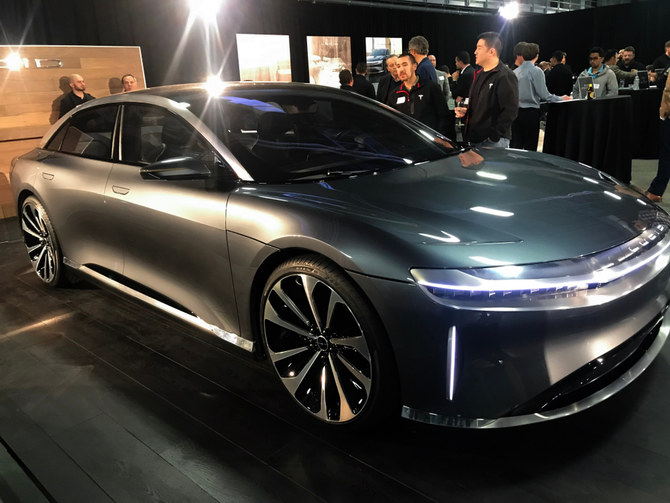
Lucid appoints Faisal Sultan as Middle East VP and MD

The government plans to ensure 30 percent of all vehicles in the capital city Riyadh run on electricity by 2030. (Shutterstock)
Short Url
Updated 24 October 2022
Follow

Lucid appoints Faisal Sultan as Middle East VP and MD

RIYADH: US-based electric vehicle manufacturer Lucid Group Inc., in which Saudi Arabia's Public Investment Fund holds a 60 percent stake, has promoted Faisal Sultan to vice president and managing director in the Middle East.

According to a press release, Sultan will directly report to Lucid’s CEO and Chief Technology Officer Peter Rawlinson. 

Sultan's appointment comes as Lucid plans the construction of a plant in the Kingdom that will produce 150,000 electric vehicles per year.

“Our mission is to inspire the adoption of sustainable energy by creating the most captivating electric vehicles in the world, and the Middle East is a strategic region in fulfilling that mission, for both manufacturing and retail,” said Rawlinson. 

He added: “This requires deep knowledge of the area along with business acumen, and we are very fortunate to have Faisal leading our team here in the Middle East.” 

Sultan has 23 years of combined automotive experience with Lucid, Industrial Clusters, FCA, Magna, Ford, and GM, where he held leadership positions spanning industrial development, manufacturing, operations, engineering, and program management. 

In August, Sultan, who was then the managing director of global operations at Lucid, said the PIF was supportive of Lucid when it faced a supply crunch. 

During an interview with Bloomberg, Sultan noted that supply chain issues will be righted soon, and things will get back to normal by the end of this year. 

He also lauded the Saudi Arabian government for changing the atmosphere of the Kingdom, making it suitable for the roll-out of EVs. 

“The government is very serious and they’ve been working very hard with us to make sure the environment is ready,” Sultan said. 

The government plans to ensure 30 percent of all vehicles in the capital city Riyadh run on electricity by 2030.


Gulf emerging as beneficiary amid changing global alliances, says TCW executive

Updated 4 sec ago
Follow

Gulf emerging as beneficiary amid changing global alliances, says TCW executive

DAVOS: As artificial intelligence dominated discussions at this year’s World Economic Forum in Davos, asset managers are exploring how the technology can be deployed at scale without losing the human judgement that underpins investment decisions.

For Jennifer Grancio, global head of distribution at asset management firm TCW, Saudi Arabia’s approach to energy and AI makes it a particularly attractive hub for investors.

“Saudi Arabia has been very forward-leaning in traditional energy,” Grancio said.

“They’ve also invested heavily in grid efficiency and electricity, which positions them to serve the wider region. Combined with AI adoption, it makes them a powerhouse for investment opportunities.”

For TCW, the focus is not on replacing human expertise but on expanding capacity.

“We’re using AI to increase capacity, not to replace investment analysts or people who write commentaries or evaluate securities,” Grancio explained.

The firm continues to rely on deep research, deploying AI selectively across functions such as securitized credit, marketing and investment teams.

TCW’s engagement with AI predates the current wave of enthusiasm and adoption.

“We were actually an early AI investor. In the US, we have the oldest AI fund, launched over eight years ago, focused on both enablers and adopters,” Grancio said.

The dual focus on technology and infrastructure increasingly aligns with developments in the Gulf.

“As an investment manager, we look at both the AI systems being developed and how energy and power infrastructure supports them,” she said, highlighting TCW’s global energy and power strategy, which has consistently outperformed its benchmark.

Geopolitical shifts are also reshaping investment flows to the Gulf.

“Concerns around the US, China or Russia have led global investors to rely more on the Gulf,” Grancio said. “It’s a great time for development and trade there.”

Emerging markets are drawing growing attention from investors.

“In the US, there’s a rotation toward global exposure. Elsewhere, there’s renewed focus on emerging markets and managing through volatility,” she said.

TCW has benefited from this trend, particularly in emerging market debt, with sovereign clients increasing allocations by billions of dollars.

Volatility, Grancio added, can create opportunity. “As a value manager, we do deep research and focus on relative valuation. In fixed income and securitized credit, volatility allows us to increase returns for clients.”

In the Middle East, sovereign wealth funds and pension systems are expanding into private credit and alternative income strategies. Education is key, Grancio said.

“Understanding what’s different about private investments is critical. They offer strong compounding and portfolio diversification.”

Private asset-backed finance is a growing trend in the region. “We’re seeing portfolios shift from public fixed income into private securitized credit, a major growth area.” 

Looking ahead to 2026, Grancio said that shifts will vary by region and investor type. “In the US, the wealth market has moved toward ETFs. We’ve rapidly built out a $6 billion ETF platform to meet demand,” she said.