PM Sharif arrives in Saudi Arabia on two-day visit to attend ‘Davos in the Desert’

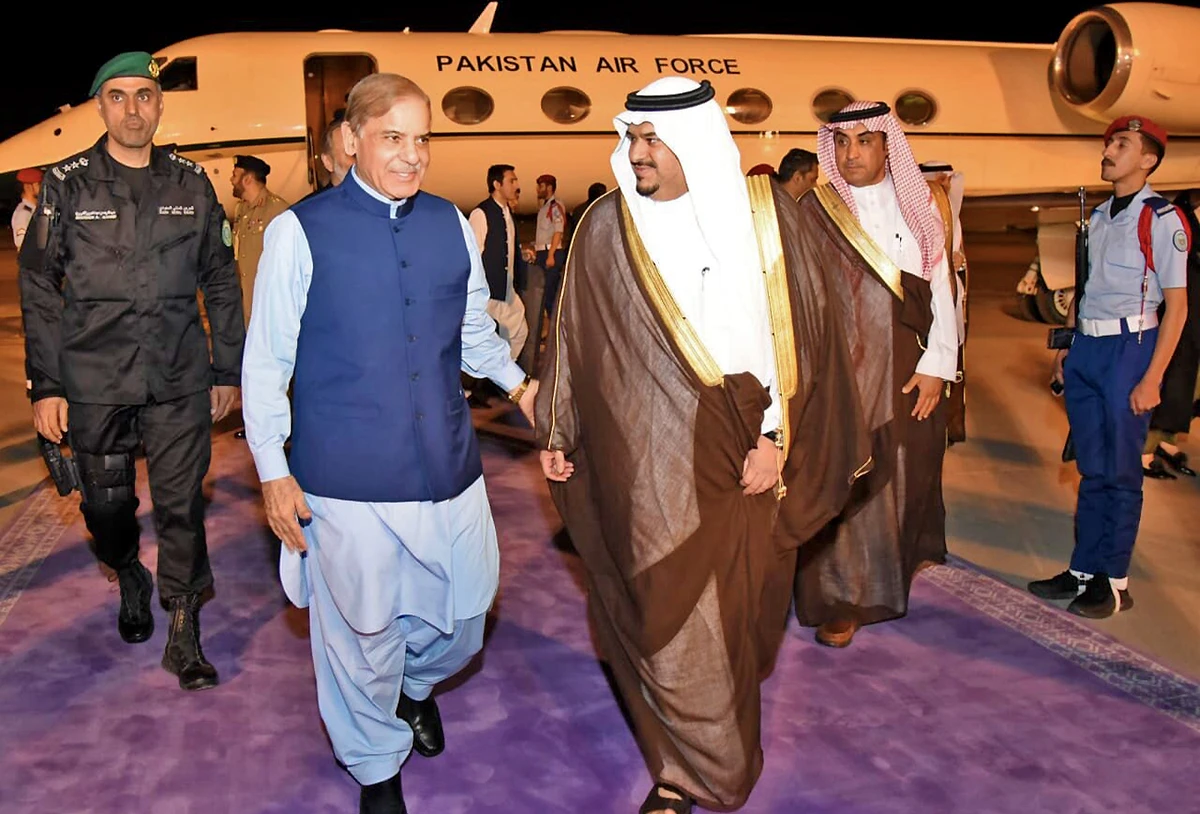
Deputy Governor of Riyadh, Prince Mohammed bin Abdulrahman bin Abdulaziz (right) receives Pakistan's Prime Minister Shehbaz Sharif in Riyadh, Saudi Arabia, on October 24, 2022. (PMO/Twitter)
Short Url
Updated 24 October 2022
Follow

PM Sharif arrives in Saudi Arabia on two-day visit to attend ‘Davos in the Desert’

  • The prime minister says the current state of global economy requires new thinking to overcome irritants
  • This is the second visit by the Pakistani premier to the Kingdom this year since assuming office in April

ISLAMABAD: Pakistani prime minister Shehbaz Sharif on Monday arrived in Saudi Arabia on a two-day visit to participate in an investment conference in Riyadh, his office said.

Hundreds of CEOs and finance moguls are expected in Riyadh from Tuesday for a Davos-style investment conference, the Future Investment Initiative (FII), launched in 2017 by the world’s largest crude exporter, which is trying to diversify away from oil under Crown Prince Mohammed bin Salman.

This is the second visit by Sharif to Saudi Arabia since he took office in April. A statement from Sharif's office said the prime minister is visiting the Kingdom on the invitation of Saudi Arabia’s Crown Prince Mohammed bin Salman.

“During his stay in the capital Riyadh, the prime minister will meet with the Saudi crown prince and discuss strengthening the multi-faceted cooperation between the two countries in the economic sector and further improving the long-standing fraternal relations,” the statement read.

Sharif wrote on Twitter he would attend the Future Investment Initiative (FII) conference being held in Riyadh from October 25-27 on the crown prince’s invitation.

The prime minister maintained the state of the global economy required new thinking to overcome the irritants.

“There are serious concerns about the threat of global recession hitting the economies,” he said. “The pandemic & climate-induced disasters have already put immense strains on the developing countries. High time the world explored solutions to the deepening challenges through candid dialogue.”

This year’s theme of the annual conference, which started in 2017, is “Investing in Humanity: Enabling a New Global Order.”

During the visit, Sharif is expected to meet Saudi leaders and highlight at the conference various investment opportunities in Pakistan.

Members of Sharif’s cabinet, including interior minister Rana Sanaullah, have also confirmed that the Saudi crown prince will visit Pakistan next month.
Pakistani business federation says EU envoy pledges support for training industrial workforce

Updated 4 sec ago
Follow

Pakistani business federation says EU envoy pledges support for training industrial workforce

  • Support aims to boost competitiveness as Pakistan expands skilled labor for exports and remittances
  • FPCCI says the country’s economic future hinges on preparing its workforce for modern technologies

ISLAMABAD: The European Union’s top diplomat in Pakistan has pledged support for the country’s push to train its industrial workforce, exporters and small businesses through the national technical and vocational education system, Pakistan’s top business federation said in a statement on Tuesday, calling the assistance critical for boosting competitiveness.

The commitment came during the first annual conference on Technical and Vocational Education and Training (TVET), jointly organized by the Federation of Pakistan Chambers of Commerce and Industry (FPCCI) and the TVET Sector Support Program, where the EU envoy addressed business leaders and government officials.

“Pakistani industries, exporters, trade bodies and SMEs will be facilitated and supported in their training, and exporters should draw maximum benefit from the GSP+ program,” said EU Ambassador Raymonds Kroblis, according to the FPCCI statement, referring to the EU trade scheme that grants Pakistan preferential, duty-free access for most exports in return for implementing international conventions.

He added that Pakistan’s economic future depended on preparing its workforce for modern technologies.
FPCCI President Atif Ikram Sheikh said Pakistan could “change its economic trajectory” through large-scale skills development and called for a sustained public–private partnership to modernize vocational training.

He said the federation would train 1,000 officials from chambers and trade bodies to strengthen workforce readiness.

Sheikh said Pakistan’s youth had “immense potential” and required structured opportunities to advance, both for domestic industry and for overseas employment.

Pakistan has been working to expand its pool of skilled workers to tap opportunities in Gulf economies, where higher-skilled migration could help lift remittances, a major stabilizing force for Pakistan’s economy.

Speakers at the conference said aligning Pakistan’s workforce with international standards was key to improving productivity, securing export growth and preparing workers for global labor markets.