At least 200 killed in clashes in Sudan’s southern Blue Nile state

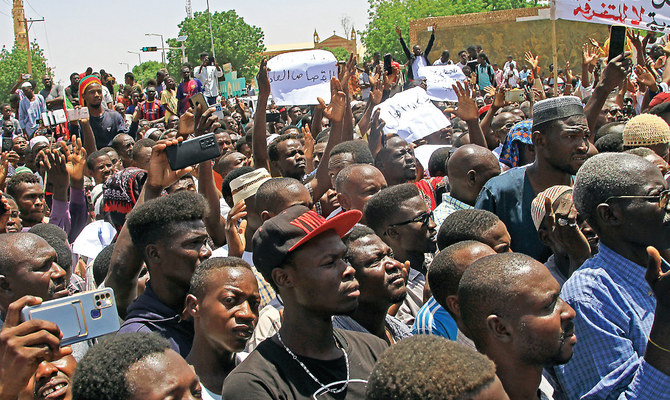
Sudan’s Hausa people protest on July 19 in El-Obeid, demanding justice for comrades killed in a deadly land dispute with a rival ethnic group. (AFP)
Short Url
Updated 23 October 2022
Follow

At least 200 killed in clashes in Sudan’s southern Blue Nile state

KHARTOUM: At least 200 people were killed in two days of ethnic clashes in Sudan’s southern Blue Nile state, official media said on Saturday, up from an earlier toll of 150.

Clashes in Blue Nile, which borders Ethiopia and South Sudan, broke out last week after reported disputes over land between members of the Hausa people and rival groups, with residents reporting hundreds fleeing intense gunfire and homes and shops set ablaze.

Fighting peaked on Wednesday and Thursday to some of the worst in recent months, prompting the provincial governor to declare a state of emergency on Friday.

“Two hundred people were killed” in three villages in the Wad Al-Mahi area, some 500 km south of the capital Khartoum, said local assembly chief Abdel Aziz Al-Amin.

“Some of the bodies have not been buried yet,” he told state television, calling on “humanitarian groups to help” local authorities bury the dead.

Governor Ahmed Al-Omda Badi had ordered a “state of emergency ... in the whole Blue Nile state for 30 days,” according to a Friday provincial decree.

Abbas Moussa, the head of the Wad Al-Mahi hospital, told AFP on Thursday that “women, children and elderly” people were among the dead.

Several hundred people had demonstrated in the Blue Nile capital, Damazin, earlier that day, shouting: “No to violence.” Some demanded Governor Badi be sacked, accusing him of not protecting them.

From July to early October, at least 149 people were killed and 65,000 displaced in Blue Nile, according to the United Nations.

The Hausa have mobilized across Sudan, claiming they are discriminated against by tribal law which forbids them to own land in Blue Nile because they were the last group to arrive there.

The issue of access to land is highly sensitive in impoverished Sudan, where agriculture and livestock account for 43 percent of employment and 30 percent of GDP, according to UN and World Bank statistics.

Sudan has been grappling with deepening political unrest and a spiraling economic crisis since last year’s military coup led by army chief Abdel Fattah Al-Burhan.

A surge in ethnic violence in recent months has highlighted the security breakdown in Sudan since the coup.

A total of 546 people were killed and at least 211,000 forced to flee their homes in inter-communal conflicts across the country from January to September, according to the UN.


Gazans salvage ancient books in mosque library damaged by war

Updated 17 sec ago
Follow

Gazans salvage ancient books in mosque library damaged by war

  • The Great Omari Mosque library sustained terrible damaged during the war in Gaza
  • The mosque now stands largely ruined, with its library littered with rubble and dust

GAZA CITY, Palestinian Territories: Inside the dusty shell of one of the oldest libraries in the Palestinian territories, a group of Gazan volunteers work diligently to salvage what remains of their ancient cultural heritage.
The Great Omari Mosque library sustained terrible damaged during the war in Gaza, which erupted in October 2023 and devastated swathes of the Palestinian territory, including cultural and religious sites.
The mosque — in the old town of Gaza City — now stands largely ruined, with its library littered with rubble and dust.
“I was shocked and stunned when I saw the extent of the destruction in the library,” Haneen Al-Amsi told AFP, saying the scenes of devastation had spurred her to help launch the restoration initiative.
Amsi, who heads the Eyes on Heritage Volunteer Foundation, said the western part of the library was burned when the mosque was hit, causing irreversible damage.
“The library was estimated to contain about 20,000 books, but currently we are left with fewer than 3,000 or 4,000,” she explained.
Among the debris, volunteers hoping to restore the collection pored over charred fragments of manuscript and shards of yellowed paper.
“The library of the Great Omari Mosque is considered the third largest library in Palestine after the Al-Aqsa Mosque library and the Ahmed Pasha Al-Jazzar library,” Amsi said.
“It is an important historical library that contains original manuscripts and a diverse collection of books on jurisprudence, medicine, Islamic law, literature and various other subjects.”
Gaza’s history stretches back thousands of years, making the tiny territory a treasure trove of archaeological artefacts from past civilizations including Canaanites, Egyptians, Persians and Greeks.
But more than two years of war between Israel and Hamas took a heavy toll on Gaza’s heritage sites.
As of January 2026, the UN’s cultural agency UNESCO, had verified damage to 150 sites since the start of the war on October 7, 2023 sparked by Hamas’s attack on Israel.
These include 14 religious sites and 115 buildings of historical or artistic interest.

- ‘Represent history’ -

Inside one of the library’s old stone rooms, one woman used a paintbrush to dust off an old tome, while other volunteers wearing facemasks and gloves crouched on the floor to leaf through piles of books.
“The condition of the rare and historical books is deplorable due to their being left for more than 700 to 800 days,” Amsi said, talking of “immense damage and gunpowder residue” on the volumes.
An independent United Nations commission said in June 2025 that Israeli attacks on schools, religious and cultural sites in Gaza amounted to war crimes.
“Israel has obliterated Gaza’s education system and destroyed more than half of all religious and cultural sites in the Gaza Strip,” the UN Independent International Commission of Inquiry on the Occupied Palestinian Territory said in a report.
Israel rejected the commission as “an inherently biased and politicized mechanism of the Human Rights Council” and said the report was “another attempt to promote its fictitious narrative of the Gaza war.”
For Amsi, the importance of restoring the books lay in preserving crucial historic records.
“These books represent the history of the city and bear witness to historical events,” she said.