KHERSON, Ukraine: Ukrainian President Volodymyr Zelensky called on the West to warn Russia not to blow up a huge dam that would flood a swath of southern Ukraine.
The call comes as his forces prepare to push Moscow’s troops from Kherson in one of the war’s most important battles.
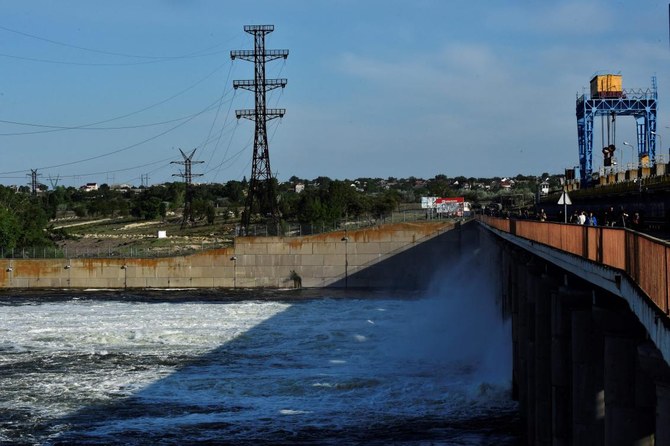
In a television address, Zelensky said Russian forces had planted explosives inside the huge Nova Kakhovka dam, which holds back an enormous reservoir that dominates much of southern Ukraine, and were planning to blow it up.
“Now everyone in the world must act powerfully and quickly to prevent a new Russian terrorist attack. Destroying the dam would mean a large-scale disaster,” he said.
Russia accused Kyiv earlier this week of rocketing the dam and planning to destroy it, in what Ukrainian officials called a sign that Moscow might blow it up and blame Kyiv. Neither side produced evidence to back up their allegations.
The vast Dnipro bisects Ukraine and is several km wide in places. Bursting the dam could send a wall of water flooding settlements below it, toward the city of Kherson, which Ukrainian forces hope to recapture in a major advance.
It would also wreck the canal system that irrigates much of southern Ukraine, including Crimea, which Moscow seized in 2014.
The alarm has echoes of a World War Two disaster at another huge dam further upriver, which Ukrainian historians say was dynamited by Soviet sappers as their troops retreated, causing floods that swept away villages and killed thousands of people.
Zelensky called on world leaders to make clear that blowing up the dam would be treated “exactly the same as the use of weapons of mass destruction,” with similar consequences to those threatened if Russia uses nuclear or chemical weapons.
’DIFFICULT DECISIONS’
One of the most important battles of the eight-month-old war is coming to a head near the dam as Ukrainian forces advance along the river’s west bank, aiming to recapture Kherson city and encircle thousands of Russian troops.
Ukraine has imposed an information blackout from the Kherson front, but Russia’s commander Sergei Surovikin said this week that the situation in Kherson was “already difficult” and Russia was “not ruling out difficult decisions” there.
Ukrainian troops manning a section of the front north of Kherson on Friday said there had been a noticeable reduction in recent weeks in shellfire from Russian positions in a tree line that sweeps across an expanse of fallow fields, some 4 km away. The drop off in shooting and an absence of Russian armor movement in the sector, they said, indicated the Russians were short of ammunition and equipment. The only sign of fighting was the occasional crump of an exploding shell in the distance.
“They’ve been shooting less starting about three weeks ago,” said Myhailo, 42, who like other soldiers deployed with him withheld his last name. “And their drones are less active.”
“It’s probably been about a month there’s been less shelling,” agreed Sasha, 19. “This has to finish at some point. Their ammunition can’t last forever.”
The Kremlin on Friday sidestepped a question about whether or not President Vladimir Putin had given an order for Russian forces to withdraw from Kherson.
Ukraine’s armed forces general staff said up to 2,000 newly-mobilized Russians had arrived in the region “to replenish losses and strengthen units on the contact line.”
Russian-installed occupation officials have begun what they say is the evacuation of tens of thousands of civilians across the river from towns on the west bank. They accused Kyiv of shelling a ferry overnight, killing at least four civilians. Ukraine said it had fired at a barge but only after a curfew when no civilians should have been out.
As Russian forces have faced setbacks on the battlefield since September, Putin has escalated the war. Last month he ordered the call-up of hundreds of thousands of reservists, announced the annexation of Russian-occupied territory and repeatedly threatened to use nuclear weapons to protect Russia.
This month, he began a campaign of attacks using cruise missiles and Iranian drones to knock out Ukraine’s power supply ahead of winter. Kyiv and the West say that amounts to deliberate targeting of civil infrastructure and a war crime.
Moscow has acknowledged targeting energy infrastructure but denies targeting civilians, saying the aim of its “special military operation” is to degrade Ukraine’s military.
Since Thursday, Ukrainians have experienced countrywide calls to reduce electricity consumption and some blackouts, which the authorities say are necessary to fix power stations damaged in the attacks.
The United States said on Thursday that Iranian troops were in Crimea and had helped fly the drones to attack Ukraine.
“We can confirm that Russian military personnel based in Crimea have been piloting Iranian UAVs and using them to conduct kinetic strikes across Ukraine, including in strikes against Kyiv in recent days,” US State Department spokesman Ned Price told a briefing.
Iran has denied supplying the drones, as has Moscow, although many have been shot down and recovered making their provenance clear.
“Iran and Russia, they can lie to the world, but they certainly can’t hide the facts, and the fact is this: Tehran is now directly engaged on the ground,” White House national security spokesman John Kirby said.


![]()

Zelensky calls on West to warn Russia not to blow up dam
Short Url
https://arab.news/pnjsr
Zelensky calls on West to warn Russia not to blow up dam
- Zelenskiy said Russian forces had planted explosives inside the huge Nova Kakhovka dam and were planning to blow it up
- "Now everyone in the world must act powerfully and quickly to prevent a new Russian terrorist attack”


Latest updates


© 2026 SAUDI RESEARCH & PUBLISHING COMPANY, All Rights Reserved And subject to Terms of Use Agreement.