

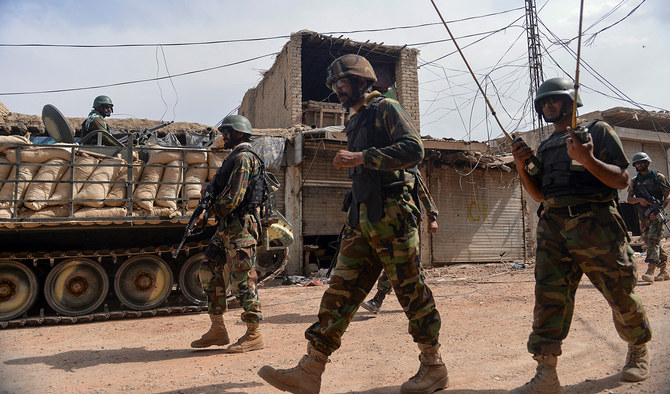

ISLAMABAD: The banned Pakistani Taliban said on Thursday it was willing to find a negotiated settlement to its conflict with the government, responding to a “request” for peace by the provincial government of Khyber Pakhtunkhwa province.
The provincial government’s spokesperson, Barrister Muhammad Ali Saif, publicly "requested” the Tehreek-e-Taliban Pakistan (TTP) on Wednesday to recall its armed fighters from the scenic Swat valley in the country’s northwest where militants have reportedly returned in recent weeks.
TTP insurgents took partial control of Swat Valley in Khyber Pakhtunkhwa province in 2007, before being ousted two years later in a major military operation hailed as a telling blow against militant violence. During this time, militants unleashed a reign of terror, killing and beheading politicians, singers, soldiers and opponents. They banned female education and destroyed almost 200 girls’ schools.
The widespread reports of a return of militants to Swat Valley and other parts of Khyber Pakhtunkhwa come amid a stalled peace deal with Islamabad and drawn-out negotiations that began last year.
“The TTP welcomes the appeal of special assistant to [the chief minister of] Khyber Pakhtunkhwa on information, Barrister Saif,” the militant faction said in a statement. “The TTP believes in the negotiation process and establishment of ceasefire.”
“If [the] government shows seriousness and does not force our mujahideen [fighters] to defend [themselves], we will issue directives to all of them to stop their operations and move to safe places,” the statement added.
The group said its recent attacks were a reaction to “ceasefire violations by Pakistan” and such actions were “defensive” in nature.
Earlier this month, unidentified gunmen on a motorcycle opened fire on a school van in Swat’s Charbagh area, killing the driver and injuring students. The incident happened about a decade after the TTP tried to kill Malala Yousafzai, though she survived the gun attack and went on to become a global girls’ education activist and win a Nobel Prize.
Though the Khyber Pakhtunkhwa police chief has said the attack on the school van was not an act of terror, thousands of people, have come out in protest in Swat since the assault, calling for the restoration of peace in the Valley.
Addressing media at the Swat Press Club on Wednesday, Saif, the provincial administration’s spokesperson, assured the residents of the area that militancy would not be allowed to return to the Valley “for the rest of our lives.”
“I publicly request Taliban leaders in my personal capacity to recall all the armed individuals who are working for them in Swat – or any other part of Pakistan – and are spreading fear [among people],” he said.
“Give us a chance,” he added. “We came to you [in Afghanistan] to discuss peace … We still want peace.”
Last year, Pakistan’s then prime minister Imran Khan told media his administration was negotiating with TTP leaders since he was not in favor of a military solution to conflicts.
Khan’s government said it was also willing to offer amnesty to TTP militants if they laid down arms, abandoned their extremist ideology and adhered to the constitution.
The negotiations between the two sides continued even after Khan was ousted from power in a no-confidence vote in April.
However, Pakistan’s new defense minister Khawaja Muhammad Asif revealed last week that talks had remained inconclusive. He also said another military operation in Swat was “not on the cards.”


