Provincial government in northwest ‘requests’ Pakistan Taliban to call back fighters from Swat Valley

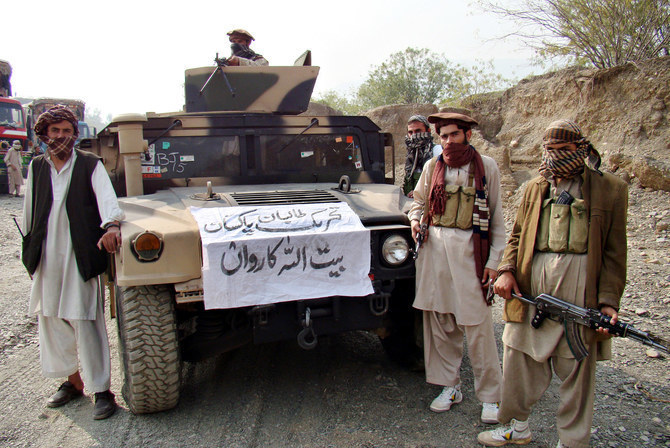
Armed militants of Tehreek-e-Taliban Pakistan (TTP) pose for photographs next to a captured armored vehicle in the Pakistan-Afghanistan border town of Landikotal on November 10, 2008. (AFP/FILE)
Short Url
Updated 20 October 2022
Follow

Provincial government in northwest ‘requests’ Pakistan Taliban to call back fighters from Swat Valley

  • Barrister Muhammad Ali Saif says he wants to find an ‘honorable solution’ to Pakistan’s conflict with TTP militants
  • Media reports indicate militants have returned to Swat after being driven out of the area in a 2009 military operation

ISLAMABAD: The official spokesperson of Khyber Pakhtunkhwa’s provincial administration on Wednesday “publicly requested” a proscribed militant faction to recall its armed fighters from the scenic Swat valley in the northwest of the country which has seen growing militant presence in recent weeks. 
Swat witnessed an upsurge in extremist violence more than a decade ago after it was taken over by Tehreek-e-Taliban Pakistan (TTP) which decided to establish its own brand of religious rule in the area.  Pakistan’s security forces launched a military operation to reclaim the district and its adjoining region in 2009, though senior TTP leaders melted away and later found refuge in neighboring Afghanistan. 
Media reports indicate militants have once again returned to Swat where thousands of residents recently protested after unidentified gunmen targeted a school van and killed the driver. 
Addressing a gathering at the Swat Press Club, the provincial administration’s spokesperson, Barrister Muhammad Ali Saif, assured the residents of the district that the days of violence and militancy would not return in the district “for the rest of our lives.” 
“I publicly request Taliban leaders in my personal capacity to recall those people who are working for them and are present in Swat – or any other part of Pakistan – and are armed and spreading fear [among people],” he said. 
“Give us a chance,” he continued. “We came to you [in Afghanistan] to discuss peace … We still want peace.” 
Saif said he wanted to find an “honorable solution to this conflict which has been going on in Pakistan for the last 20 years.” 
He added when the Pakistani government negotiated with the TTP leaders in Afghanistan, it told them that they would have to abide by the constitution on their return to the country.
Pakistan’s former prime minister Imran Khan told the media last year his administration was negotiating with the TTP since he was not in favor of military solution to conflicts. 
Khan’s government said it was also willing to offer amnesty to TTP militants if the laid down arms, abandoned their extremist ideology and adhered to the constitution. 
The negotiations between the two sides continued even after Khan was ousted from power in a no-confidence vote in April. 
However, Pakistan’s new defense minister Khawaja Muhammad Asif revealed last week the talks had remained inconclusive. 
He also maintained that another military operation in Swat was “not on the cards.” 


Sindh assembly passes resolution rejecting move to separate Karachi

Updated 21 February 2026
Follow

Sindh assembly passes resolution rejecting move to separate Karachi

  • Chief Minister Shah cites constitutional safeguards against altering provincial boundaries
  • Calls to separate Karachi intensified amid governance concerns after a mall fire last month

ISLAMABAD: The provincial assembly of Pakistan’s southern Sindh province on Saturday passed a resolution rejecting any move to separate Karachi, declaring its territorial integrity “non-negotiable” amid political calls to carve the city out as a separate administrative unit.

The resolution comes after fresh demands by the Muttahida Qaumi Movement (MQM) and other voices to grant Karachi provincial or federal status following governance challenges highlighted by the deadly Gul Plaza fire earlier this year that killed 80 people.

Karachi, Pakistan’s largest and most densely populated city, is the country’s main commercial hub and contributes a significant share to the national economy.

Chief Minister Syed Murad Ali Shah tabled the resolution in the assembly, condemning what he described as “divisive statements” about breaking up Sindh or detaching Karachi.

“The province that played a foundational role in the creation of Pakistan cannot allow the fragmentation of its own historic homeland,” Shah told lawmakers, adding that any attempt to divide Sindh or separate Karachi was contrary to the constitution and democratic norms.

Citing Article 239 of Pakistan’s 1973 Constitution, which requires the consent of not less than two-thirds of a provincial assembly to alter provincial boundaries, Shah said any such move could not proceed without the assembly’s approval.

“If any such move is attempted, it is this Assembly — by a two-thirds majority — that will decide,” he said.

The resolution reaffirmed that Karachi would “forever remain” an integral part of Sindh and directed the provincial government to forward the motion to the president, prime minister and parliamentary leadership for record.

Shah said the resolution was not aimed at anyone but referred to the shifting stance of MQM in the debate while warning that opposing the resolution would amount to supporting the division of Sindh.

The party has been a major political force in Karachi with a significant vote bank in the city and has frequently criticized Shah’s provincial administration over its governance of Pakistan’s largest metropolis.

Taha Ahmed Khan, a senior MQM leader, acknowledged that his party had “presented its demand openly on television channels with clear and logical arguments” to separate Karachi from Sindh.

“It is a purely constitutional debate,” he told Arab News by phone. “We are aware that the Pakistan Peoples Party, which rules the province, holds a two-thirds majority and that a new province cannot be created at this stage. But that does not mean new provinces can never be formed.”

Calls to alter Karachi’s status have periodically surfaced amid longstanding complaints over governance, infrastructure and administrative control in the megacity, though no formal proposal to redraw provincial boundaries has been introduced at the federal level.