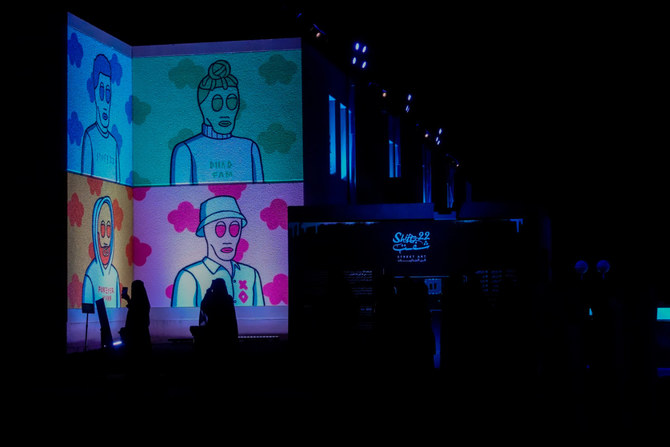

RIYADH: The walls of Irqah Hospital’s compound, thought among young Riyadh locals to be haunted, has been transformed into a canvas for local and international graffiti artists.
Once suppressed, the art is now celebrated as the Kingdom'd Visual Arts Commission presents its inaugural annual street art festival, Shift22.
The festival showcases commissioned and existing works from over 30 Saudi and international graffiti artists, focusing on murals, sound and video installations, and unconventional sculptures built by repurposing the abandoned hospital’s discarded materials.
Visual Arts Commission's CEO Dina Amin said: “Shift22 is part of the commission’s efforts to celebrate and encourage local and international visual artists by providing platforms for creative exchange and dialogue. This festival is an example of the many exciting visual arts opportunities that are a result of the growing local art scene.”
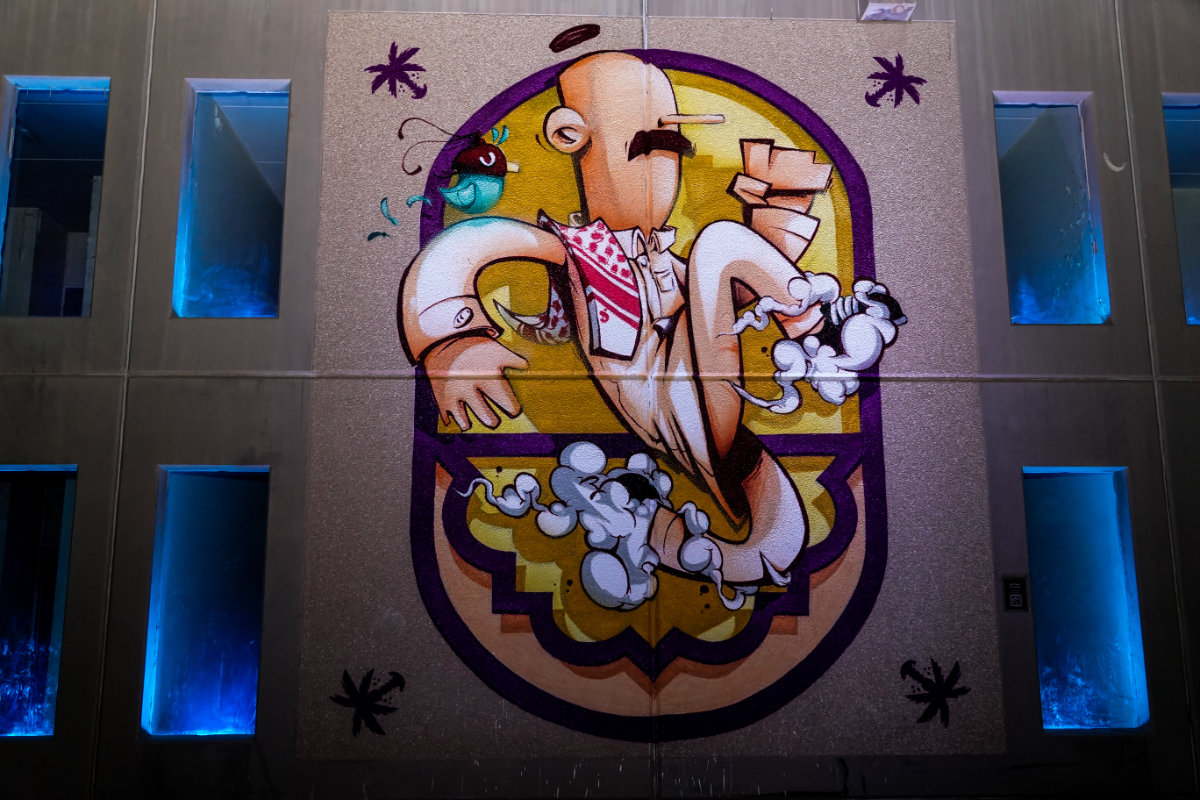
Saudi artist Deyaa Rambo’s piece ‘Harwala,’ an Arabic word for jogging, reflects a culture that is moving only forward with intention. (AN photo by Huda Bashatah)
Saudi artist Deyaa Rambo’s piece is inspired by the transformation of the country and its modern reality. “Harwala,” an Arabic word for jogging, reflects a culture that is only moving forward with intention.
“As a culture, we carry the past and present with us, to walk towards the future … The idea talks about how culture is moving forward towards development, but not at an incomprehensible speed: It’s a calculated speed,” Rambo told Arab News.
Coming from an artistic family, he credits his passion to the environment he was raised in. In the early 2000s, when graffiti first began surfacing within the region as a legitimate art form, he discovered the underground scene.
“Meeting other graffiti artists, I got inspired and realized I need to develop as an artist myself,” Rambo said
After creating a small community of like-minded individuals, importing spray cans, taking part in small projects, and the occasional bit of street vandalism, they opened up the first graffiti store in the Kingdom: DHAD.
Locally, the DHAD family has collaborated with schools, institutes, exhibitions, galleries, and companies such as Mercedes and HP to design inspiring, unique interiors and exteriors.
Globally, the community’s work was recognized and showcased in exhibitions and events across the Gulf and beyond, including Tunisia, Morocco, Malaysia, Germany, and France.
“DHAD is basically all about the lifestyle of graffiti, (providing) tools, spray cans for artists, This is when the community was first created in Saudi Arabia,” Rambo said.
Deriving his inspiration from fantastical elements, his piece reimagines a modern Saudi as an anonymous figure trotting forward in a traditional thobe and shemagh.
According to Rambo, the responsibility of spreading awareness about the art form lies ultimately with local artists, not just in dedicated spaces, but true to traditional graffiti style: Publicly.
“That’s our mission, because graffiti globally was fought against, that it sends a negative message. Graffiti art isn’t restricted to exhibitions or museums to see the art. It’s in the streets — it’s for everyone.”
Contributing Saudi artist Zeinab Al-Mahoozi began her journey in 2011, credited to her curiosity, using stencil techniques to create dynamic and captivating artworks. She made a promise to herself that if she succeeded in her first attempt at the method, she would dedicate a whole exhibition to her street artworks.
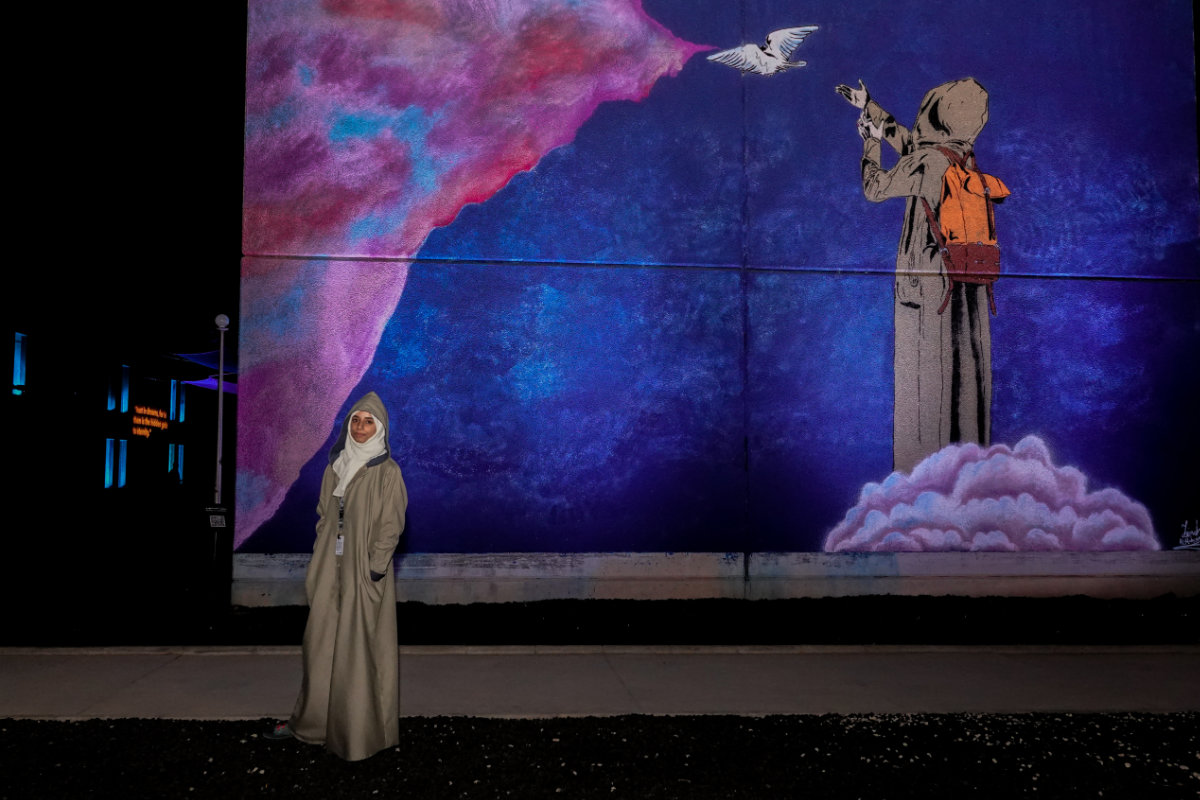
Contributing Saudi artist Zeinab Al-Mahoozi's mural shows her graffiti-d self setting a bird free into a corner of the universe. (AN photo by Huda Bashatah)
Her mural is a whimsical self-portrait, showing herself setting a bird free into a corner of the universe.
“Graffiti art is known as an illegal art form, but to be supported as graffiti artists from government sectors — either the Ministry of Culture, or media, or others — that’s something we really needed. We’re very happy about it, and we’re very lucky,” she said.
While Shift22 is dedicated to platforming local talent, it also creates cultural exchange opportunities as it hosts various artists from around the world to contribute to the festival.
Europe-based Australian artist James Reka, like many graffiti artists, was first introduced to the underground scene through skateboarding and hiphop culture. His 20 years of experience started off with traditional letterform graffiti, which later developed into characters and figures.
“I’m honored to be invited to come to Saudi Arabia to be able to leave my own message behind … It’s nice to be acknowledged that it is something special, it is an art form,” he told Arab News.
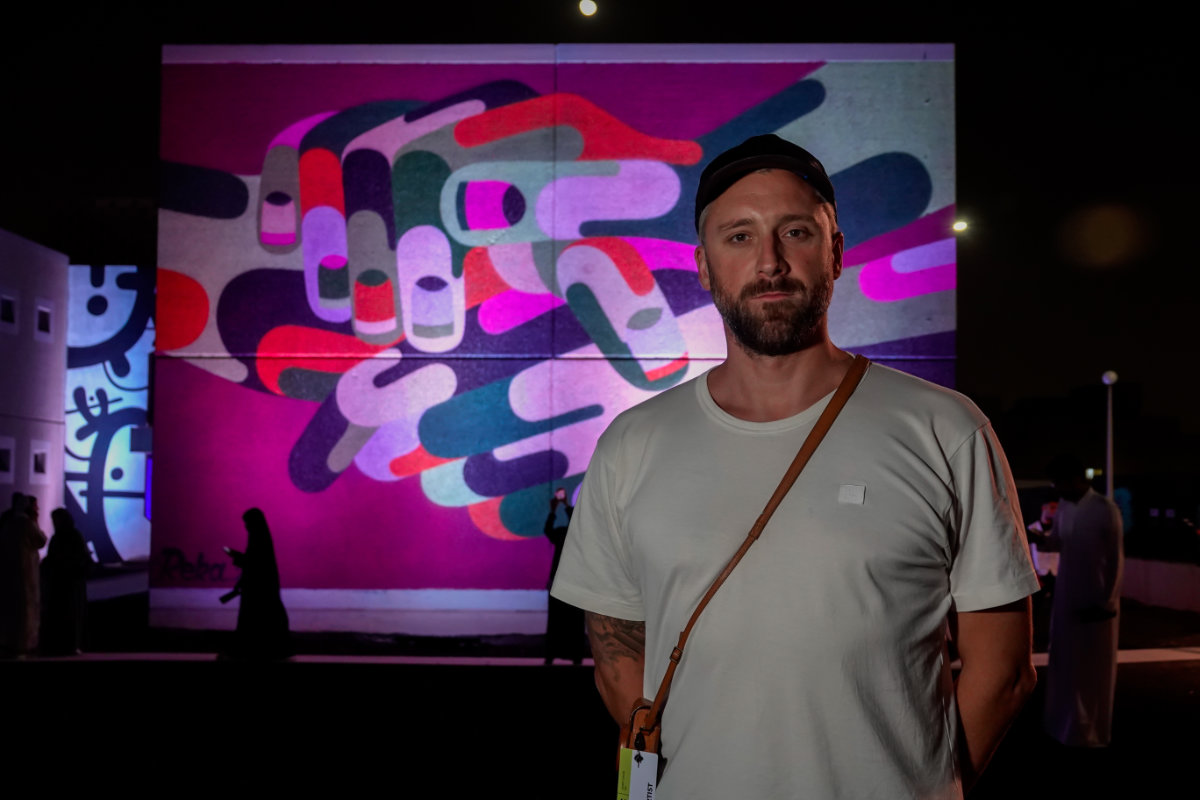
Australian James Reka’s work shows colorful hands reaching for each other, carrying the message that love and community are at the heart of graffiti culture. (AN photo by Huda Bashatah)
Adhering to his signature style, Reka’s work is abstract, but carries a message of unity. A closer look at the mural would show colorful hands all reaching for each other, embedding the idea that love and community are at the heart of graffiti culture.
“(I’m honored) to also be able to paint and meet with a lot of local artists and share common knowledge about art, creativity, life in general — we’re all children of this earth. It’s a small world sometimes, even though I came from the other side of the world, we have a lot of things in common,” Reka said.
The festival is held at the abandoned hospital, holding true to the vintage graffiti fashion of marking underground and deserted spaces.
The open-air exhibition was curated by the New York-based artistic agency Creative Philosophy, dedicating the theme to geometric patterns to parallel the hospital’s architecture.
In addition to featured works by renowned and upcoming artists, such as Saudi REXCHOUK and Turkish-American Refik Anadol, the festival will hold a series of workshops, seminars, and activities highlighting the various elements of street art.
The festival will run until Oct. 30 alongside live music, streetwear shops, street food, breakdancing, and skateboarding.