

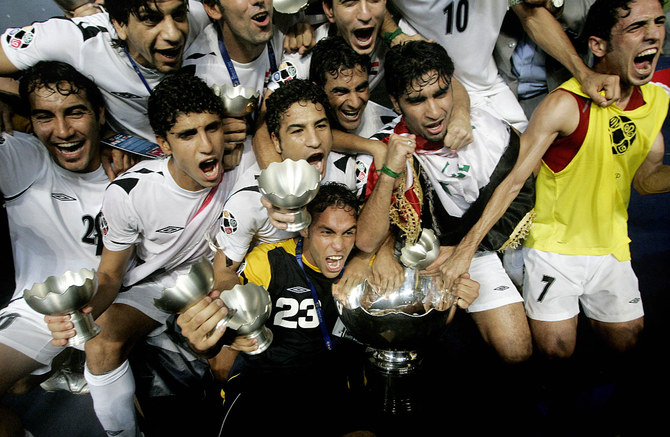

During the COVID-19 lockdown, I sat down to write a book on the history of Iraqi football.
Actually, it was three books.
The result was the trilogy of “Birth of the Lions of Mesopotamia: The early years of football in Iraq” (2020); “Lions of Mesopotamia: Iraqi football in the two Republics Vol. I” (2021); and “Lions of Mesopotamia: Iraqi football in the two Republics Vol. II” (2021).
On Oct. 2, exactly two years to the day since I had published my first book, I released my fourth book, “Far from War and Politics: The story of Iraq’s 2007 Asian Cup victory.”
Even as I was editing my second and third books, the idea of writing a book on the 2007 Asian Cup triumph had always been at the back of my mind, being as it was one of Iraq’s greatest sporting accomplishments.
These days, when people speak of Iraqi football, that astonishing achievement is the first thing that crops up.
In 2018, when I first started researching my book on the first Iraqi team of 1951, I asked respected Asian football journalist John Duerden if he thought of any publisher who would be interested in it. He suggested starting with “the Saddam era, the 2007 Asian Cup win and the issues following the invasion,” and then including details on the 1951 Iraqi team as historical background.
Four years on, and this is more or less what I have finished with. The story of 2007 is one that inspires.
Six months after speaking to Duerden, I met with Hassanane Balal of the Iraq Football Podcast, and former US Army sergeant-turned-journalist Adam Linehan at an Iraqi restaurant in London to discuss the 2007 Asian Cup and the stories behind the tournament.
Linehan, who served in Afghanistan and Iraq as an army medic, had been intrigued by the story of Iraq’s victory in Jakarta and was determined to make a documentary on the subject, which I became involved in and which is set to be released in the near future.
Iraq’s 2007 Asian Cup victory is the ultimate sporting underdog story — a tale of a football team from a war-torn nation winning against all odds.
But there is more to it than that.
The world only sat up and took notice of that Iraqi side after they beat South Korea on penalties in the semifinals, but the team’s story was multi-faceted and had begun many years earlier.
The seeds of the “Lions of Mesopotamia” were sown in 1998, during Saddam Hussein’s reign, as an under-17 side, and their road to that final in 2007 was full of obstacles. The players had to endure the challenges of representing the national team at international level and the greater hardships of the subsequent US occupation that had turned their lives upside down.
On the eve of the finals, the Iraqi FA appointed a new coach in Brazilian Jorvan Vieira, who no one had ever heard of before, after the team’s coach was sacked and three players suspended following a controversial match-fixing scandal during the Gulf Cup four months earlier.
The book goes into detail on how the team developed, and the stories and incidents that accompanied them before, during and after the 2007 Asian Cup.
I look at the era of Saddam, his son Uday and how he first got involved in football, and what happened to football in Iraq after the 2003 war. There are funny stories, controversies, tales of bribery, the Iraqi Balotelli and a lot more which I think people will find interesting, giving them an added layer to the victory in 2007.
I also wanted to document the stories of the players, from the likes of Nour Sabri and Nashat Akram, to Hawar Mohammed and former Iraqi Army conscript Younis Mahmoud. Collectively they would become the first Iraqi team known as the “Lions of Mesopotamia,” having achieved an unlikely triumph during one of Iraq’s most turbulent periods, uniting the nation along the way.
This book was different from the other three, primarily because the 2007 Asian Cup is still a vivid, somewhat recent memory, and having lived through it myself, it was easier to recall certain incidents and events. I could also go back to notes I had jotted down when the tournament took place 15 years ago, compared to the first three books which were set 70 years ago.
A decade and half on, the victory in 2007 remains an incredible story.
It is hard to convey just how divided the Iraqi team was only two days before the opening game. I wrote a whole chapter on what happened and it still continues to amaze me how the players, the coach and the FA turned it around.
The book is 536 pages long, but I wanted it to start at the very beginning when the team was first formed, and end after what became known as the “Miracle in Jakarta,” and I think people will understand why.
It signifies the end of one cycle and gives the complete story of the 2007 Asian Cup triumph and the Iraqi team, both an important part of Iraq’s football history and that of the country and its people as a whole.


