

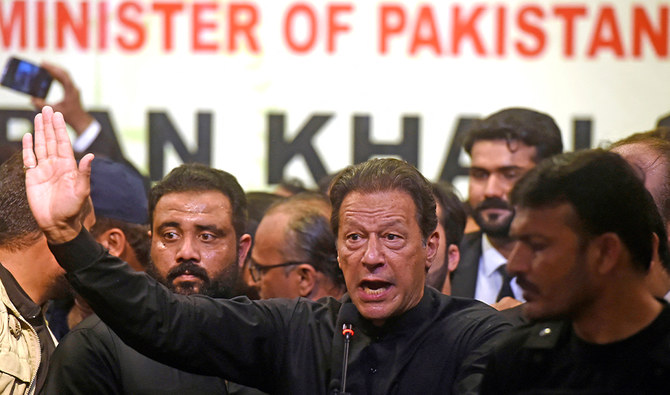
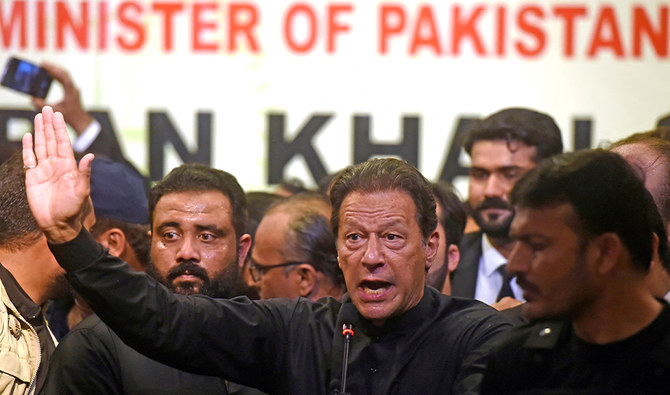
ISLAMABAD: Former Pakistan prime minister Imran Khan is a candidate for seven of eight national assembly seats up for grabs in a key by-election Sunday, a vote he says is “a referendum” on his popularity.
The by-election is the latest twist in political wrangling that began after Khan’s April 10 ouster via a parliamentary no-confidence vote.
It comes as the nation grapples with the aftermath of devasting monsoon floods that affected more than 30 million people and left a third of the country under water.
Candidates can stand for multiple seats in Pakistan elections. If they win more than one they choose which to keep, and a separate vote must later be held for those forfeited.
It is rare, however, for a candidate to stand for as many seats as Khan is doing Sunday, and his disruptive move is clearly to gauge his popularity.
“This is not just a simple election, it’s a referendum,” he told a rally late Friday in Karachi, the bustling port city in the south of the nation of 220 million.
Khan has held dozens of rallies since being ousted — drawing crowds of tens of thousands — and has vowed soon to announce the date of a “long march” of his supporters on the capital, Islamabad.
He is demanding the coalition government of Prime Minister Shehbaz Sharif calls an immediate general election rather than wait until October next year.
“If he wins most of the seats, he will press the government more,” political analyst Hassan Askari Rizvi told AFP.
“But the government will reject the election call, claiming it doesn’t reflect the national will.”
Khan has already scored a string of recent by-election victories, with his Pakistan Tehreek-e-Insaf (PTI) party seizing control in July of the state assembly in Punjab, the country’s most populous province.
He has, so far, also emerged largely unscathed from a series of court cases against him and his party.
Pakistan’s courts are often used to tie up lawmakers in tedious and long-winding proceedings that rights monitors have criticized for stifling political opposition.
Khan blames the current government for soaring inflation, although most analysts agree Sharif inherited the country’s economic woes.
Catastrophic flooding this summer put one-third of Pakistan under water, displaced eight million people, and caused at least an estimated $28 billion in damage.
The United Nations has warned of a “second wave” of catastrophe, with the risk that deaths from water-borne disease and malnutrition will outstrip the 1,700 drowned and electrocuted in the initial cascade.
Khan rode to power in 2018 on a populist platform promising social reforms, religious conservatism and fighting corruption, overturning decades of rule by two feuding political dynasties interspersed with military takeovers.
But, under his tenure, the economy stagnated and he lost the support of the army, which was accused of helping to get him elected.
Sunday’s polls take place in eight constituencies of three provinces — three each in Punjab and Khyber Pakhtunkhwa, where Khan’s party holds sway, and two in Sindh.
“This is indeed a litmus test of his popularity provided elections are held in a free and fair atmosphere and they are not rigged,” said Imtiaz Gul of the Center for Research and Security Studies in Islamabad.
“If he wins the majority of the seats, that will again be a testimony to the success of his narrative that he has built since his exit from power and that will obviously bring more pressure on the government.”


