

No.1 Swiatek rips Gauff to reach WTA San Diego semis

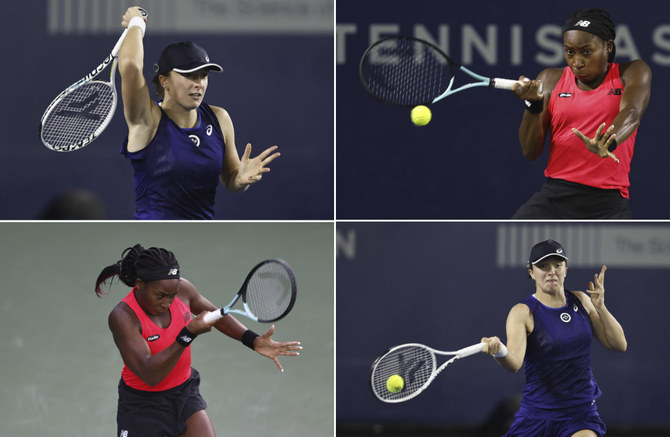
Combo image showing Iga Swiatek and Coco Gauff in action during their quarterfinal match in the San Diego Open on Oct. 14, 2022. (Getty Images/AFP)
Short Url
Updated 15 October 2022
Follow

No.1 Swiatek rips Gauff to reach WTA San Diego semis

  • Swiatek advanced to a Saturday semifinal against sixth-ranked Jessica Pegula, who defeated 18th-ranked US compatriot Madison Keys

SAN DIEGO, California: World number one Iga Swiatek, seeking her eighth WTA title of the year, cruised over eighth-ranked Coco Gauff on Friday to reach the San Diego Open semifinals.
In a rematch of the French Open women’s final, the 21-year-old Polish star rolled over 18-year-old American Gauff 6-0, 6-3 in 65 minutes.
Three-time Grand Slam champion Swiatek advanced to a Saturday semifinal against sixth-ranked Jessica Pegula, who defeated 18th-ranked US compatriot Madison Keys 6-4, 7-5.
Croatia’s Donna Vekic made the semifinals by ousting fifth-ranked Aryna Sabalenka 6-4, 6-7 (5/7), 6-1.
Vekic, ranked 77th, will next face the winner of a later match between Spain’s fourth-ranked Paula Badosa and 19th-ranked American Danielle Collins.
Swiatek won her WTA-best 62nd match triumph of the year in her tour-best 12th quarter-final of the season.
Swiatek, a runner-up last week at Ostrava, seeks her 11th career WTA title and her eighth of the year after crowns at Qatar, Indian Wells, Miami, Stuttgart, Rome and the US and French Opens.
Gauff fell to 0-4 all-time against Swiatek, having lost last year in Rome and this year at Miami and Roland Garros, where Swiatek dispatched her 6-1, 6-3 for the trophy.
Swiatek broke three times to lead 5-0, saved two break points in the final game and held to claim the opening set after 29 minutes. Swiatek broke to open and close the second set for the victory.
Swiatek is 3-1 all-time against Pegula, having lost their first meeting in 2019 at Washington but won this year at the Miami semifinals and US and French Open quarter-finals.
Vekic improved to 5-1 all-time over Sabalenka after two hours and 37 minutes to reach her first semifinal of the year.


Football returns to Gaza pitch scarred by war and loss

Updated 11 sec ago
Follow

Football returns to Gaza pitch scarred by war and loss

  • Fans gather to cheer the first football tournament in two years in the ruins of Gaza City’s Tal Al-Hawa district
  • 'No matter what happened in ‌terms of destruction and genocidal war, we continue with playing,' Gazan footballer says
On a worn-out five-a-side pitch in a wasteland of ruined buildings and rubble, Jabalia Youth took on Al-Sadaqa in the Gaza Strip’s first organized football tournament in more ​than two years.
The match ended in a draw, as did a second fixture featuring Beit Hanoun vs Al-Shujaiya. But the spectators were hardly disappointed, cheering and shaking the chain-link fence next to the Palestine Pitch in the ruins of Gaza City’s Tal Al-Hawa district.
Boys climbed a broken concrete wall or peered through holes in the ruins to get a look. Someone ‌was banging on ‌a drum.
Youssef Jendiya, 21, one ‌of ⁠the ​Jabalia Youth ‌players from a part of Gaza largely depopulated and bulldozed by Israeli forces, described his feeling at being back on the pitch: “Confused. Happy, sad, joyful, happy.”
“People search for water in the morning: food, bread. Life is a little difficult. But there is a little left of the day, when you can come and play ⁠football and express some of the joy inside you,” he said.
“You come to the ‌stadium missing many of your teammates... killed, ‍injured, or those who ‍traveled for treatment. So the joy is incomplete.”
Four months since a ‍ceasefire ended major fighting in Gaza, there has been almost no reconstruction. Israeli forces have ordered all residents out of nearly two-thirds of the strip, jamming more than 2 million people into a sliver of ​ruins along the coast, most in makeshift tents or damaged buildings.
The former site of Gaza City’s 9,000-seat ⁠Yarmouk Stadium, which Israeli forces levelled during the war and used as a detention center, now houses displaced families in white tents, crowded in the brown dirt of what was once the pitch.
For this week’s tournament the Football Association managed to clear the rubble from a collapsed wall off a half-sized pitch, put up a fence and sweep the debris off the old artificial turf.
By coming out, the teams were “delivering a message,” said Amjad Abu Awda, 31, a player for Beit Hanoun. “That no matter what happened in ‌terms of destruction and genocidal war, we continue with playing, and with life. Life must continue.”