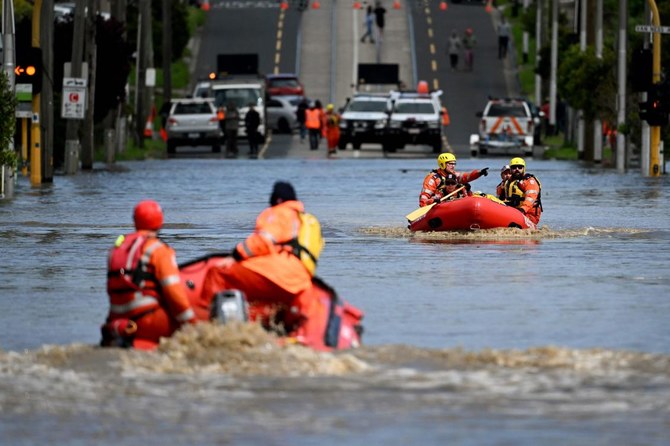
SYDNEY: Thousands of people across Australia’s southeast were asked to evacuate their homes on Friday, including some in a western suburb of Melbourne, after two days of incessant rains triggered flash flooding and fast-moving waters burst river banks.
Large parts of Victoria state, southern New South Wales and the northern regions of the island state of Tasmania were pounded by an intense weather system with some taking more than a month’s worth of rain since late Wednesday, officials said.
“Our river systems... are reaching major flood levels at various times over today, through the weekend and through next week,” Victoria emergency services chief operations officer Tim Wiebusch told reporters.
Many rivers in Victoria, including the Maribyrnong in Melbourne’s west and the Goulburn further north, reached major flood levels, prompting the night-time evacuation of residents.
The Goulburn River at Seymour, about 100 kilometers north of Melbourne, has peaked above the record 7.64 meters (25 ft) reached in May 1974, data showed. More than 200 flood rescues were conducted by emergency crews.
Upstream in Shepparton, rising flood waters are expected to surpass the 1974 peak by Tuesday and threaten over 4,000 properties.
“In terms of property damage, road, public infrastructure and the sheer volume of water, this is going to set new records,” Victorian Premier Daniel Andrews said at a news conference.
Andrews said a decision would be made on Saturday about reopening the state’s purpose-built COVID-19 quarantine facility, closed last week after Australia scrapped isolation rules, to shelter flood-impacted residents.
Prime Minister Anthony Albanese said the federal government stood ready to provide assistance to the flood-stricken states.
“There are already ADF (Australian Defense Force) personnel on the ground in Victoria ... this is a difficult time, my heart goes out to those communities affected at this time,” local media quoted him as saying.
Footage on social media showed people wading through knee-deep water with their pets and some being rescued in boats, while local media reported about 200 stud horses were at risk of being washed away in the rural Victorian town of Mangalore.
“Everyone is in a state of ‘how is this actually happening?’” Maribyrnong suburb resident Matt Iozzi, who had to evacuate in the early hours of Friday morning, told the Australian Broadcasting Corp.
“I spoke to a few neighbors, everyone was on their way out or planning to leave in the next 30 minutes after seeing how fast the water was rising.”
About 1,000 residents of Wedderburn, a small town 200 km (125 miles) north of Melbourne, were ordered to evacuate urgently due to the potential breach of a nearby dam.
Agnico Eagle’s Fosterville gold mine, Victoria’s largest, paused all non-essential operations, the company said. A spokesperson said that the resumption of full operations could take several days.
In Tasmania, the flooding crisis intensified with fresh evacuation orders on Friday, while hundreds of residents in southern New South Wales spent the night in evacuation centers.
Rains had eased by Friday afternoon but the weather bureau has warned of another potential wild weather system next week.
Devastating floods have repeatedly struck Australia’s east coast since early last year because of a multi-year La Nina weather phenomenon, which brings more rain.


![]()

Australia suffers flash floods in southeast, Melbourne suburb evacuated
Short Url
https://arab.news/zunq4
Australia suffers flash floods in southeast, Melbourne suburb evacuated


Latest updates




© 2026 SAUDI RESEARCH & PUBLISHING COMPANY, All Rights Reserved And subject to Terms of Use Agreement.