

Baltimore murder case dropped against Pakistani-American Adnan Syed, subject of ‘Serial’ podcast

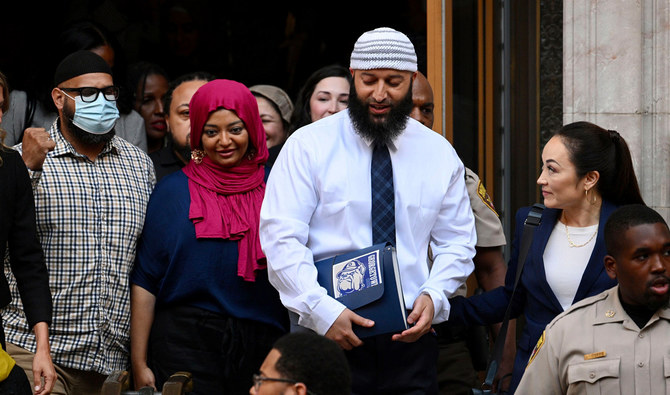
Adnan Syed (center right) leaves the courthouse after a hearing on September 19, 2022, in Baltimore. (AP/File)
Short Url
Updated 12 October 2022
Follow

Baltimore murder case dropped against Pakistani-American Adnan Syed, subject of ‘Serial’ podcast

  • Syed was found guilty of 1999 killing of his ex-girlfriend in a case that drew national attention after “Serial” raised doubts about his guilt
  • Syed has maintained he was innocent and did not kill Hae Min Lee, who was 18 when she was strangled and buried in a Baltimore park

CHICAGO: Baltimore prosecutors on Tuesday dismissed their case against a Pakistani origin American man found guilty of the 1999 killing of his ex-girlfriend in a case that drew national attention after the podcast “Serial” raised doubts about his guilt.

Adnan Syed, 42, served more than 20 years in prison for the slaying of Hae Min Lee. A circuit court judge vacated the murder conviction last month and released him after an investigation identified problems with the case, leaving prosecutors to decide whether to retry him.

On Tuesday, the State’s Attorney for Baltimore City Marilyn Mosby said during a news conference that she ordered prosecutors to drop the criminal case against Syed after DNA testing cast doubt on his guilt.

“The criminal justice system should be based on fair and just prosecution and crux of the matter is that we are standing here today because that wasn’t done 23 years ago,” she said, apologizing to the Lee and Syed families. “Today, justice is done.”

Mosby said no DNA was recovered from Lee’s skirt, panty hose or jacket during a touch DNA testing that was recently performed for the first time on the evidence. She added that DNA was found on Lee’s shoes, but it was not from Syed.

“Finally, Adnan Syed is able to live as a free man,” Syed’s lawyer, Erica Suter, said in a statement released to local media.

Mosby said the investigation into who killed Lee remains open.

Syed has maintained he was innocent and did not kill Lee, who was 18 when she was strangled and buried in a Baltimore park. The podcast “Serial,” produced by Chicago public radio station WBEZ, drew national attention to the case in 2014.

Prosecutors filed a motion on Sept. 15 to vacate the conviction after conducting a yearlong investigation alongside a public defender representing Syed. Several problems were found with witnesses and evidence from the trial, the investigation found.

Four days later, prosecutors told Baltimore Circuit Court Judge Melissa Phinn that they no longer had confidence in “the integrity of the conviction,” and that justice required that Syed at least be afforded a new trial.

Prosecutors said they had discovered new information about two alternative suspects, whom they have not named, including one who had threatened to kill Lee, and both of whom have a history of violent crimes against women. Their identities were known to the original prosecutors but not disclosed to the defense as required by law.

Phinn then ordered Syed to be released from prison, where he was serving a life sentence, and put him on home detention.

Mosby said Syed will need to go through an innocence certification process for those who are wrongly convicted.


ICC to hold hearing on charges against former Philippine President Rodrigo Duterte

Updated 2 sec ago
Follow

ICC to hold hearing on charges against former Philippine President Rodrigo Duterte

THE HAGUE: Prosecutors at the International Criminal Court will begin presenting evidence Monday to support their charges against former Philippine President Rodrigo Duterte, detailing his alleged involvement in dozens of killings as part of his so-called war on drugs.
The ex-leader is facing three counts of crimes against humanity for deadly anti-drugs crackdowns he oversaw, first while he served as mayor of the southern Philippine city of Davao and later as president.
Rights groups and families of victims hailed Duterte’s arrest in March, saying it was a step forward for justice.
“We have waited for this for so long, for years we have waited, but we did not relent,” Llore Pasco told reporters at a news conference ahead of the hearing. She said both of her sons left for work in May 2017 and never returned. Their bodies were later found riddled with bullets.
The hearing is not a trial, but allows prosecutors to outline their case in court. After weighing the evidence, judges have 60 days to decide whether or not to confirm the charges.
Duterte will not be present for the hearing at The Hague-based court. He waived his right to appear, writing in a letter to judges that he did not want to attend legal proceedings “that I will forget within minutes. I am old, tired, and frail.”
He also called the charges against him an “outrageous lie.”
Last month, judges found the octogenarian was fit to stand trial, after postponing an earlier hearing over concerns about his health.
Supporters of Duterte criticized the administration of current Philippine President Ferdinand Marcos Jr., Duterte’s political rival, for arresting and surrendering the former leader to a court whose jurisdiction they dispute. Detractors include his daughter, current Philippine Vice President Sara Duterte who announced last week that she would seek the presidency in the 2028 elections.
Sheerah Escudero is worried about what will happen if another Duterte comes to power. The body of her 18-year-old brother was found wrapped in packaging tape in 2017. “We know that the same policy of killings will continue,” she told reporters ahead of the hearing.
Prosecutors at the ICC announced in February 2018 that they would open a preliminary investigation into the violent drug crackdowns. In a move that human rights activists say was aimed at escaping accountability, Duterte, who was president at the time, announced a month later that the Philippines would leave the court.
Judges rejected a request from Duterte’s legal team to throw out the case on the grounds that the court did not have jurisdiction because of the Philippine withdrawal. Countries can’t “abuse” their right to withdraw from the court’s foundational Rome Statute “by shielding persons from justice in relation to alleged crimes that are already under consideration,” the September decision says.
An appeal of that decision is still pending.
Estimates of the death toll during Duterte’s presidential term vary, from the more than 6,000 that the national police have reported to up to 30,000 claimed by human rights groups.