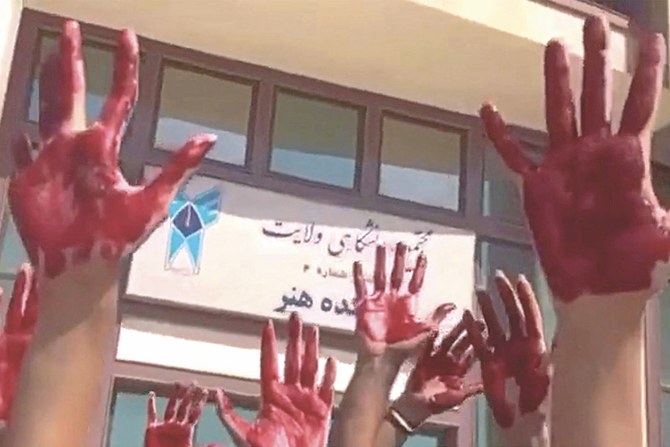
JEDDAH: Iranian security chiefs on Tuesday deployed tanks, a warplane and busloads of special forces to the city of Sanandaj in Kurdistan province, as more than three weeks of protests showed no sign of abating.
Kurdistan is the home province of Mahsa Amini, 22, whose death in morality police custody sparked the nationwide wave of demonstrations. More than 200 people have been killed in Iran’s brutal response to the protests.
Protests have been especially intense in Sanandaj, where rights groups fear heavy casualties and accuse authorities of resorting to shelling neighborhoods.
The Norway-based Hengaw rights group said an Iranian warplane had arrived at the airport in Sanandaj, and buses carrying special forces were on their way to the city.
Amnesty International said it was “alarmed by the crackdown on protests in Sanandaj amid reports of security forces using firearms and firing tear gas indiscriminately, including into people’s homes.”
The Center for Human Rights in Iran said there was a risk of a similar situation in Sistan-Baluchistan province in the southeast, where activists say more than 90 people have been killed since Sept. 30.
“The ruthless killings of civilians by security forces in Kurdistan province, on the heels of the massacre in Sistan-Baluchistan province, are likely preludes to severe state violence to come,” said its director Hadi Ghaemi.
Among those arrested in the security crackdown was the daughter of Iran’s former president Akbar Hashemi Rafsanjani. Faezeh Hashemi, 59, a former member of parliament and a women’s rights activist, was detained in Tehran on Sept. 27 for inciting residents to take part in demonstrations. Judicial authorities said she had been charged with “collusion, disruption of public order, and propaganda against the Islamic republic.”


Iran sends tanks, warplane to restive Kurdistan
https://arab.news/6f3wg
Iran sends tanks, warplane to restive Kurdistan


The art of war: fears for masterpieces on loan to Louvre Abu Dhabi
- UAE paid more than €1 billion to borrow priceless works, but experts in France want them back
PARIS: The Middle East war has raised fears for the safety of priceless masterpieces on loan from France to the Louvre Abu Dhabi, the museum’s only foreign branch.
The Abu Dhabi museum, which opened in 2017, has so far escaped damage from nearly 1,800 Iranian drone and missile strikes launched since the conflict erupted on Feb. 28.
However, concerns are mounting in France. “The works must be removed,” said Didier Selles, who helped broker the original agreement between France and the UAE.
French journal La Tribune de l’Art echoed that alarm. “The Louvre’s works in Abu Dhabi must be secured!” it said.
France’s culture ministry said French authorities were “in close and regular contact with the authorities of the UAE to ensure the protection of the works loaned by France.”
Under the agreement with the UAE, France agreed to provide expertise, lend works of art and organize exhibitions, in return for €1 billion, including €400 million for licensing the use of the Louvre name. The deal was extended in 2021 to 2047 for an additional €165 million.
Works on loan include paintings by Rembrandt and Chardin, Classical statues of Isis, Roman sarcophagi and Islamic masterpieces: such as the Pyxis of Al-Mughira.
A Louvre Abu Dhabi source said the museum was designed to protect collections from both security threats and natural disasters.