

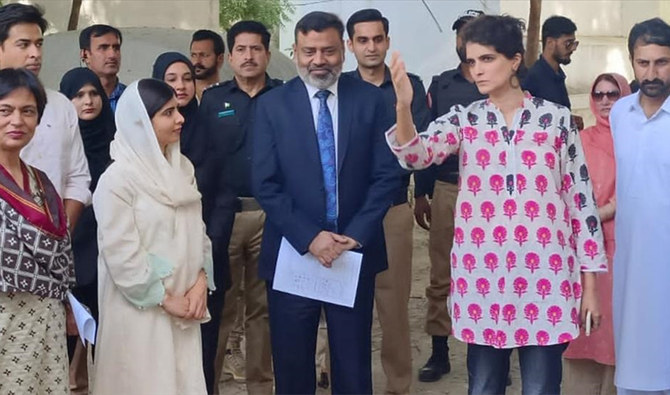
Malala Yousafzai in Pakistan to visit flood-hit areas, spends day at Karachi government college

Pakistani activist and Nobel Peace Prize laureate Malala Yousafzai visits Government Elementary College of Education Azizabad, Karachi on October 11, 2022. (@Roohan_Ahmed/Twitter)
Short Url
Updated 11 October 2022
Follow

Malala Yousafzai in Pakistan to visit flood-hit areas, spends day at Karachi government college

  • Malala is returning to Pakistan on the 10th anniversary of being shot in her hometown of Swat by a Taliban gunman
  • She visited Government Elementary College Azizabad, discussed promotion of education, teacher training with staff

KARACHI: Pakistani Nobel Peace Prize winner Malala Yousafzai spent time at a government college in Karachi on Tuesday, a senior education official in the city said, ahead of a visit tomorrow, Wednesday, to areas in Pakistan devastated by floods that have left over 1,700 people dead and 33 million scrambling to survive. 

Malala is returning to Pakistan on the 10th anniversary of being shot in her hometown of Swat by a Taliban gunman for her outspoken advocacy for girls’ education. She has since won the Nobel Peace Prize and co-founded the Malala Fund. She has lived in the United Kingdom since the attempt on her life. 
“Malala visited Government Elementary College of Education Azizabad,” Professor Dr. Khalid M. Iraqi, vice-chancellor of Karachi University with which the college is affiliated, told Arab News. “She spent almost an hour there and discussed with us the promotion of education in the country, especially the training of teachers.” 

The college has been adopted by Durbeen, a non-profit organization that aims to staff public schools in Pakistan with professional teachers. 

In an email response to Arab News, a Malala fund spokesperson said Malala and Ziauddin Yousafzai, her father, were in Pakistan to help keep international attention focused on the impact of recent floods and reinforce the need for critical humanitarian aid. 

“The trip is an extension of Malala Fund’s flood relief efforts,” the statement said, adding that the Fund had supported an emergency grant to support relief efforts and the well-being of girls and young women in Pakistan. 

“Malala has also joined wider calls for emergency aid and called on world leaders to provide funds to protect livelihoods in impacted regions. She supported an appeal led by the Disasters Relief Committee, a group of 15 UK charities, which helped raise over £30 million for flood relief.” 

Yousafzai arrived in Karachi early on Tuesday morning, a Pakistan Civil Aviation Authority spokesperson said. The schedule and duration of her visit have not been shared with media. 

In 2009 at age 12, Malala blogged under a pen name for the BBC about living under the rule of the Pakistani Taliban. In 2012 she survived being shot in the head by a Taliban gunman. In 2014, she became the youngest-ever Nobel Peace Prize laureate at age 17. In 2018 she launched Assembly, a digital publication for girls and young women available on Apple News. She graduated from Oxford University in June 2021. 


Pakistan raises fuel prices by Rs55 per liter as Middle East conflict drives oil surge

Updated 06 March 2026
Follow

Pakistan raises fuel prices by Rs55 per liter as Middle East conflict drives oil surge

  • Government says adequate fuel stocks in place despite global energy shock
  • Oil prices jump from about $78 to over $106 per barrel amid regional conflict

ISLAMABAD: Pakistan on Friday increased petrol and diesel prices by Rs55 ($0.20) per liter each as escalating conflict in the Middle East sent global oil prices sharply higher and disrupted energy supply routes, officials said.

Global oil markets have been rattled since coordinated strikes by the United States and Israel against Iran began last week, triggering retaliatory attacks across the region, raising fears of disruption to key energy shipping routes and pushing petroleum prices sharply upward.

The price adjustment in Pakistan was announced after a joint press conference by Finance Minister Muhammad Aurangzeb, Deputy Prime Minister and Foreign Minister Ishaq Dar and Petroleum Minister Ali Pervaiz Malik, who said the government was monitoring international energy markets and domestic supply conditions amid the crisis.

“So, the decision we have made by changing the levy a little bit is that we are going ahead with increasing the price of both fuels, petrol and diesel, by Rs55 ($0.20),” Malik told reporters. 

“And as soon as this matter settles, we will revise the prices downward with the same speed and take steps on how to increase people’s income and purchasing power.”

He said Pakistan entered the crisis with “comfortable energy reserves” due to earlier planning but rising global prices had forced the government to adjust domestic fuel rates to maintain supply continuity.

He said international petrol prices had climbed from roughly $78 per barrel on March 1 to around $106.8 per barrel, while diesel prices had risen to about $150 per barrel.

Malik added that the government had taken steps to minimize the burden on consumers, noting diesel plays a critical role in agriculture, transportation and public mobility.

Malik also warned that authorities would take strict action against anyone attempting to hoard fuel or manipulate supply for profiteering.

The minister said Pakistan was working with international partners to secure additional energy supplies, including arrangements with Saudi Aramco and the use of Pakistan National Shipping Corporation vessels to transport crude oil imports.

Finance Minister Aurangzeb said a high-level government committee formed by Prime Minister Shehbaz Sharif had been meeting daily to review developments in global petroleum markets and their potential impact on Pakistan’s economy.

“Pakistan currently maintains adequate energy stocks and macroeconomic stability,” Aurangzeb said, adding that the government’s response was based on preparedness rather than panic.

He said the committee, which includes senior ministers, the governor of the State Bank of Pakistan and other officials, was assessing short-, medium- and long-term implications of the crisis for inflation, foreign exchange reserves and broader economic indicators.

Deputy PM Dar said the regional conflict had significantly disrupted global energy markets, with international petroleum prices rising by as much as 50–70 percent in recent days.

The deputy prime minister added that Pakistan was also engaged in diplomatic efforts aimed at de-escalating tensions and restoring stability in the region.

Petroleum prices will now be reviewed more frequently, potentially on a weekly basis, and any reduction in global oil prices would be passed on to consumers.

Pakistan, which relies heavily on imported fuel to meet its energy needs, is particularly vulnerable to global oil price shocks that can quickly feed into inflation and pressure the country’s external accounts.