

Thousands protest after deadly attack on Pakistan school van 

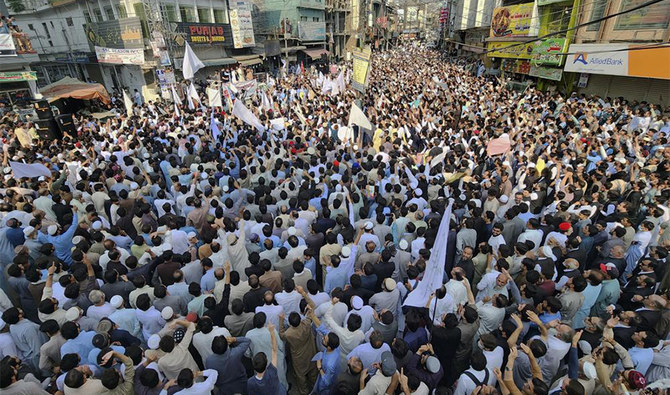
People take part in a protest rally to condemn the killing of a school van driver by a gunman in a Monday attack and demanding the immediate arrest of the attacker, in Mingora, Swat Valley, Pakistan, Tuesday, Oct. 11, 2022. (AP)
Short Url
Updated 11 October 2022
Follow

Thousands protest after deadly attack on Pakistan school van 

  • School van attack coincided with the 10th anniversary of Malala Yousufzai being shot in Swat 
  • Protesters demanded immediate arrest of the attackers and for peace and order to be restored 

PESHAWAR: Thousands of people protested in northwest Pakistan on Tuesday after a gunman opened fire on a school van, killing the driver and critically injuring a child, a decade after schoolgirl Malala Yousufzai was shot by the Taliban in the same city. 
Monday’s attack took place in Mingora in the Gully Bagh neighborhood, sparking fears of a resurgence in militant activity in the Swat Valley. 
The Swat Valley was the focus of a monthslong army offensive in 2009 to push out militants from the area, but the operation also displaced hundreds of thousands of people. 
Political activists, members of civil society and members of the public thronged to the city’s main intersection chanting slogans denouncing the Gully Bagh attack. The mass protest brought the city to a standstill, with businesses and markets closing in solidarity. 
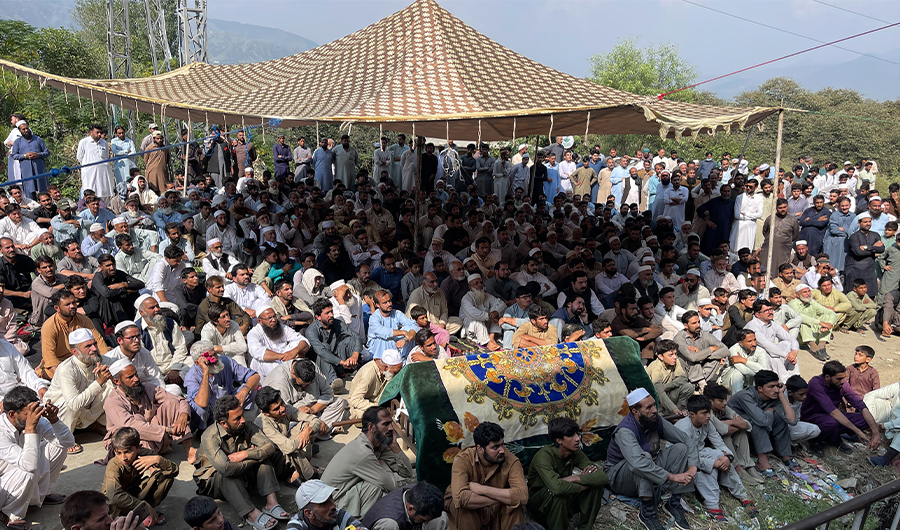


Relatives and residents take part in a protest with the body of a school bus driver a day after he was shot dead in an attack on his bus in Mingora on October 11, 2022. (AFP)

Protesters demanded the immediate arrest of the attackers and for peace and order to be restored. One placard read: “We cannot let the hard earned peace be destroyed,” while another read: “Act now against the attackers before it becomes too late.” 
The school van attack coincided with the 10th anniversary of Yousufzai being shot in Swat for her outspoken advocacy for girls’ education. On Tuesday, the Nobel winner arrived in Pakistan to visit flood-hit areas.
The funeral for the driver killed in Monday’s attack hadn’t yet take place as his relatives are demanding the arrest of the perpetrators. A protest was also held in Gully Bagh, with the driver’s casket put out on the street. Police have made security arrangements at both the places to avert any violence. 
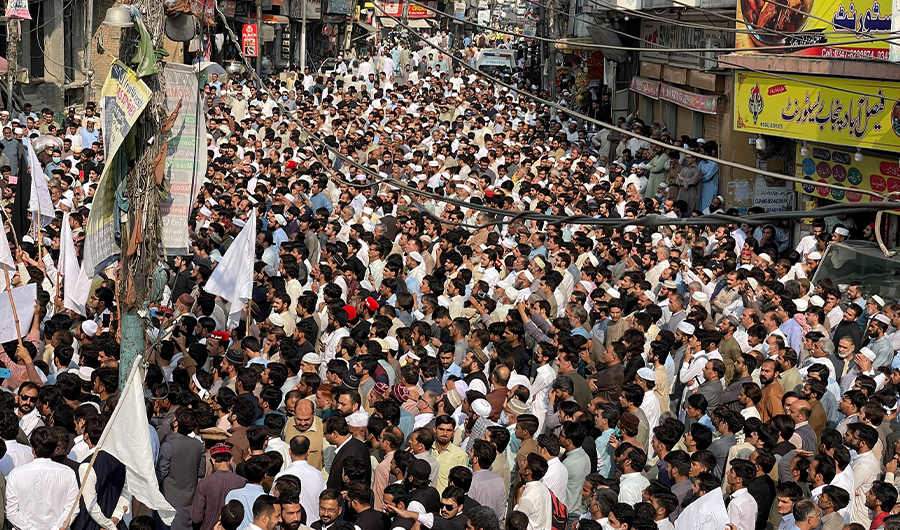


Residents take part in a protest a day after an attack on a school bus in Mingora on October 11, 2022. (AFP)

No one claimed immediate responsibility for the shooting. A local police officer, Zafar Khan, said Monday that a hunt was underway to trace the attackers who fled the scene on a motorcycle. 
Sawab Khan, president of the Private Schools Management Association, told The Associated Press that all 1,300 private schools in the Swat Valley were shut Monday and Tuesday. From Wednesday, the private schools will observe a partial strike and teachers and staff will hold a demonstration. 


Pakistan says Indonesia’s Pertamina exploring cooperation in ‘vast untapped potential’ in minerals 

Updated 6 sec ago
Follow

Pakistan says Indonesia’s Pertamina exploring cooperation in ‘vast untapped potential’ in minerals 

  • Islamabad is pitching its largely untapped mineral sector to foreign investors as a new pillar of economic recovery and industrial growth
  • Jakarta is eyeing overseas mining partnerships through Pertamina to leverage its exploration expertise and secure strategic raw materials

ISLAMABAD: Indonesia has expressed interest in engaging in Pakistan’s largely untapped mineral sector, with Jakarta’s state-owned energy company Pertamina seen as a potential partner for exploration and mining cooperation, a statement from Pakistan’s Information Ministry said this week.

The engagement comes as Pakistan positions mining as a potential engine of long-term growth, following years of underinvestment and stalled projects, and as resource-rich Asian economies increasingly look overseas to secure supplies of critical minerals and diversify investment portfolios.

Government and industry estimates suggest Pakistan’s untapped mineral resources could be worth trillions of dollars, anchored by major copper-gold deposits such as Reko Diq, as well as coal, iron ore and emerging critical minerals. Meanwhile, Indonesia, one of the world’s leading producers of minerals such as nickel, coal and copper, has in recent years expanded the role of its state-owned firms in overseas energy and extractive ventures, driven by rising domestic demand, industrial policy linked to downstream processing and global competition for strategic resources.

Against this backdrop, Federal Minister for Petroleum Ali Pervaiz Malik met Indonesia’s Ambassador to Pakistan, Chandra Warsenanto Sukotjo, on Thursday to discuss cooperation with a particular focus on minerals and exploration, the information ministry said.

“Indonesia’s state-owned company, Pertamina, possesses extensive experience in exploration, and avenues for cooperation in exploration activities between the two countries could be explored,” the Indonesian ambassador said, according to the statement.

Malik welcomed Indonesia’s interest and assured full government support, highlighting what the statement described as Pakistan’s “vast untapped potential” in minerals and exploration. He encouraged Indonesian companies to partner with Pakistani firms on mutually beneficial projects.

The petroleum minister also formally invited Indonesia to participate in the Pakistan Minerals Investment Forum (PMIF) 2026, telling the ambassador that the upcoming event would be significantly larger than the previous two editions and aimed at attracting a wider pool of international investors.

Both sides agreed to continue engagement and explore concrete opportunities to deepen cooperation across minerals, exploration and energy, the statement said, framing the talks as part of broader efforts to strengthen Pakistan–Indonesia economic ties beyond traditional diplomatic and cultural links.

Pakistan holds significant reserves of copper, gold, coal and other minerals across Balochistan, Khyber Pakhtunkhwa and Gilgit-Baltistan, but officials say much of this potential remains underdeveloped due to legal disputes, infrastructure gaps and lack of foreign investment. In recent years, Islamabad has sought to change that by resolving long-running disputes, hosting international mineral investment forums, and courting partners from North America, the Gulf and Asia.

The government has placed particular emphasis on large-scale projects such as the Reko Diq copper-gold mine in Balochistan, while also encouraging smaller exploration and mining ventures through joint partnerships with foreign companies and state-owned enterprises.