

G1 Panelist: ‘Saudi Arabia used technology to maintain education during pandemic’

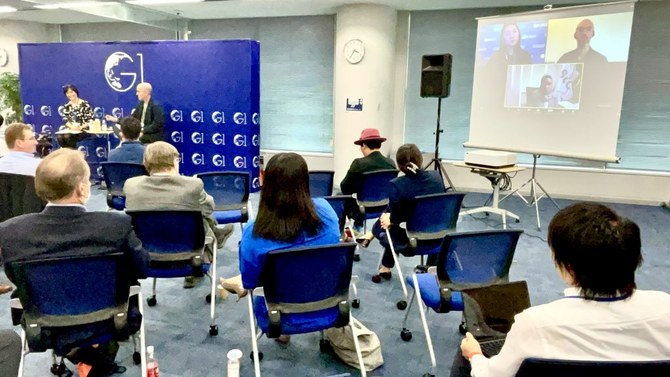
Aljamea said it was a challenge to switch from a limited time working at home to doing it virtually all of the time. (ANJ Photo)
Short Url
Updated 11 October 2022
Follow

G1 Panelist: ‘Saudi Arabia used technology to maintain education during pandemic’

  • “Working from home” methodology had been in place and in practice at STC before the pandemic, said Aljamea

TOKYO: At the Global G1 Conference 2022, Dr. Moudhi Aljamea of STC Academy and a member of the panel on “Crafting a Grand Design for Digital Education after the Covid Pandemic,” related how Saudi Telecom responded to the recent COVID-19 pandemic as far as education was concerned.

Aljamea said that, as with other countries, the pandemic took Saudi Arabia by surprise but noted that STC had been making serious efforts for a decade to develop and enable digital access and awareness in the Kingdom.  In fact, “working from home” methodology had been in place and in practice at STC before the pandemic, with 18 days per year to be worked from home. When the pandemic hit, the system was already up and running and STC staff were experienced with using it.

However, Aljamea said it was a challenge to switch from a limited time working at home to doing it virtually all of the time. STC saw adapting the system to an everyday practice as an opportunity. STC developed software to maintain the system during the pandemic to support productivity, communication and normal workplace socialization, and much of this software remains in use.  

Aljamea admitted that STC had not taken the importance of on-line learning capabilities and tools quite as seriously before the pandemic, but that has changed as a result of the pandemic.


As a company, STC provided free access for learning platforms for people studying at home and supplied more than 40,000 free SIM Cards for those who needed them. 

“We also provided access for people who were quarantined during the pandemic,” Aljamea said. “We tried as a company, as a kingdom and as a government to provide access to our citizens during the pandemic and to do the job right, because this was very important for us.”  

Aljamea also pointed out that STC, in collaboration with the government, donated recycled laptops to students who did not have them to ensure education could continue uniformly and to reduce the gap in the educational resources among students.

When asked about how teachers were forced to train and adapt to online learning, Aljmaea replied that compared to corporate training where trainers were more familiar with the most up-to-date methods, teaching general education teachers was a significant challenge at first. She said that considerable training was required and implemented in teaching online. It was not known how long online education would continue, so great reliance was placed on feedback and trial and error to optimize training methods as the situation developed. In this way, considerable progress was made.

In terms of the impact of social media reducing the online attention span of learners of all ages, Aljamea responded thatthey are experimenting with animation, optimizing the time periods for teaching individual items of information at one sitting, and innovating software design. However, more work needs to be done on this in Saudi Arabia, as elsewhere in the world.

G1 sets itself out as “a forum for the leaders of the next generation to gather, discuss, and paint a vision for the rebirth of Japan in a turbulent world.”


Arab Energy Fund approved for Panda bonds, first MENA multilateral issuer in China

Updated 5 sec ago
Follow

Arab Energy Fund approved for Panda bonds, first MENA multilateral issuer in China

RIYADH: The Arab Energy Fund has received regulatory approval to issue Panda bonds in China, marking a significant step in linking Middle Eastern and Chinese capital markets.

This decision makes the Riyadh-based institution the first multilateral financial institution from the Middle East and North Africa region to secure such approval, granting it direct access to China’s domestic bond market.

According to a press release, the approval was granted by the Asian country’s National Association of Financial Market Institutional Investors, the regulator overseeing the interbank bond market.

This milestone reflects rapidly deepening ties between the Gulf Cooperation Council, especially Saudi Arabia, and China.

Recent high-level engagements have prioritized strategic investment and technology transfer in Vision 2030 sectors, resulting in dozens of agreements, and in December Foreign Minister Wang Yi described the China-GCC partnership as vital for safeguarding common interests and strengthening Global South resilience.

Under the program, TAEF is authorized to issue up to 10 billion Chinese yuan ($1.4 billion) in Renminbi-denominated bonds. The fund can issue these Panda bonds in multiple tranches over a two-year period, providing flexible, long-term capital for its strategic investments.

Vicky Bhatia, chief financial officer of the Arab Energy Fund, said: “This milestone allows us to further diversify our funding sources by tapping into a deep pool of Chinese investors, while laying a strong foundation for closer collaboration between a highly rated multilateral financial institution from the MENA region and China’s capital markets.”

This access represents a major diversification of TAEF’s funding strategy. Panda bonds provide a stable and direct source of Renminbi financing, strengthening the Fund’s capital planning capabilities as it supports projects across the energy spectrum. 

With a 50-year history, strong governance, and a high international credit rating, TAEF invests in conventional energy, energy infrastructure, and broader energy transition solutions.

By entering the onshore Panda bond market, the Arab Energy Fund reinforces its position as a trusted multilateral partner and an active, innovative participant in global capital markets. 

The move signals China’s growing role as a pivotal source of capital for international energy projects and highlights the increasing financial interconnectivity between the MENA region and Asia.