

‘Fundamental pillar of world order’: Pakistan seeks right to self-determination for people of Kashmir, Palestine

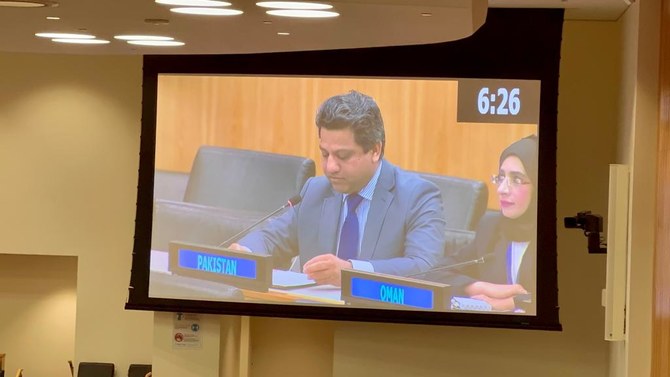
Pakistan's deputy permanent representative to the UN, Ambassador Aamir Khan speaks at the UN session on October 6, 2022. (Twitter/@G77_2022Chair)
Short Url
Updated 09 October 2022
Follow

‘Fundamental pillar of world order’: Pakistan seeks right to self-determination for people of Kashmir, Palestine

  • The country urges the UN to invest ‘more time and energy’ to deal with the protracted disputes in Kashmir and Palestine
  • A top Pakistani diplomat asks the world body to implement its own resolutions to bring about peace in South Asia, Mideast

ISLAMABAD: A top Pakistani diplomat at the United Nations has urged the world body to invest “more time and energy” to deal with situations where people are denied right to self-determination while seeking proper implementation of UN resolutions in Kashmir and Palestine, reported the state media on Sunday.

Addressing the General Assembly’s legal committee, the country’s deputy permanent representative to the UN, Ambassador Aamir Khan, described the right to self-determination as a “fundamental pillar of the world order.”

“While most dependent or occupied peoples have been able to exercise their right to self-determination peacefully, there are some who have been denied this right and have been obliged to struggle for it,” he was quoted as saying by the Associated Press of Pakistan news agency. “This is the situation in occupied Jammu and Kashmir and Palestine. There will be no peace in the Middle East or South Asia until the Palestinian people and the people of Jammu and Kashmir are enabled to exercise their right to self-determination.”

“The United Nations, particularly the Security Council, must invest more time and energy to secure the implementation of its own resolutions,” the Pakistani diplomat added. “Today, the system of international law and world order, created under the umbrella of the UN Charter, is in danger of collapse due to lack of consistent implementation and enforcement.”

Pakistan has consistently advocated for the rights of people in Kashmir and Palestine on various international forums.

In his speech, Khan also urged all nations to affirm the importance of the rule of law domestically.

“A uniform and consistent approach to uphold the rule of law would significantly contribute to improving equitable socio-economic development and a just international system,” he added.


Pakistan, Canada explore deeper mineral investment as Reko Diq mine project advances

Updated 6 sec ago
Follow

Pakistan, Canada explore deeper mineral investment as Reko Diq mine project advances

  • Canadian envoy cites Reko Diq as model for expanding Pakistan-Canada mineral cooperation
  • Islamabad pitches vast copper-gold reserves as economic lifeline after years of stalled development

ISLAMABAD: Pakistan and Canada are exploring deeper cooperation in the minerals and energy sectors as Islamabad accelerates efforts to revive long-delayed mining projects, including the Reko Diq copper-gold mine, one of the world’s largest undeveloped mineral deposits, according to a statement from Pakistan’s Information Ministry this week. 

The Reko Diq copper-gold project is one of the world’s largest undeveloped mineral deposits, with estimated reserves of around 5.9 billion tons of ore containing both copper and gold. The project, in Balochistan’s Chagai District, was stalled for over a decade amid international legal disputes but was reconstituted in 2022 with Canadian mining giant Barrick Gold holding a 50 percent stake alongside Pakistani federal and provincial partners. 

Recent steps toward implementation include multilateral financing arrangements involving international banks and institutions, and major equipment contracts, such as a $440 million deal with Japan’s Komatsu for mining machinery, signaling readiness for construction phase activities starting in 2026. Last month, Washington approved $1.25 billion in US Export-Import Bank financing for Reko Diq, with the package also expected to unlock up to $2 billion in US equipment and service exports for the project.

First production is expected by late 2028 under the revived partnership, with estimates suggesting annual output of around 200,000 tons of copper and significant gold yields once operations scale up. This project is central to Islamabad’s strategy to position mining as a pillar of economic recovery, as it hosts international mineral investment forums, seeks partnerships with Western and Gulf countries, and signs cooperation agreements on critical minerals, including with the United States. Officials see large-scale mining projects as potential drivers of exports, foreign exchange earnings and job creation in a country grappling with debt pressures and slow growth.

Against this backdrop, Federal Minister for Petroleum Ali Pervaiz Malik met Canada’s High Commissioner to Pakistan, Tarik Ali Khan, on Wednesday to discuss expanding bilateral cooperation in mining and energy, the information ministry said.

“The success of Barrick Gold at Reko Diq is a strong example to build upon Pakistan–Canada mineral cooperation,” the high commissioner said, according to the statement, adding that Canada was actively working to encourage more Canadian companies to engage with Pakistan’s mining sector.

The envoy said Canada’s ministry of natural resources was ready to support cooperation with Pakistan, noting that Canadian expertise in large-scale mining, environmental standards and community development could play a role as Pakistan opens up its mineral sector. He also said Canada was encouraging participation in the Pakistan Minerals Investment Forum to attract global investors.

The Canadian high commissioner also invited Pakistan to participate in the Prospectors & Developers Association of Canada (PDAC) convention in 2026, one of the world’s largest mining investment forums, calling it an opportunity to showcase Pakistan’s mineral potential to international investors.

Petroleum Minister Malik welcomed Canadian interest, saying technical expertise and intellectual capital would help strengthen Pakistan’s systems and boost investor confidence, particularly among international mining companies, the statement said.

Both sides also discussed cooperation in the energy sector, with Canada offering technical assistance, according to the statement. 
...