DUBAI: The US Navy held a joint drone drill with the United Kingdom on Friday in the Arabian Gulf, testing the same unmanned surveillance ships that Iran twice has seized in recent months in the Middle East.
The exercise comes as the US Navy separately told commercial shippers in the wider Mideast that it would continue using drones in the region and warned against interfering with their operations.
The drone drill — and the American pledge to keep sailing them — also comes as tensions between the US and Iran on the seas remain high amid stalled negotiations over its tattered nuclear deal with world powers and as protests sweep the Islamic Republic.
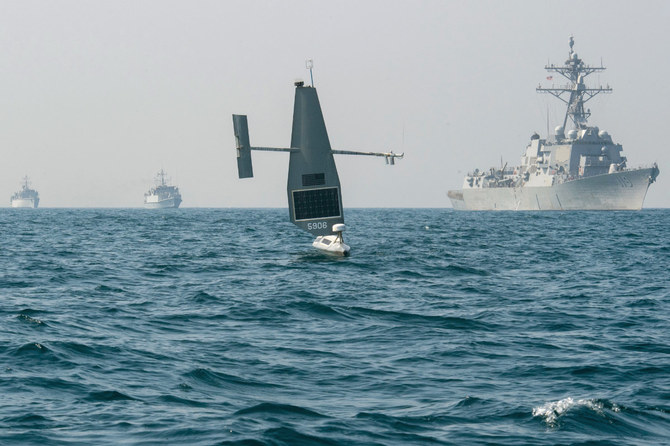
Friday’s drill involved two American and two British warships in the Arabian Gulf, as well as three Saildrone Explorers, said Cmdr. Timothy Hawkins, a spokesman for the Navy’s Mideast-based 5th Fleet.
The drones searched for a target on the seas, then sent the still images its cameras captured back to both the warships and the 5th Fleet’s command center in the island kingdom of Bahrain. There, an artificial intelligence system worked through the photos.
The 5th Fleet launched its unmanned Task Force 59 last year. Drones used by the Navy include ultra-endurance aerial surveillance drones, surface ships like the Sea Hawk and the Sea Hunter and smaller underwater drones that resemble torpedoes.
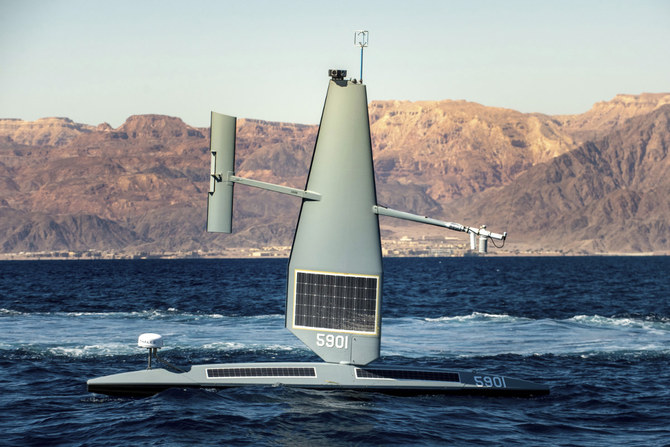
But of particular interest for the Navy has been the Saildrone Explorer, a commercially available drone that can stay at sea for long periods of time. That’s crucial for a region that has some 8,000 kilometers (5,000 miles) of coastline from the Suez Canal, down the Red Sea to the Gulf of Oman, the Strait of Hormuz and into the Arabian Gulf.
It’s a vast territory that stretches the reach of the Navy and its allies and has seen a series of attacks amid the atomic accord’s collapse. It also remains crucial to global shipping and energy supplies, as a fifth of all oil traded passes through the Strait of Hormuz.
“No matter what forces you have, you can’t cover all that,” Hawkins told The Associated Press. “You have to do that in a partnered way and an innovative way.”
But Iran, which long has equated America’s presence in the region to it patrolling the Gulf of Mexico, views the drones with suspicion. In August and September, Iranian regular and paramilitary forces seized Saildrones in both the Arabian Gulf and the Red Sea, alleging without providing evidence that the drones posed a danger to nearby ships.
Iran ultimately released the drones after the US Navy arrived to the sites. Cameras on the Saildrones involved in the Red Sea incident went missing.
Iranian state-run media did not acknowledge the drill Friday. Iran’s mission to the United Nations did not immediately respond to a request for comment.
“Recent events notwithstanding, we have been operating these systems safely, responsibly and in accordance with international law and will continue to do so,” Hawkins said.
The Navy underscored its plan to keep operating the drones in notices sent to shippers and sailors in the region beginning Thursday. It said that the drones would continue to broadcast their location via their Automatic Identification System trackers.
Ships are supposed to keep their AIS trackers on, but Iranian vessels routinely turn theirs off to mask their movements as Tehran faces international sanctions over its nuclear program and human rights abuses.
“US Navy (drones) are US government property and will lawfully operate in international waters and through straits in accordance with internationally recognized rights and freedoms,” the Navy said in the notice. “Any interference with US Navy (drones) will be considered a violation of the norms of international maritime law.”


![]()
![]()

US, UK hold drone drill in Arabian Gulf after Iran seizures
Short Url
https://arab.news/vje8g
US, UK hold drone drill in Arabian Gulf after Iran seizures
- Drill involved two American and two British warships in the Arabian Gulf, as well as three Saildrone Explorer
- Iran, which long has equated America’s presence in the region to it patrolling the Gulf of Mexico, views the drones with suspicion


Latest updates





© 2026 SAUDI RESEARCH & PUBLISHING COMPANY, All Rights Reserved And subject to Terms of Use Agreement.