

UN concerned about ‘dramatic collapse’ of Afghan economy

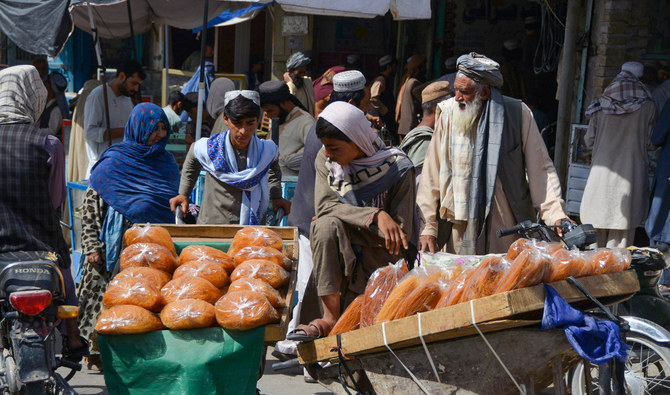
Afghan boys sell bread on a wheelbarrow at second district in Kandahar, on August 4, 2022. (AFP/File)
Short Url
Updated 06 October 2022
Follow

UN concerned about ‘dramatic collapse’ of Afghan economy

  • Up to 97% Afghan population now lives below the poverty line, UNDP official says
  • Before Taliban takeover, Afghan economy was already very small, with $20 billion GDP

United Nations: Afghanistan’s formal economy has suffered a “catastrophic collapse” since the Taliban came to power, wiping out in less than a year what had taken 10 years to build, the United Nations said in a report released Wednesday.

Before the Taliban took power in August 2021, the Afghan economy was already very small, with a GDP of about $20 billion.

But in just one year it “lost about $5 billion,” Kanni Wignaraja, director of the United Nations Development Programme (UNDP) for Asia and the Pacific, told a news conference.

“That’s about 10 years’ worth of accumulated assets and wealth that just got lost in 10 months,” Wignaraja said. “That kind of dramatic collapse we’ve not seen anywhere in the world.”

While the price of a basic food basket has increased by 35 percent since August 2021, Afghans spend “60 to 70 percent, some of them even 80 percent, of their income, household income, on food and fuel,” she said.

Meanwhile, 95 to 97 percent of the population now lives below the poverty line, she said.

That figure is up from a little more than 70 percent just a year ago.

The report paints a bleak picture of the country’s economy, highlighting a collapse of the banking and financial systems, with 700,000 jobs lost by mid-2022, mostly by women, and one in five children at risk of severe malnutrition, particularly in the south.

The collapse of the formal economy has also led to an increase in the importance of the informal economy, which represents 12 to 18 percent of gross domestic product, compared to nine to 14 percent a year ago, the report said.

Abdallah Al Dardari, the UNDP’s resident representative in Afghanistan, said humanitarian assistance alone cannot compensate for the economic collapse, adding that the number of Afghans needing assistance has climbed from 19 million people to 22 million people in just 14 months.

So over the next three years, “we want to create two million jobs through a revival of the private sector, through working with local communities, through focusing on women entrepreneurs,” and by reviving agricultural productivity, micro-finance and banking, he said.


Trump pays respects to 2 Iowa National Guardsmen and interpreter killed in Syria as they return home

Updated 18 December 2025
Follow

Trump pays respects to 2 Iowa National Guardsmen and interpreter killed in Syria as they return home

  • The two guardsmen killed in Syria on Saturday were Sgt. Edgar Brian Torres-Tovar, 25, of Des Moines, and Sgt. William Nathaniel Howard, 29, of Marshalltown, according to the US Army

DOVER AIR FORCE BASE, Delaware: President Donald Trump on Wednesday paid his respects to two Iowa National Guard members and a US civilian interpreter who were killed in an attack in the Syrian desert, joining their grieving families as their remains were brought back to the country they served.
Trump met privately with the families at Dover Air Force Base in Delaware before the dignified transfer, a solemn ritual conducted in honor of US service members killed in action. The civilian was also included in the transfer.
Trump, who traveled to Dover several times in his first term, once described it as “the toughest thing I have to do” as president.
The two guardsmen killed in Syria on Saturday were Sgt. Edgar Brian Torres-Tovar, 25, of Des Moines, and Sgt. William Nathaniel Howard, 29, of Marshalltown, according to the US Army. Both were members of the 1st Squadron, 113th Cavalry Regiment, and have been hailed as heroes by the Iowa National Guard.
Torres-Tovar’s and Howard’s families were at Dover for the return of their remains, alongside Iowa Gov. Kim Reynolds, members of Iowa’s congressional delegation and leaders of the Iowa National Guard. Their remains will be taken to Iowa after the transfer.
A US civilian working as an interpreter, identified Tuesday as Ayad Mansoor Sakat, of Macomb, Michigan, was also killed. Three other members of the Iowa National Guard were injured in the attack. The Pentagon has not identified them.
They were among hundreds of US troops deployed in eastern Syria as part of a coalition fighting the Daesh group.
The process of returning service member remains
There is no formal role for a president at a dignified transfer other than to watch in silence, with all thoughts about what happened in the past and what is happening at Dover kept to himself for the moment. There is no speaking by any of the dignitaries who attend, with the only words coming from the military officials who direct the highly choreographed transfers.
Trump arrived without first lady Melania Trump, who had been scheduled to accompany him, according to the president’s public schedule. Her office declined to elaborate, with spokesperson Nick Clemens saying the first lady “was not able to attend today.”
During the process at Dover, transfer cases draped with the American flag that hold the soldiers’ remains are carried from the belly of a hulking C-17 military aircraft to a waiting vehicle under the watchful eyes of grieving family members. The vehicle then transports the remains to the mortuary facility at the base, where the fallen are prepared for burial at their final resting places.
Iowa National Guard members hailed as heroes
Howard’s stepfather, Jeffrey Bunn, has said Howard “loved what he was doing and would be the first in and last out.” He said Howard had wanted to be a soldier since he was a boy.
In a social media post, Bunn, who is chief of the Tama, Iowa, police department, said Howard was a loving husband and an “amazing man of faith.” He said Howard’s brother, a staff sergeant in the Iowa National Guard, would escort “Nate” back to Iowa.
Torres-Tovar was remembered as a “very positive” family-oriented person who always put others first, according to fellow Guard members who were deployed with him and issued a statement to the local TV broadcast station WOI.
Dina Qiryaqoz, the daughter of the civilian interpreter who was killed, said Wednesday in a statement that her father worked for the US Army during the invasion of Iraq from 2003 to 2007. Sakat is survived by his wife and four adult children.
The interpreter was from Bakhdida, Iraq, a small Catholic village southeast of Mosul, and the family immigrated to the US in 2007 on a special visa, Qiryaqoz said. At the time of his death, Sakat was employed as an independent contractor for Virginia-based Valiant Integrated Services.
Sakat’s family was still struggling to believe that he is gone. “He was a devoted father and husband, a courageous interpreter and a man who believed deeply in the mission he served,” Qiryaqoz said.
Trump’s reaction to the attack in Syria
Trump told reporters over the weekend that he was mourning the deaths. He vowed retaliation. The most recent instance of US service members killed in action was in January 2024, when three American troops died in a drone attack in Jordan.
Saturday’s deadly attack followed a rapprochement between the US and Syria, bringing the former pariah state into a US-led coalition fighting the Daesh group.
Trump has forged a relationship with interim Syrian President Ahmed Al-Sharaa, the onetime leader of an Islamic insurgent group who led the ouster of former President Bashar Assad.
Trump, who met with Al-Sharaa last month at the White House, said Monday that the attack had nothing to do with the Syrian leader, who Trump said was “devastated by what happened.”
During his first term, Trump visited Dover in 2017 to honor a US Navy SEAL killed during a raid in Yemen, in 2019 for two Army officers whose helicopter crashed in Afghanistan, and in 2020 for two Army soldiers killed in Afghanistan when a person dressed in an Afghan army uniform opened fire.