

Paris 2024 marathon to trace path of French Revolution

World Athletics CEO Jon Ridgeon, left, and Paris 2024 Games chief Tony Estanguet attend a media conference at the City Hall in Paris Wednesday. (AP)
Short Url
Updated 28 July 2024
Follow

Paris 2024 marathon to trace path of French Revolution

  • The marathon route unveiled on Wednesday was modelled on the path of the October 1789 Women’s March on Versailles
  • Organizers have also added two mass events — a marathon and a 10-km run — to allow non-Olympians to run the course

PARIS: Competitors in the marathon at the Paris 2024 Olympics will run from central Paris to Versailles and back, on a course designed to salute women and trace one of the pivotal historic events of the French Revolution.

The marathon route unveiled on Wednesday was modelled on the path of the October 1789 Women’s March on Versailles — when thousands, mainly female market traders furious over the price of bread, marched to the lavish palace of King Louis XVI.

They forced him to return with them to the center of the capital in an event that historians say ended the absolute power of the monarchy.

“We’re trying to give some meaning to our events and choosing this course was a good way to do it,” Paris 2024 boss Tony Estanguet told Reuters. “We really want to innovate.”

For the first time since women began running the Olympic marathon in 1984, women will conclude the athletics program, with their marathon coming a day after the men’s event.
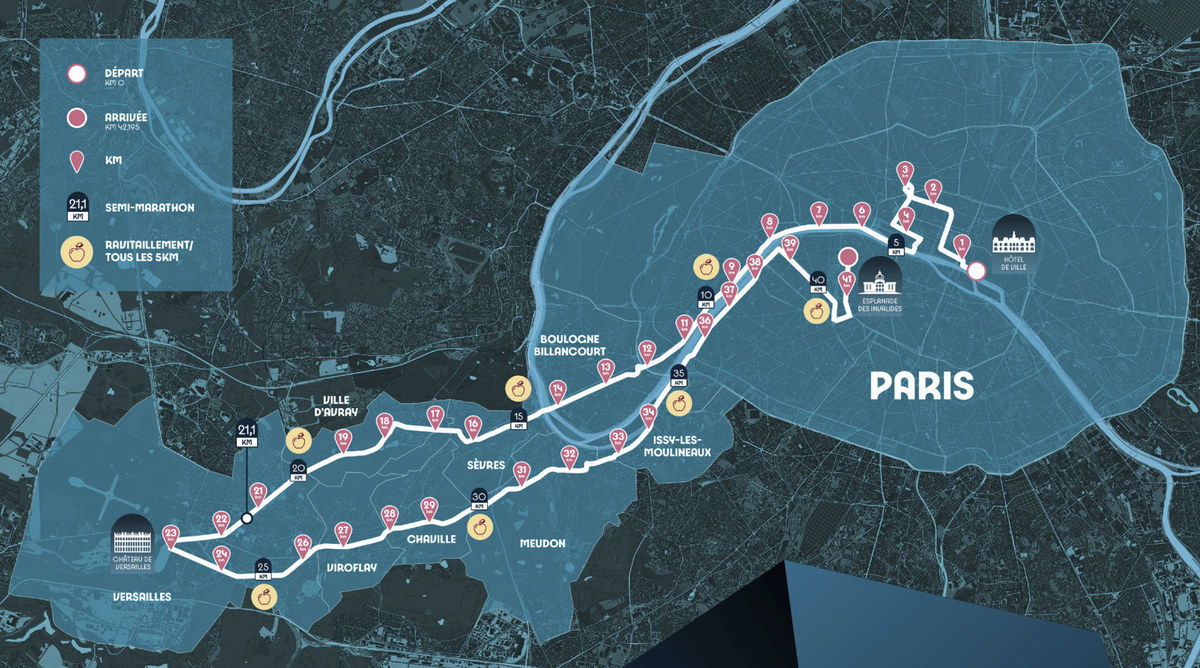


This map released by Olympics Paris 2024 on Wednesday shows the marathon course for Paris Olympics in 2024. The marathon will start from Paris City Hall and wind past famed landmarks. (AP)

“Women first. We wanted to celebrate women,” Paris mayor Anne Hidalgo told a news conference.

“Paris is a place of revolution. It’s a revolutionary city, so this course makes sense,” added Valerie Pecresse, the head of the Ile de France (greater Paris) region.

Organizers have also added two mass events — a marathon and a 10-km run — to allow non-Olympians to run the course. Each will be open to 20,024 participants.

“Our country proclaims loud and clear that high-level sport must more than ever be a source of inspiration for all generations while driving mass participation,” French Sports minister Amelie Oudea-Castera said.

“Sport has the power to positively transform society: Let us give it every means to do so.”

The marathon course will pass Parisian monuments including the Eiffel Tower, the Louvre Museum, the Palais Garnier, the Jardin des Tuileries and several world-famous bridges.

“Beyond a doubt, the Paris 2024 marathon will have something special about it. To perform in such an impressive setting, in a place so charged with history and symbolism, will be a unique experience,” said two-time Olympic champion and world record holder Eliud Kipchoge.

“I could not ask for a more perfect race for the Games.”

It will also be an unusually challenging route, with 438 meters of altitude gain.

“It appears to be more demanding than normal,” World Athletics president Sebastian Coe told Reuters. “Clearly it’s a marathon that will be challenging. But some marathon runners prefer undulating courses.” 


‘Animals in a zoo’: Swiatek backs Gauff call for more privacy

Updated 4 sec ago
Follow

‘Animals in a zoo’: Swiatek backs Gauff call for more privacy

  • Coco Gauff upset when cameras caught her smashing her racquet in the depths of the stadium on Tuesday after she was beaten in the Australian Open quarter-finals
MELBOURNE: World number two Iga Swiatek on Wednesday backed Coco Gauff’s call for more privacy during tournaments, saying players sometimes feel “like animals in the zoo where they are observed even when they poop.”
Third seed Gauff was upset when cameras caught her smashing her racquet in the depths of the stadium on Tuesday after she was beaten in the Australian Open quarter-finals.
The American was trying to find somewhere private to let out her frustrations, rather than doing so on court in front of fans including children.
“I tried to go somewhere where they wouldn’t broadcast it, but obviously they did,” said Gauff.
“So maybe some conversations can be had because I feel like at this tournament the only private place we have is the locker room.”
Swiatek, who was also bundled out of the quarter-finals in Melbourne by Elena Rybakina, said back-stage cameras could be too intrusive.
“The question is, are we tennis players, or are we animals in the zoo where they are observed even when they poop, you know?” she said.
“Okay, that was exaggerating obviously, but it would be nice to have some privacy. It would be nice also to, I don’t know, have your own process and not always be observed.
“It would be nice to have some space where you can do that without the whole world watching.”
Swiatek was caught up in her own off-court drama earlier in the week when she was denied access to an area in Melbourne Park because she was not wearing her accreditation.
It was recorded on camera and the clip did the rounds on social media.
“I don’t think it should be like that because we’re tennis players,” she said.
“We’re meant to be watched on the court and in the press. That’s our job. It’s not our job to be a meme when you forget your accreditation.
“Oh, it’s funny, yeah, for sure. People have something to talk about, but for us I don’t think it’s necessary.”
Swiatek’s straight-sets loss to Rybakina denied her a career Grand Slam of all four majors.
She has won four French Opens, the US Open and Wimbledon, but a title at Melbourne Park remains elusive.